This week, thousands of carrier executives, infrastructure operators, and AI infrastructure builders are gathering at International Telecoms Week in National Harbor. The agenda is full of sessions on network automation, RAN AI, sovereign AI infrastructure, and edge deployment. The conversations are real and the stakes are high.
But there's a question that isn't on the agenda — the one that will define which operators survive the next major AI incident and which ones spend eighteen months explaining it to regulators:
When your network automation agent pushes a bad configuration to 3,400 base stations simultaneously — what stops it?
Not "what alerts on it afterward." Not "what logs it for the post-incident review." What stops it — in under 100 milliseconds, before the cascade reaches the edge.
For most carriers and datacenter operators today, the honest answer is: nothing.
The Scale of What's Already Running
Modern 5G cores, AI-optimized data centers, and edge compute facilities are already running AI at a scale most governance frameworks weren't designed for.
None of these agents have declared identities. None have behavioral baselines. None have a kill switch. They are making decisions that affect millions of subscribers, billions of dollars of infrastructure, and the liability exposure of publicly traded companies — and they are doing it in a governance vacuum.
What the Incident Record Looks Like
This isn't hypothetical. The incidents are already happening. They're just not being framed as AI governance failures yet — because the industry doesn't have the vocabulary for it.
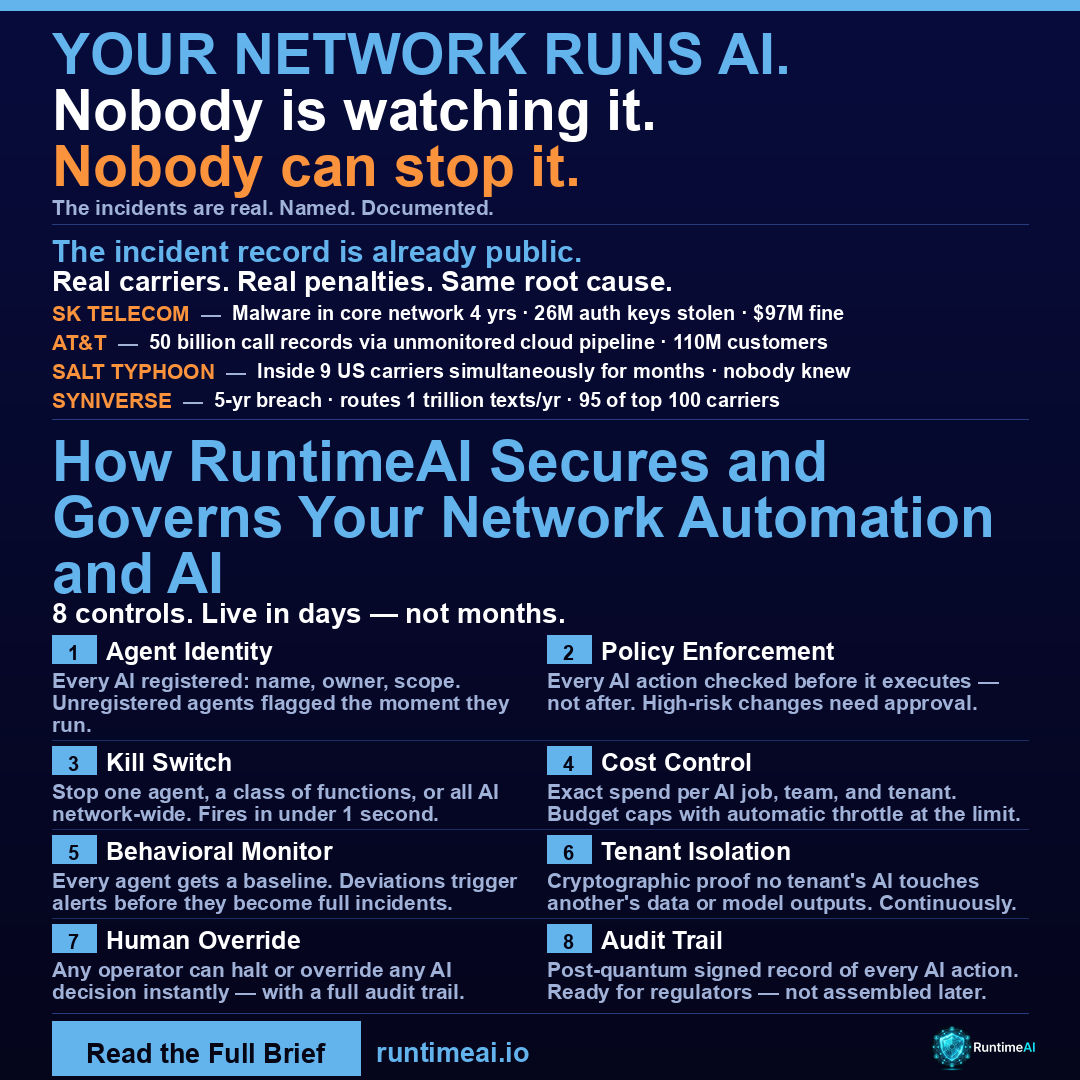
Each of these incidents has the same root cause: an AI agent operating with no identity, no behavioral boundary, and no stop control. Each could have been prevented — or stopped mid-execution — with a governance layer. None had one.
And these are the confirmed, public incidents
The AI automation failures above represent an emerging, under-reported category. What is fully documented and on the public record — from regulators, courts, and government agencies — tells the same story at scale:
Every incident above — illustrative and named — failed on the same three controls: no identity on what was accessing the network, no behavioral monitoring to detect anomalies, and no stop control to halt the damage mid-execution.
Two Sectors, One Governance Gap
The governance problem manifests differently for telecom operators and AI datacenter operators, but the underlying gap is identical.
For Telecom Carriers
Network automation agents are modifying routing tables, managing network slices, reallocating spectrum, and reconfiguring RAN parameters continuously — often across thousands of base stations simultaneously. The agents making these decisions don't have registered identities. There's no behavioral baseline that would flag an anomaly before it becomes a cascade. And regulators in 40+ jurisdictions are now writing AI governance requirements for critical infrastructure that carriers have no current way to satisfy.
Edge AI compounds the problem. A tier-1 carrier operating 1,000+ edge sites for enterprise tenants has AI inference workloads running on every one of them. Tenant isolation is an SLA claim, not a continuously attested fact. When a workload crosses a tenant boundary — as has already happened — the carrier carries the liability.
For AI Datacenter Operators
The facility itself runs AI to manage the AI it hosts. Cooling optimization, power management, workload scheduling, predictive maintenance, autonomous rack robotics — these are all AI agents making decisions that affect uptime, cost, and customer commitments. GPU clusters cost $50K–$500K per day. Finance teams have zero visibility into which agent consumed which GPU-hours, which tenant's training run overran its budget, or which inference workload caused the spike.
And the liability question is identical: when a training data set from Tenant A surfaces in Tenant B's model outputs — 11 million records, $8 million settlement — the operator is liable even if the SLA language says otherwise.
What Governance Actually Looks Like
The carriers and datacenter operators ahead of this problem have eight controls in place. Not aspirationally — operationally. And they got there in days, not months.
Live in Days — Not Months
The most common objection we hear is that deploying a governance control plane sounds like a 12-month infrastructure project. It isn't. Here's what the actual deployment timeline looks like:
RuntimeAI deploys as a control plane overlay — not a rip-and-replace. It integrates with your existing OSS/BSS, cloud infrastructure, and orchestration layer via API. No forklift. No downtime. The governance layer goes live while your network keeps running.
The Governance Revenue Opportunity
The most important reframe for carriers and datacenter operators is this: governance isn't a compliance cost. It's a product differentiation and a new revenue layer.
A colocation operator or GPU cloud that can offer "governed AI tenancy" — with per-tenant isolation attestation, signed audit trails, and compliance evidence the enterprise can show its own auditors — can charge a premium for that capacity. The same governance platform that reduces your liability exposure becomes the basis for a premium SKU your enterprise customers will pay for.
Carriers who can prove that their edge AI is governed, that tenant workloads are isolated at the agent layer (not just the infrastructure layer), and that regulatory mandates are continuously satisfied in real time have a commercial advantage over carriers who are still assembling audit evidence the week before a regulator arrives.
The carriers and datacenter operators who survive the first major AI governance incident in their sector will be the ones who already had a kill switch. The ones who didn't will spend the next two years explaining why not.
What to Do This Week
If you're at ITW this week — or talking to carriers and infrastructure operators who are — here are three questions worth asking every vendor on the floor:
- Can you show me a live kill switch demo? Not a diagram. Not a whitepaper. A working demo that stops a specific agent in under 100ms and produces a signed audit record.
- How do you handle tenant isolation at the agent layer? Infrastructure-level isolation isn't enough. The question is whether AI agent outputs, memory, and model access are continuously monitored and attested across tenant boundaries.
- What does your compliance evidence look like 30 days before an audit? If the answer involves manual assembly, you already have a governance gap.
RuntimeAI is the AI Governance Control Plane built for the operators running AI at carrier and facility scale. On-premises, air-gapped sovereign, or SaaS. Post-quantum cryptography built in from day one. The only platform with all eight control pillars — and a kill switch that actually fires.