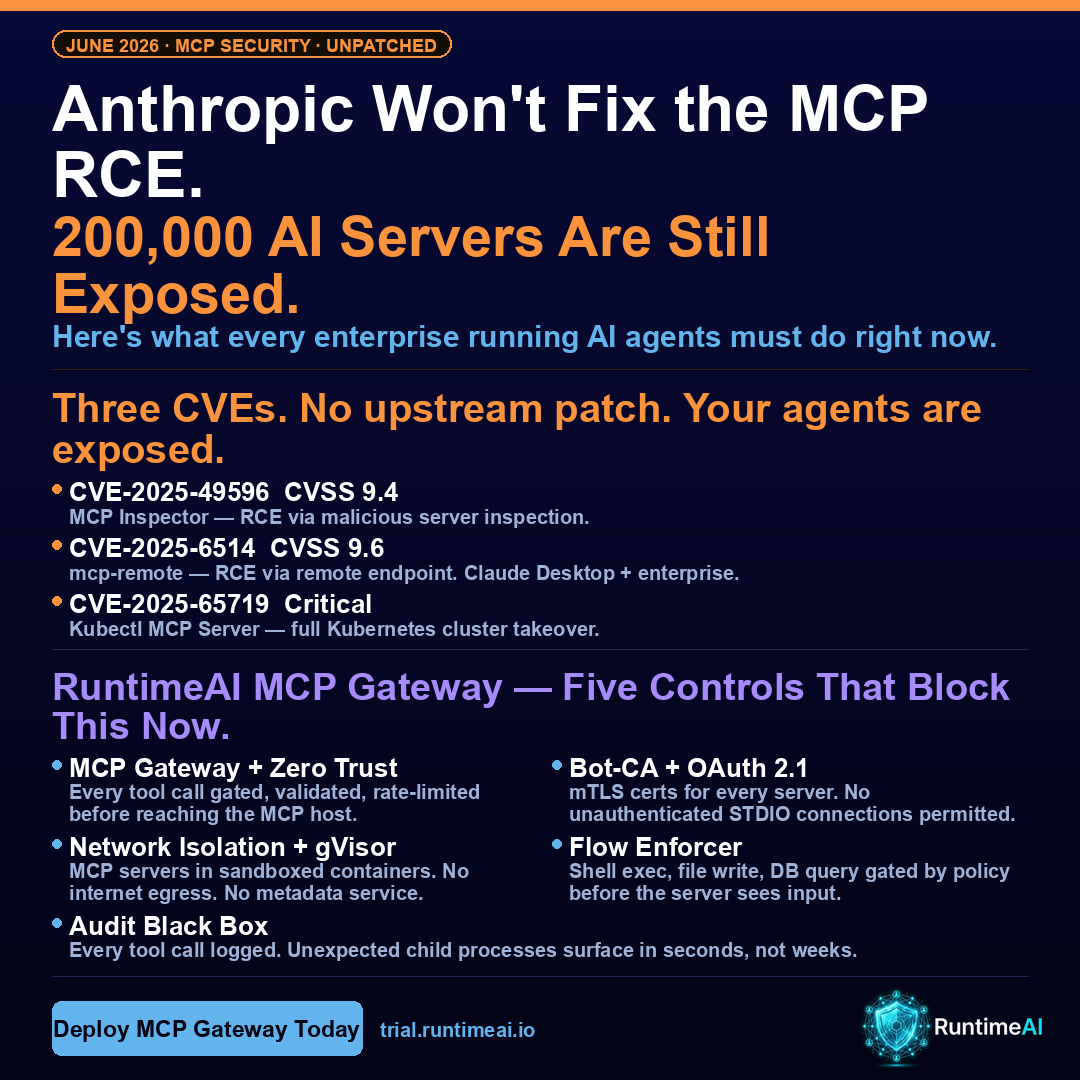
A systemic Remote Code Execution (RCE) flaw in the official Model Context Protocol (MCP) STDIO transport affects an estimated 200,000 servers and 150 million downstream package downloads across Python, TypeScript, Java, and Rust SDKs. Anthropic has reviewed the research and confirmed the behavior is "expected protocol behavior" — not a bug it will fix. Three confirmed CVEs have already been assigned to implementations built on the flawed foundation. There is no patch coming. The fix is architecture.
MCP has become the de facto standard for connecting AI agents to external tools — databases, APIs, code execution environments, cloud infrastructure. Every enterprise wiring agents to MCP servers is wiring them to a protocol with an unfixed design flaw that allows full remote command execution on the host system.
This isn't a theoretical risk. It's already being exploited in the implementations built on top of it.
server instances
carrying the flaw
across confirmed CVEs
The Vulnerability: STDIO Executes What It's Told
The flaw lives in how MCP's official SDKs handle STDIO process commands. When an MCP server initializes, it blindly executes process commands passed to the STDIO interface. The SDK does not sanitize these commands. It does not validate that the spawned process is what was intended. It executes first and asks no questions.
The exploit path is direct:
Across Python, TypeScript, Java, and Rust — all four official MCP SDKs carry the same flaw. Every MCP server built on any of them inherits it.
Three CVEs Already Confirmed in the Wild
Because Anthropic won't fix the protocol, the flaw propagates into every implementation. Researchers have already confirmed three critical CVEs in tools built directly on MCP:
Anthropic has positioned MCP as an open protocol with intentional design decisions around STDIO. Sanitizing STDIO commands by default would require a breaking change to the protocol specification. Anthropic has declined to make that change. This means every implementation built on the official SDKs — today and going forward — inherits the flaw until the protocol spec changes. Don't wait for an upstream patch. Mitigate at your architecture layer.
What Attackers Can Do Once They Have RCE
Remote code execution on an MCP host isn't a contained incident. The MCP server exists specifically to bridge AI agents to sensitive systems. Once an attacker has RCE on that host, the path to high-value targets is short:
- API key theft — MCP servers store credentials for every external service the agent can call. A single RCE yields the keys to databases, cloud services, third-party APIs.
- Cloud pipeline takeover — If the host runs in AWS, Azure, or GCP, the instance metadata service exposes IAM credentials. Full cloud account takeover is one HTTP call away.
- Kubernetes cluster compromise — Via CVE-2025-65719, attackers go from MCP server to full K8s cluster control. Every container, every workload, every secret in the cluster.
- Internal database access — MCP servers frequently hold connection strings for internal databases. RCE means direct access to production data.
- Lateral movement — The MCP host is inside your network perimeter by design. It's a trusted internal system with broad connectivity — an ideal pivot point.
Five Controls That Mitigate the Risk Today
Because the vulnerability is architectural — not a code bug — the mitigations are architectural too. Each of these reduces blast radius and attack surface independently.
Immediate Actions for Your MCP Deployments
# 1. Audit every MCP server your agents connect to
kubectl get deployments -n rt19 | grep mcp
# For each: verify it runs as non-root, has no host network, no internet egress

# 2. Verify no MCP server accepts unauthenticated STDIO connections
# In your MCP server config — confirm OAuth 2.1 or mTLS is required
grep -r "allow_unauthenticated\|no_auth" ./mcp-servers/

# 3. Check for vulnerable tooling in your development environment
npm list mcp-remote 2>/dev/null | grep -v "empty"
pip show mcp-inspector 2>/dev/null | grep Version

# 4. Review all MCP server Dockerfiles for root execution
grep -r "USER root\|RUN.*sudo" ./mcp-servers/*/Dockerfile
Recommended container security profile for MCP servers
# k8s deployment patch — apply to all MCP server deployments
securityContext:
  runAsNonRoot: true
  runAsUser: 10001
  readOnlyRootFilesystem: true
  allowPrivilegeEscalation: false
  capabilities:
    drop: ["ALL"]
# NetworkPolicy — restrict egress to allowed services only
egress:
  - to:
    - podSelector:
        matchLabels:
          role: allowed-mcp-target
    ports:
- port: 443Every MCP server registered with RuntimeAI's MCP Gateway runs behind mutual TLS authentication (Bot-CA), with per-tenant ACL enforcement on every tool call, rate limiting, and full audit logging. The gateway acts as the authenticated entry point — no direct STDIO connection is possible from an unauthenticated source. Behavioral anomaly detection monitors process-level activity on every registered server. If you're running MCP through RuntimeAI's gateway today, the primary attack vector for this vulnerability is blocked at the connection layer.
Deploy RuntimeAI's MCP Gateway
Secure your MCP servers in under an hour.
RuntimeAI's MCP Gateway wraps every MCP server connection with authentication, authorization, rate limiting, audit logging, and behavioral monitoring — without requiring changes to your MCP servers themselves.
# Register your MCP server with RuntimeAI Gateway
POST /api/v1/mcp/servers/register
{
  "server_id":    "kubectl-mcp-prod",
  "tenant_id":    "acme-corp",
  "auth_mode":    "mtls",            // Bot-CA mTLS required
  "allowed_tools": ["get_pods", "get_logs", "describe_deployment"],
  "sensitive_tools": ["apply", "delete", "exec"],
  "egress_allow":  ["kube-api.internal:6443"],
  "sandbox":       "gvisor"
}High-risk AI system enforcement begins August 2, 2026 — 61 days from today. If your AI agents access Kubernetes clusters, production databases, or cloud infrastructure via MCP, you are operating a high-risk agentic system. Article 9 risk management and Article 12 audit logging are mandatory. An unpatched RCE in your MCP infrastructure with no audit trail is not a position you want to defend.
Your MCP servers are exposed. Your agents don't have to be.
RuntimeAI's MCP Gateway wraps every MCP connection with authentication, Zero Trust enforcement, behavioral monitoring, and a full audit trail — without touching your MCP servers.
Start Your Trial MCP Gateway Docs- Anthropic MCP Design Vulnerability Enables RCE — The Hacker News, April 2026
- Technical Analysis: MCP STDIO Design Flaw — OX Security Research
- Cloud Security Alliance Research Note on MCP Security
- CVE-2025-49596 — Anthropic MCP Inspector RCE (CVSS 9.4)
- CVE-2025-6514 — mcp-remote RCE (CVSS 9.6)
- CVE-2025-65719 — Kubectl MCP Server RCE