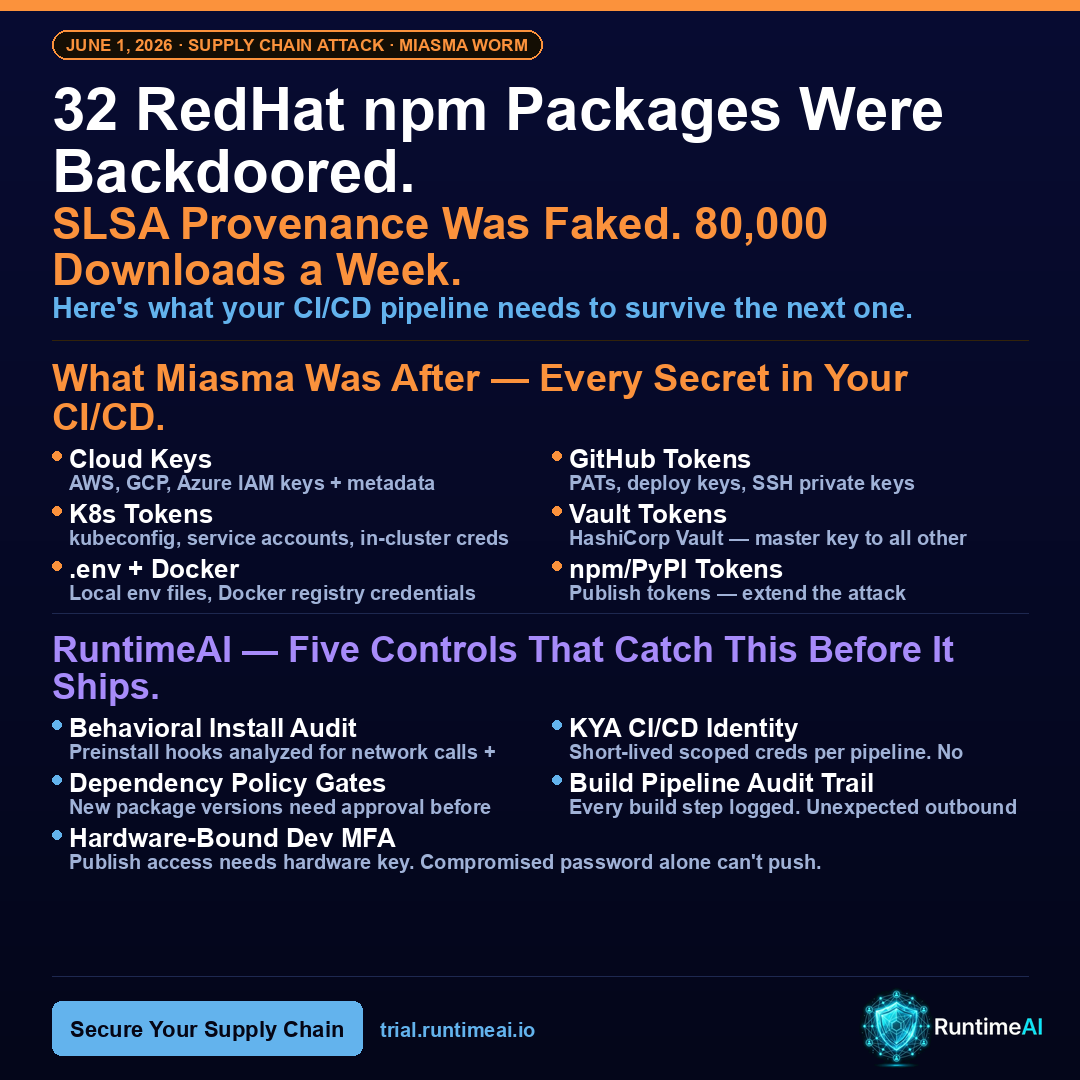
Attackers compromised a Red Hat employee's GitHub account and pushed malicious code into 32 official packages under the @redhat-cloud-services npm namespace — packages averaging 80,000 combined weekly downloads. The payload deployed the Miasma worm, a credential-stealing tool that targets cloud provider keys, GitHub tokens, Kubernetes tokens, and CI/CD secrets. The most alarming detail: attackers abused GitHub Actions OIDC to generate valid SLSA provenance attestations, making the backdoored packages appear as formally verified, legitimate releases. Red Hat confirmed no enterprise production systems were impacted — version pinning in enterprise deployments prevented the compromised versions from being installed.
This attack is significant not because of what it stole — but because of what it forged. SLSA (Supply-chain Levels for Software Artifacts) is the industry's answer to supply chain integrity. It's the verification framework enterprises rely on to trust open-source packages. The Miasma attackers didn't bypass it. They abused it — generating authentic-looking provenance for packages that were actively malicious.
If your CI/CD pipeline trusts SLSA attestations as the final word on package integrity, this attack broke your model.
packages compromised
across the 32 packages
in the exposure window
How the Attack Worked
@redhat-cloud-services namespace. The payload hid inside npm preinstall hooks — multi-stage JavaScript that executes automatically when anyone runs npm install. No explicit invocation required.npm install, the preinstall hook fires. The Miasma worm (a fork of the publicly leaked "Mini Shai-Hulud" malware) runs a multi-stage JavaScript payload designed for stealth and completeness. It searches the developer's environment and any connected CI/CD context for every high-value credential class it knows about.What Miasma Was After
The worm performed a sweeping, systematic search for every credential class it could reach. This wasn't opportunistic — it was engineered for maximum yield from a developer or CI/CD environment:
Red Hat confirmed no enterprise production systems were impacted. The reason: version pinning. Enterprise deployments that pin specific package versions in their lockfiles didn't automatically pull the compromised releases. This is the defense that worked — and it worked passively, without any security tooling detecting the attack in real time.
Why This Attack Is Different: SLSA Provenance Was Not a Defense
The standard enterprise response to supply chain risk is to verify provenance — trust only packages with valid SLSA attestations from known build systems. This attack breaks that assumption.
GitHub Actions OIDC is the mechanism that many SLSA Level 2 and Level 3 attestations rely on. When a GitHub Actions workflow runs, it can request an OIDC token that proves the workflow ran in a specific repository at a specific commit. SLSA tooling uses this to generate signed provenance records.
The Miasma attackers had write access to the repository. They triggered the standard CI/CD workflow from the compromised account. The OIDC token was legitimately issued — because from GitHub's perspective, the workflow ran exactly as configured, in the correct repository. The SLSA provenance was cryptographically valid. The package was malicious.
This is the class of attack where policy-as-attestation fails: the attestation proves the process ran correctly, not that the process produced safe output. Behavioral verification at runtime is the only control that catches this.
What Every Enterprise Must Do Right Now
@redhat-cloud-services package version published June 1, 2026 between 1PM and 3PM UTC. Rotation is not optional.npm install with an affected package version should be isolated, forensically reviewed, and re-imaged before being returned to production use. The credential theft is the visible payload — the persistence mechanism is the longer-term risk.package-lock.json and yarn.lock in your organization. If any file resolves to a @redhat-cloud-services package with a version published on June 1, update to the latest clean version and re-lock. The clean versions were revoked and re-published — latest is safe.# Audit your package-lock.json for affected packages
grep "@redhat-cloud-services" package-lock.json | grep -E '"version": ".*"'
# Check for suspicious preinstall hooks in node_modules
find node_modules/@redhat-cloud-services -name "package.json" \
-exec grep -l "preinstall" {} \;
# Rotate GitHub token immediately if affected
gh auth token | xargs -I{} gh api user/tokens/revoke -f access_token={}
# Then re-authenticate: gh auth login
# Scan for Miasma IOCs on developer machines (Aikido Security IOC list)
find ~ -name ".miasma*" -o -name ".shai*" 2>/dev/nullThe Five Controls That Catch This Before It Ships
.env files for Miasma to find. Automatic rotation means any credential captured is expired before the attacker can use it.@redhat-cloud-services — require explicit approval before they can be installed in production pipelines. The compromised June 1 versions would have been blocked at the gate, not discovered after installation.Version Pinning Is Good. Runtime Behavioral Monitoring Is Better.
Red Hat's enterprises were saved by version pinning — a passive control that happened to work because no one had updated their lockfiles to the compromised release window. That's a narrow save. The next campaign may target a package that enterprise pipelines do auto-update, or may use a different timing window.
The defense posture that catches this reliably is not provenance verification alone — it's runtime behavioral monitoring at the install boundary combined with scoped, short-lived CI/CD credentials that expire before exfiltrated secrets can be used.
Protect your supply chain with RuntimeAI.
RuntimeAI's platform extends Zero Trust governance into the CI/CD layer — behavioral verification at install time, scoped short-lived CI/CD identities, anomaly detection on build pipeline network activity, and an audit trail that covers every dependency resolution, build step, and artifact production event.
EU AI Act Article 13 requires providers of high-risk AI systems to document their supply chain — including third-party components. If your AI application depends on npm packages and one of those packages was Miasma-compromised during development, that's a supply chain integrity event you are now obligated to disclose and document. SLSA attestation alone does not satisfy this obligation when the provenance was generated from a compromised build process.
The next supply chain attack won't wait for your lockfile to protect you.
Behavioral verification at install time, scoped CI/CD identities, and real-time build pipeline monitoring — deployed in under an hour with RuntimeAI.
Start Your Trial Supply Chain Docs