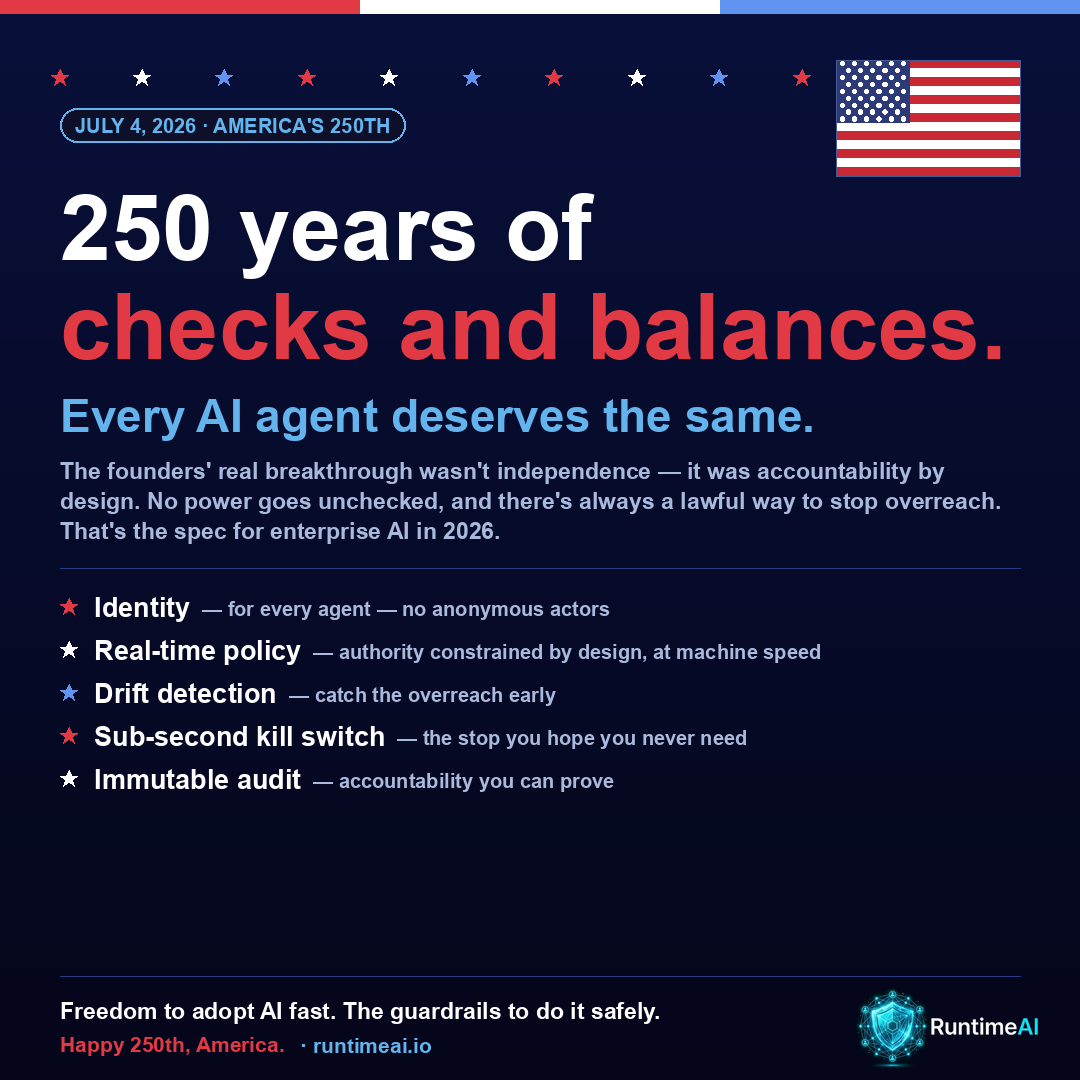
Two hundred and fifty years ago today, thirteen colonies declared independence. It is the line everyone remembers. But independence was the easy part to announce and the hard part to keep — and the founders knew it. Their real breakthrough came in the years after 1776, when they had to answer a harder question: how do you give a government real power without letting that power go unchecked?
Their answer was checks and balances — authority constrained by design. Separated powers. Enumerated limits. A system where every actor answers to something, and where there is always a lawful way to stop an overreach before it becomes a crisis. That idea, not the declaration itself, is what has held up for 250 years.
It also turns out to be a surprisingly good specification for enterprise AI in 2026.
The Founders' Actual Innovation
The genius of the American system was never that it trusted people in power. It was that it assumed the opposite. "If men were angels, no government would be necessary," Madison wrote — and since they are not, you engineer accountability into the structure itself. Power is divided so no single branch can act alone. Actions are recorded so they can be reviewed. And there is always a mechanism — a veto, a court, an election — to halt authority that exceeds its mandate.
Freedom and accountability, in this design, are not opposites. Accountability is what lets a free society move fast without breaking trust. You can extend enormous latitude to an actor precisely because the system can see what it does and stop it if it goes wrong.
The founders didn't just declare freedom. They engineered a system where power answers to something — and where there is always a way to stop overreach. That is the job for agentic AI now.
The Newest Unchecked Power
Fast forward to today. Enterprises are handing real authority to AI agents — software that acts at machine speed, touches sensitive data, moves money, and makes decisions on a company's behalf. It is the fastest delegation of power in business history, and most of it is happening without any of the safeguards the founders would have recognized as non-negotiable.
Most agents have no verifiable identity — they act anonymously, indistinguishable from one another in the logs. They operate under no enforced policy — the "rules" live in a prompt or a README, not in anything that can stop an action mid-flight. There is often no way to halt them once they are running, and no trustworthy record of what they did afterward. That is unchecked power, inside the business, acting faster than any human can review. We have already seen how that story ends — the year's breaches keep tracing back to an over-privileged, unwatched non-human actor doing exactly what it was allowed to do.
A Control Plane Is Checks and Balances for AI
The remedy is not to slow AI down, any more than the founders' answer was to weaken the government. It is to constrain authority by design — to give autonomous agents the same structure of accountability that lets us trust any powerful actor. That is precisely what a control plane does. Each control maps to a founding principle.
| RuntimeAI Control | Founding Principle | What It Does |
|---|---|---|
| Identity for every agent | No anonymous power | Every AI agent and non-human identity gets a verifiable identity and scoped, least-privilege credentials. No anonymous actors, no unaccountable authority. |
| Real-time policy enforcement | Authority constrained by design | Policy checked inline on every tool call and data access, at machine speed. The limits are enforced by the system, not asserted in a document. |
| Behavioral drift detection | Catch overreach early | A behavioral baseline per agent, with anomaly detection when an actor starts doing something outside its mandate — the early warning before a crisis. |
| Sub-second kill switch | A lawful way to stop | Terminate a single agent or an entire fleet in milliseconds — the stop you hope you never need, wired as an operable function, not a fire drill. |
| Immutable audit trail | Accountability you can prove | A tamper-evident, post-quantum record of what every agent did — the forensic account that makes the whole system reviewable after the fact. |
Security, control and governance — deployed as an overlay on the AI you already run, with no rip-and-replace. Identity so no power is anonymous. Policy so authority is constrained by design. Drift detection to catch overreach early. A kill switch as the lawful way to stop. An audit trail as accountability you can prove. It is the separation-of-powers idea, rebuilt for software that acts on its own.
Freedom and Accountability
The lesson of the last 250 years is not that freedom is dangerous. It is that freedom lasts when it is paired with accountability — when a free people build the checks that let them trust extraordinary power without surrendering to it. Enterprises adopting AI face the same choice the founders did: not whether to embrace something powerful, but whether to govern it well enough to keep it.
You should adopt AI fast. American innovation has never won by moving slowly. But move fast on infrastructure that gives every agent an identity, enforces the rules in real time, and keeps a kill switch and an audit trail that actually work — so speed never costs you control. Freedom to adopt AI fast. The guardrails to do it safely.
Happy 250th, America. Here's to the next 250 — and to building the autonomous economy on the best idea the founders ever had.
Checks and Balances for the Autonomous Economy
RuntimeAI is the control plane for agentic AI — identity, real-time policy, drift detection, a sub-second kill switch, and an immutable audit trail. Security, control and governance over your existing AI.
Explore RuntimeAIBuilding or governing agentic AI? Start a conversation with our team.