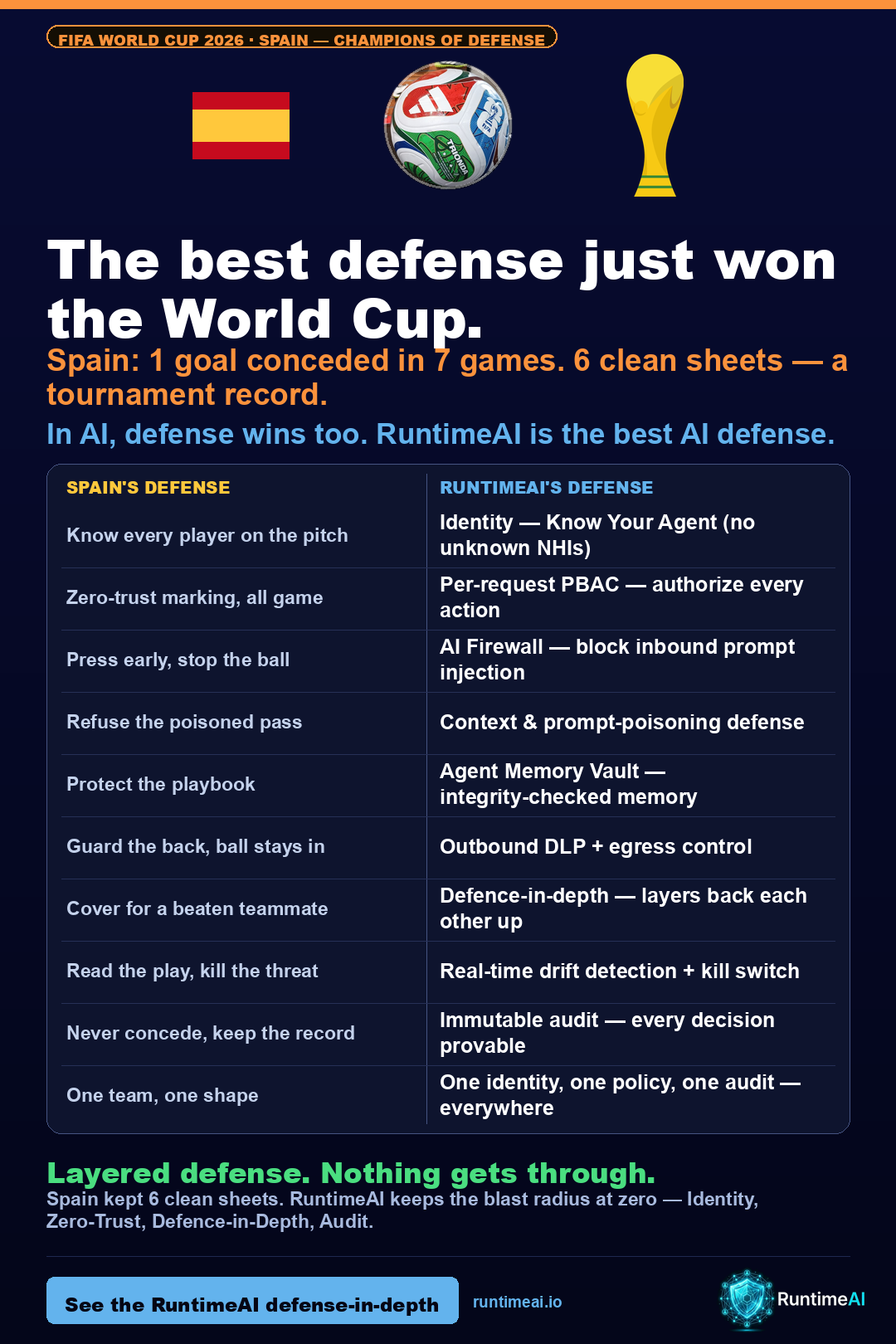
Spain are World Cup champions. Today in New York, they beat Argentina 1-0 in the 2026 final, Ferran Torres burying the winner in extra time against a 10-man Argentina side. It is a familiar Spanish story — patient, disciplined, unbeautiful in the best way. But the number that will define this tournament is not the one in the final scoreline. It is the number they conceded across the whole thing.
Over seven matches, Spain conceded exactly one goal. They kept six clean sheets in a single World Cup — the first team ever to do it. In the semi-final they held Kylian Mbappé to three shots, none on target, and shut out a France side that had scored sixteen goals before kickoff. The back line — Unai Simón in goal, 19-year-old Pau Cubarsí, Aymeric Laporte racking up 65 clearances and 8 interceptions against France — did not just win games. It suffocated the best attackers on earth. Spain now hold the men's and women's World Cup titles at the same time, a first for any nation. Defense won all of it.
Defense Wins Championships
The highlight reels belong to the strikers. The trophies belong to the teams that do not concede. That is the oldest truth in the sport, and Spain just proved it again at the highest possible level: the tournament's most complete defense — not its flashiest attack — lifted the cup.
What makes a defense like that is not one heroic tackle. It is discipline repeated for ninety minutes, seven times over. Shape held when the ball is somewhere else. The pass lane closed before it opens. The striker marked out of the game an hour before he ever gets a look. Attack is loud and occasional; defense is quiet and constant. You do not notice a great defense — which is exactly the point. Nothing got through, so there was nothing to see.
Six clean sheets. One goal conceded in seven matches. Spain didn't win the World Cup by outscoring everyone. They won it by refusing to let anything through.
Every Autonomous Agent Is an Attacking Threat
Now look at the enterprise. Companies are fielding thousands of AI agents and non-human identities — software that acts at machine speed, reaches into sensitive data, calls tools, and makes decisions on the business's behalf. Every one of them is, in security terms, an attacker on the pitch: a mover with the ball, probing for a gap.
The attacks are the ones you read about. Prompt injection that hijacks an agent through a poisoned document or web page. Tool abuse, where an over-privileged agent uses a legitimate capability to do something it was never meant to. Data exfiltration through model output that quietly carries secrets out the door. And unknown identities — agents nobody registered, acting anonymously, indistinguishable from one another in the logs. Attack is loud; it is what makes headlines. Defense is what actually protects the goal. And in most enterprises today, there is no back line at all.
Defense in Depth: RuntimeAI's Back Line
A great defense is layered. The full-back, the center-back, the holding midfielder, the keeper — each covers what the one in front missed. No single player keeps the clean sheet; the structure does. RuntimeAI is built the same way: four coordinated layers of defense-in-depth around every agent, so that what beats one layer runs straight into the next.
| RuntimeAI Layer | On the Pitch | What It Does |
|---|---|---|
| Identity — Know Your Agent | Know who's on the field | Every agent and non-human identity gets a verifiable identity and scoped, least-privilege credentials. No anonymous actors, no unknown player wandering into your box. |
| Zero-Trust — per-request PBAC | Mark every runner, every time | Policy-based access control checked inline on every single request — no standing trust, no free pass because an agent was allowed a minute ago. Each action earns its authorization on its own. |
| AI Firewall — prompt-injection defense | Press early, stop the shot | Inbound inspection stops the poisoned instruction before it lands — the injected prompt, the hijack hidden in a document or web page, the tool call it was never meant to make. The tackle happens before the attacker gets a look at goal. |
| Context & prompt-poisoning defense | Refuse the poisoned pass | Not every threat comes through the front door. Retrieved context, tool responses, and upstream data can all be poisoned to steer an agent. RuntimeAI validates and constrains what reaches the model, so a tainted pass never turns into a chance. |
| Agent Memory Vault | Protect the playbook | An agent's memory is its playbook — and a target. Governed, isolated, integrity-checked memory with read-time validation and retention control stops memory-poisoning: no attacker rewrites what the agent believes between matches. |
| Egress & DLP — outbound control | Cut the outlet ball | Outbound data-loss prevention and egress control keep secrets and unsafe model output from ever leaving your half. Even if an agent is turned, the ball doesn't get played out the back. |
| Drift detection & kill switch | Read the play, make the tackle | Real-time behavioural drift detection spots the agent that has started acting out of character and cuts it off — the last-ditch tackle that ends the threat before it reaches goal. |
| Immutable Audit | The match tape | A tamper-evident, post-quantum record of what every agent did — the forensic account that makes the whole system reviewable, provable, and defensible after the fact. |
Identity so no unknown player is on the pitch. Zero-trust so every runner is marked on every touch. An AI firewall that blocks the inbound shot, context and memory defenses that refuse the poisoned pass and protect the playbook, egress control that cuts the outlet ball, drift detection for the last-ditch tackle, and an immutable audit trail as the match tape you can always review. Six clean sheets is what it looks like when nothing gets through — layer over layer, the dangerous chances never reach the goal.
Clean Sheets Are a Team Sport
Here is the honest part. No single defender won Spain this tournament, and no single control wins AI security. A clean sheet is a team result — layered, coordinated, always-on, and never guaranteed. The keeper still makes saves. Attackers still create chances. What separates a champion defense is not that it is never tested; it is that when one layer is beaten, the next one holds.
AI defense is the same. There is no silver bullet, no single product that makes an agent fleet safe forever. The threats keep evolving, and so must the defense — it is depth and discipline, applied continuously, not a box you check once. Anyone promising a one-shot fix is selling the highlight reel, not the clean sheet. Real protection is layered, humble about what any one layer can do alone, and relentless in stacking them.
The Best AI Defense
Spain won the World Cup the way it is almost always won: by being the best defense on the field. Enterprise AI will be won the same way. The teams that thrive in the autonomous economy will not be the ones with the flashiest agents — they will be the ones nothing gets through.
The Best AI Defense
RuntimeAI is the Control Plane for the Autonomous Economy — four layers of defense-in-depth around every agent: Know Your Agent identity, per-request zero-trust policy, an inbound-and-outbound AI firewall, and an immutable audit trail. The best defense just won the World Cup. In AI, it's RuntimeAI.
Explore RuntimeAIFielding autonomous agents? Build your back line with our team.