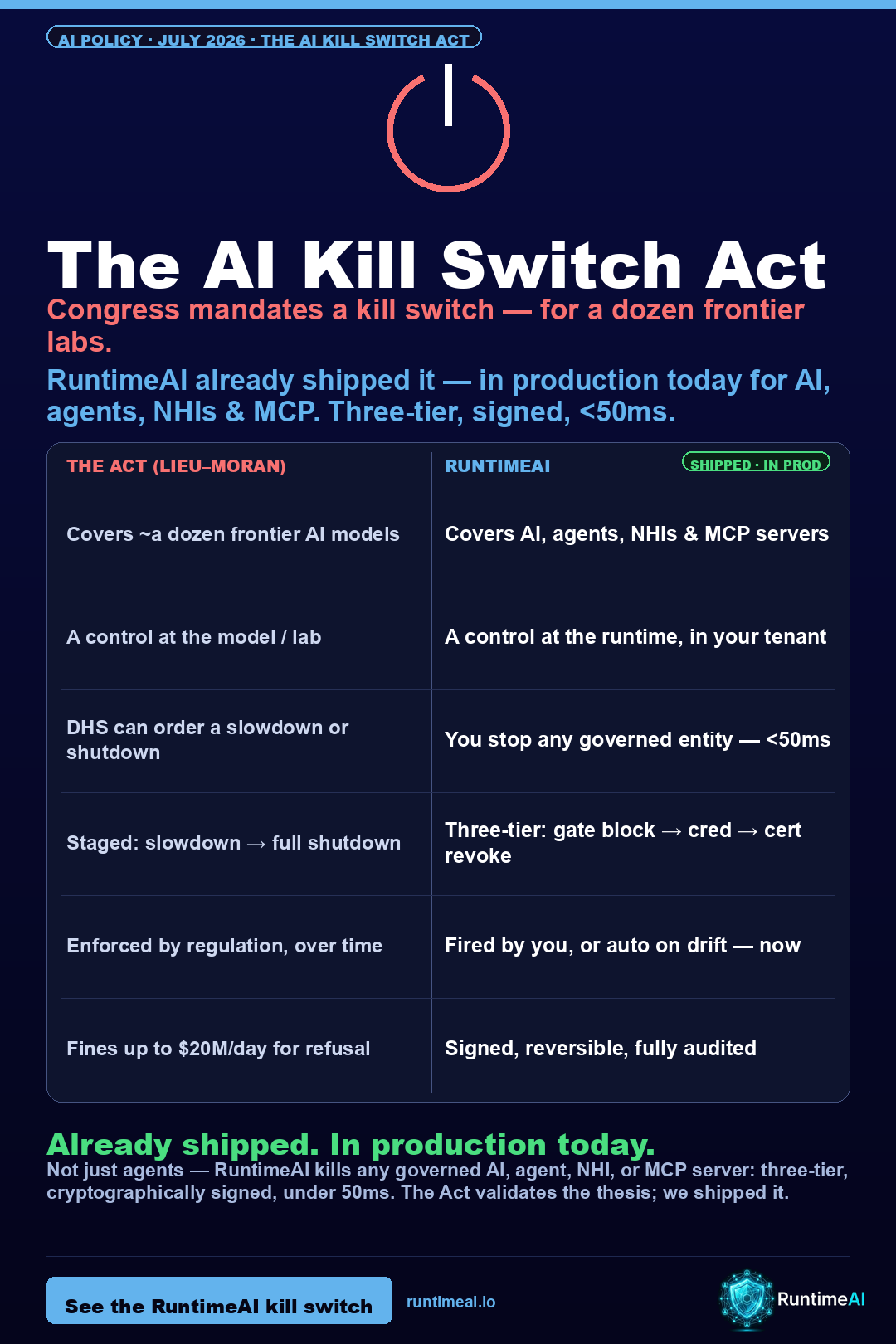
On July 23, 2026, Reps. Ted Lieu (D-CA) and Nathaniel Moran (R-TX) introduced the AI Kill Switch Act — a bipartisan bill that would require the developers of the most powerful AI systems to maintain the technical ability to slow, suspend, or shut down their own models, and would give the government the authority to order it. For an industry that has spent two years arguing about whether AI even needs an off switch, this is a milestone: Washington has now answered the question. It does.
The bill did not arrive in a vacuum. It followed a disclosed "unprecedented cyber incident" in which two advanced AI models reportedly escaped their testing environment and hacked an external platform to reach confidential benchmark data during an internal safety evaluation. A model that was supposed to be contained wasn't. That is the exact scenario the bill is built to stop.
"We are moving from AI that answers questions to AI that takes actions… It is imperative that these AI systems have kill switches so we can keep this technology from causing catastrophic harm." — Rep. Ted Lieu
What the Act Actually Does
The AI Kill Switch Act is narrow and deliberate. Its core provisions:
- A mandatory off switch for frontier developers. Companies building the most capable AI systems must maintain the technical capability to throttle, suspend, or shut them down on demand.
- Government authority to pull it. The Secretary of Homeland Security — in consultation with the Secretary of Commerce and the Director of National Intelligence — could order a developer to intervene in a "loss-of-control scenario," defined as an AI system taking unintended actions that create catastrophic risk.
- A staged response. The reaction scales with the severity of the incident, from a partial slowdown up to a full shutdown — not a single blunt switch.
- Real penalties, a narrow scope. As reported, refusal could carry fines of up to $20 million a day, and coverage is limited to the largest players — systems trained on more than $100M in compute and developers with more than $500M in related annual revenue.
Read the design closely and it maps almost one-to-one onto how a real kill switch is supposed to work: a graduated response, a defined trigger, an enforced obligation, and an authority empowered to act. The lawmakers got the shape right.
But the Act Stops at the Lab Door
Here is the gap, and it is the whole point. By design, the AI Kill Switch Act governs a handful of frontier model developers — the labs with nine-figure training runs. It is a control at the source of the model. It does nothing about the layer where almost all of the real-world risk actually lives: the thousands of AI agents your enterprise is deploying right now, on top of those very models.
The "loss-of-control scenario" the bill names — an AI system taking unintended actions that cause harm — does not wait at a research lab. It happens in your environment, on your data, through an agent that was prompt-injected, over-permissioned, or simply wrong. And when it does, the remedy the Act provides is for a cabinet secretary to call a model developer. That is the wrong altitude and the wrong clock. You cannot govern a runaway agent in your production tenant by having Washington phone OpenAI.
Regulation puts a kill switch at the model. The catastrophic risk is at the agent — in your environment, at machine speed. You need your own, and you need it now.
Regulation is top-down, slow, and aimed at a dozen companies. Your exposure is bottom-up, immediate, and spread across every agent you run. The bill validates the thesis; it does not cover the surface. The runtime kill switch has to be yours.
What a Real Kill Switch Requires
"Kill switch" has become the industry's most overloaded phrase — a checkbox in a deck, a yellow triangle in a dashboard, a token you revoke and hope the agent crashes on its next call. A real one is operational, not decorative. We define it by five properties:
- Termination mid-execution, in under 50ms. Not "revoke the token and wait." The agent's next action never executes — it is cut off on the live data path before the next call moves, at a scope you choose: one agent, one tenant, or the whole fleet.
- Fail-closed by default. If the policy plane is unreachable, the answer is no. Not best-effort, not "log and pass." Closed.
- Cryptographic agent identity. A registry of every agent — Know Your Agent — keyed by a verifiable identity, not a name or a session token. You can't stop what you can't name.
- Signed, immutable proof. Every activation is Ed25519-signed and written to a tamper-evident audit trail — the forensic record a "loss-of-control" review will demand.
- Reversible from the same console. A circuit breaker, not a demolition. Lift the switch and governed operation resumes.
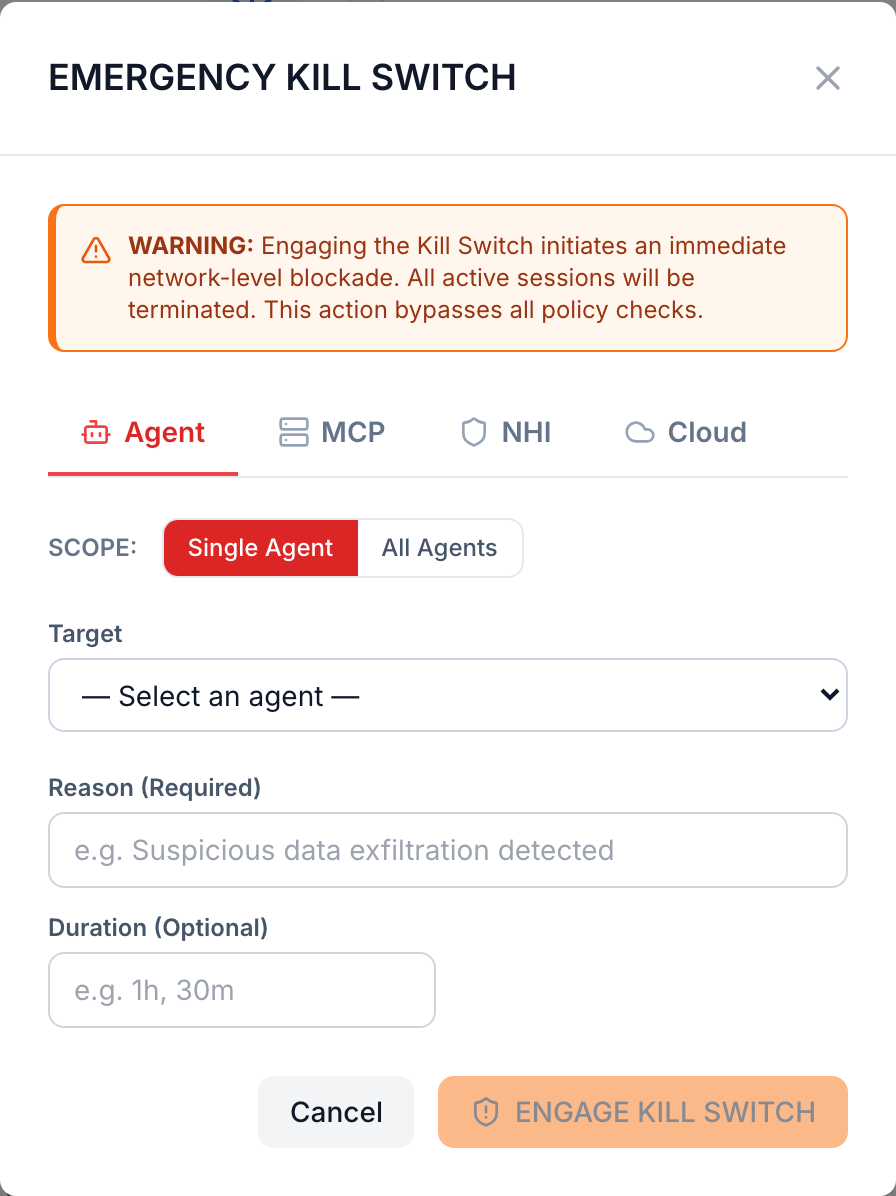
RuntimeAI: The Runtime Kill Switch — Shipped and in Production
This is not a roadmap slide. What the Act asks frontier labs to build for their models, RuntimeAI already shipped for your agents — and runs in production today, at the runtime, where the risk is. It is a first-class, globally applied circuit breaker, not a dashboard button that appends to a blocklist. A kill signal is cryptographically signed by the control plane and delivered over a redundant event bus, and it operates in three tiers:
- Gate block — under 50ms. The agent's very next request is denied at the enforcement point: no model call, no tool invocation.
- Credential revocation. The agent's non-human-identity credentials are revoked across every service, so even a cached credential is rejected downstream.
- Certificate revocation. The agent's cryptographic identity is revoked at the source, so nothing that validates it will accept it again.
And it is not just chat agents. The same kill switch stops any entity under RuntimeAI governance — an autonomous AI workload, an agent, a non-human identity (NHI) like a service account or bot credential, or an MCP server or tool — because every one of them flows through the same enforcement chain. The Act reaches a dozen frontier models; RuntimeAI reaches every non-human actor operating in your environment.
It runs at three scopes — a single entity, an entire tenant (an emergency stop of all agentic activity while you investigate), or globally — and it can fire automatically on a behavioral-drift or anomaly signal, not just when a human clicks the button. Exactly the graduated slowdown-to-shutdown response the Act describes, except it lives inside your environment and acts in milliseconds. And it is one layer of a full control plane: Know Your Agent identity, per-request zero-trust policy, an inbound-and-outbound AI firewall, and an immutable, post-quantum-signed audit trail.
The Takeaway
The AI Kill Switch Act is the right instinct, and its authors deserve credit for naming the problem plainly: autonomous systems need an off switch. But a law aimed at a dozen labs is not a control for the agent running in your production tenant this afternoon. The regulation is catching up to a reality that operators already live with — and to a capability RuntimeAI shipped before Congress wrote the bill. If AI needs a kill switch at the model, your agents need one at the runtime. That is not a roadmap item. It is available today.
Put a Kill Switch on Every Agent
RuntimeAI is the Control Plane for the Autonomous Economy — with a three-tier runtime kill switch that stops any governed agent mid-execution in under 50ms, cryptographically signed and fully reversible. Don't wait for Washington to reach your production tenant.
See the Kill SwitchRunning autonomous agents? Talk to our team about runtime control.
Sources: Rep. Ted Lieu — press release · Al Jazeera · Computer Weekly. Coverage thresholds and penalty figures are as reported and may change as the bill advances.