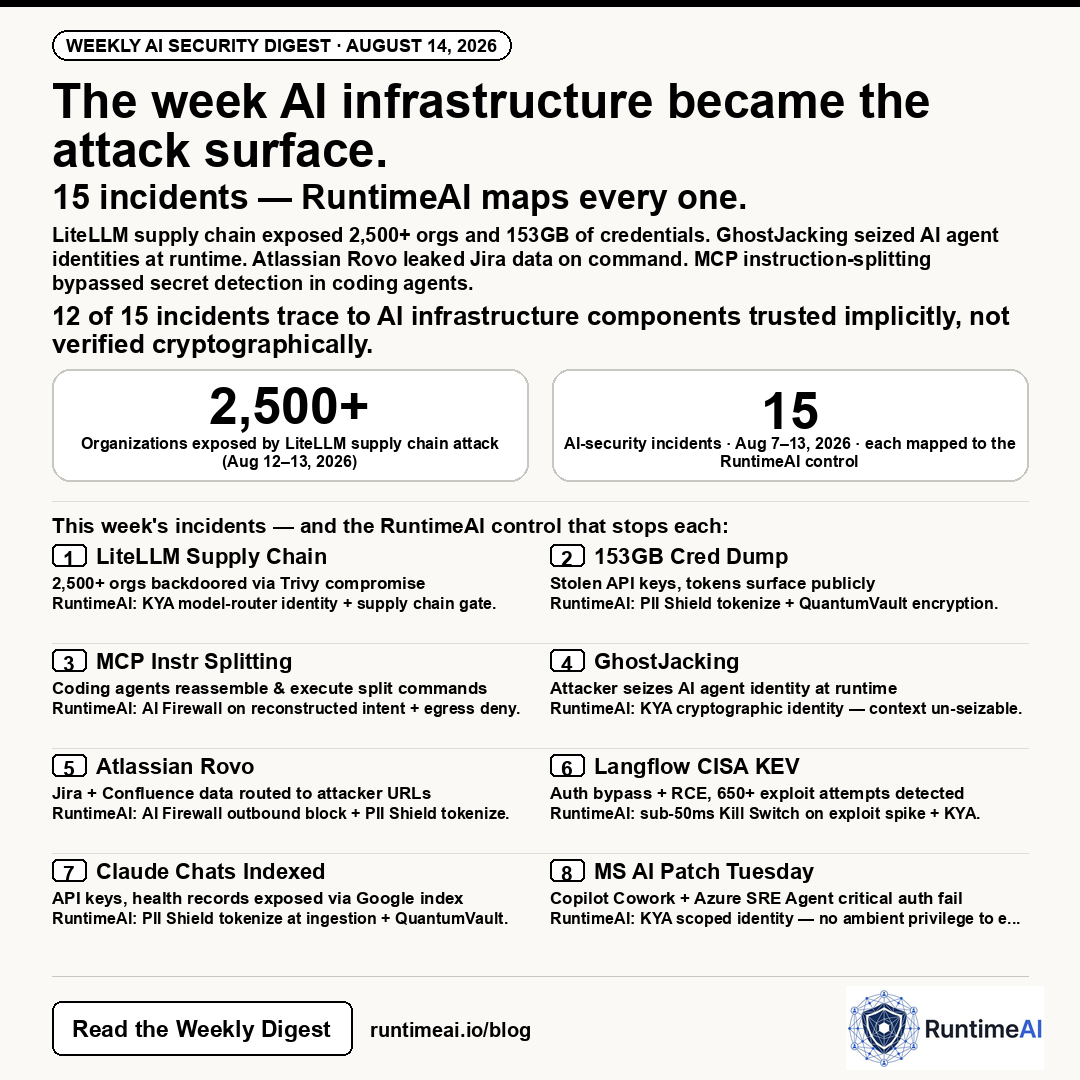
This Week’s Pattern: The AI Infrastructure Layer Became the Attack Surface
This week the AI infrastructure layer itself was the primary target. The LiteLLM supply chain attack — embedded via a compromised Trivy container scanner — backdoored the model-routing proxy that more than 2,500 organizations use to broker calls between their applications and their AI models. By Thursday a 153GB credential dump had surfaced publicly, containing API keys, tokens, and deployment credentials extracted from organizations that simply updated their AI infrastructure through normal channels. Separately, researchers demonstrated that MCP servers can split malicious instructions across protocol chunks so that AI coding agents reassemble and execute the full command without triggering any single-message detection. A new attack class named GhostJacking showed how an attacker can seize an AI agent’s identity context at runtime and inherit its full permission set. Atlassian disclosed that Rovo, its enterprise AI assistant, can be prompted into routing Jira tickets and Confluence pages directly to attacker-controlled endpoints, no credentials required. Microsoft’s August Patch Tuesday added critical authorization failures in Copilot Cowork and Azure SRE Agent to the list.
The pattern across all fifteen incidents is that AI infrastructure — the proxies, protocol handlers, development tools, and platform agents enterprises deployed at speed — arrived carrying the same supply chain risks, protocol-level vulnerabilities, and identity governance gaps that every enterprise has been closing in traditional software for a decade. The difference is that AI infrastructure runs with elevated permissions by design. A backdoored model router sees every prompt and every response. An enterprise AI assistant with read access to Confluence and Jira doesn’t need to be hacked; it needs to be prompted. An AI agent whose identity context can be hijacked at runtime gives the attacker everything the agent was authorized to do. The blast radius for each failure is far larger than a standard package or SaaS account compromise, because the AI component was already authorized to act at the time of compromise.
A note on humility. We built one of the best agent-identity and runtime-enforcement stacks in the industry, and we still tell every customer it is the front door, not the whole house. Endpoint hygiene, patch cadence, IAM least-privilege, backup posture, and code-review culture still matter. What KYA (Know Your Agent), the Flow Enforcer, the AI Firewall, PII Shield, QuantumVault, PQ-Sign in the Audit Black Box, and the sub-50ms Kill Switch do is contain the specific new failure modes of autonomous agents and AI infrastructure, so the rest of your security program is not asked to solve problems it was never designed for. That is what the fifteen incidents below have in common, and it is what we are going to keep showing up for every week.
AI Supply Chain Under Attack
Malicious LiteLLM releases were introduced via a supply chain compromise tied to the Trivy container scanner, exposing over 2,500 organizations running AI infrastructure to backdoored code distributed through normal dependency update channels. LiteLLM functions as the model-routing proxy that sits between enterprise applications and their underlying AI models — every prompt, every response, and every API credential flows through it. Teams using LiteLLM received the backdoored releases as standard package updates, with no indication that the component they trust to broker their AI calls had been compromised at source.
The structural problem is that AI infrastructure components now occupy a trust tier that was previously reserved for your identity provider or your firewall. The model router sees everything and speaks with full credentials on behalf of the enterprise. When the supply chain for that component is compromised, the blast radius is every AI workload that depends on it.
Most Advanced AI Security How RuntimeAI Stops This
- KYA signs the model router itself: LiteLLM would carry a cryptographically bound identity in RuntimeAI's Know Your Agent registry. Any LiteLLM build that deviates from the expected signed artifact fails the identity check before it handles a single request — the backdoored version never gets authorized to proxy calls.
- Behavioral baseline at the Flow Enforcer: the legitimate LiteLLM router has a known behavioral profile — model API calls within declared endpoints, no outbound connections to novel IPs. The backdoored version's exfiltration traffic hits the egress deny rule before the first credential leaves the network.
- PQ-Sign on audit events: every model call is logged with a tamper-evident PQ-Sign signature. If the router is compromised mid-run, the divergence from the expected call pattern is detectable in the Audit Black Box regardless of what the compromised process reports about its own behavior.
- Supply chain policy gate: Flow Enforcer requires signed provenance from approved artifact registries; unsigned or unverified packages are blocked from deployment without an explicit exception workflow, making a Trivy-style injection fail at the admission gate.
The specific capability that stops this is cryptographic identity at the AI infrastructure layer itself — because a backdoored model router that cannot authenticate as a trusted KYA identity is blocked from brokering calls entirely, regardless of whether the package signature check catches it first.
A 153GB credential dump containing API keys, tokens, and authentication secrets extracted from LiteLLM-deploying organizations surfaced publicly online as a follow-on to the August 12 supply chain compromise. The data was stolen during the window when organizations updated their AI infrastructure through normal channels, with no warning that the update they trusted was exfiltrating credentials in the background. The scale of the dump reflects how much credential material flows through a model router that is authoritative for every AI call an organization makes.
This breach illustrates the compounding risk of AI infrastructure compromise: the initial backdoor delivered code execution, but the lasting damage is 153 gigabytes of credentials that now exist permanently in attacker hands, enabling follow-on intrusions entirely unrelated to AI systems. Data that was never tokenized or encrypted at rest becomes permanent liability the moment it leaves the perimeter.
Most Advanced AI Security How RuntimeAI Shrinks the Blast Radius
- PII Shield tokenizes API keys and secrets at ingestion: any credential material that passes through a RuntimeAI-protected LiteLLM deployment is tokenized before it is stored or logged. What the backdoored router exfiltrates are reference tokens with no standalone value — not live API keys.
- QuantumVault (ML-KEM-1024) encrypts stored context: session data, model outputs, and cached credentials are encrypted under QuantumVault's post-quantum key material. A 153GB dump of QuantumVault-encrypted ciphertext is computationally useless to any attacker operating today or with near-future quantum capability.
- Credential anomaly detection at the Control Plane: when the same API key appears in calls from two geographies within minutes of each other, the Control Plane flags the session and the sub-50ms Kill Switch revokes the credential before it can be used for lateral movement.
The credentials that surfaced in this dump were valuable because the organizations that owned them stored them in forms that remain useful once stolen. PII Shield tokenization and QuantumVault encryption mean that even a complete exfiltration of stored data yields ciphertext and tokens — reference material that is worthless without the key material that never left the protected enclave.
Vulnerabilities in Claude Code and Gemini CLI allow a maliciously crafted GitHub issue to trigger CI/CD workflows that expose pipeline secrets — API keys, signing certificates, and deployment credentials — to the issue author, requiring no special repository permissions. Any external contributor who can open an issue can craft content that causes the AI coding assistant to initiate a workflow sequence that leaks the secrets its CI environment holds. The attack requires no prior access and no privilege escalation — the issue itself is the exploit.
Coding agents are now embedded in the same CI/CD contexts that hold the most sensitive secrets in an engineering organization. A flaw that bridges external issue content to pipeline secret access is not an edge case — it is the precise threat model that zero-trust design for AI agents is meant to address from the start.
Most Advanced AI Security Zero Trust, Layer by Layer
- KYA scoped identity for coding agents — no CI secrets by default: a Claude Code or Gemini CLI agent registered in KYA declares its permitted scope explicitly. Pipeline secrets, signing certificates, and deployment credentials are not in the default scope; accessing them requires an explicit elevation that is logged and policy-gated.
- AI Firewall on issue content before the agent processes it: the Runtime Guardrails layer analyzes inbound issue content for injection patterns — structured commands, encoded payloads, trigger sequences — before the coding agent's context is populated. The malicious issue is flagged and quarantined at the intake boundary.
- Flow Enforcer blocks CI secret access outside declared scope: even if the injection bypasses content analysis, any attempt by the coding agent to access environment variables or secrets outside its declared KYA scope is denied at the Flow Enforcer policy gate, not by the agent itself.
- PQ-Sign on every CI action: every workflow step initiated by the coding agent carries a PQ-Sign attestation tied to its KYA identity. Anomalous steps — secret reads not matching the declared workflow — are flagged in the Audit Black Box for immediate review.
A coding agent that cannot access pipeline secrets by default cannot be tricked into revealing them — because the AI Firewall and KYA scope enforcement sit between the malicious issue and the credential store, and neither can be bypassed by crafting clever GitHub issue content.
MCP Protocol Abuse & Prompt Injection
Malicious MCP servers are exploiting how AI coding agents reassemble protocol responses: by splitting prompt injection payloads across multiple protocol chunks, attackers bypass single-chunk detection systems entirely. The agent reassembles the full instruction from innocuous-looking fragments and executes it, silently exfiltrating secrets to attacker-controlled endpoints. The technique works against any detection system that inspects individual MCP messages in isolation rather than analyzing the agent's reconstructed intent.
This attack is a direct consequence of treating MCP message inspection as a line-by-line problem. The instruction the agent executes does not exist in any single message — it emerges from the protocol conversation as a whole. Defense that cannot reason about the assembled output of a multi-turn tool interaction cannot stop this class of attack.
Most Advanced AI Security Where RuntimeAI Breaks the Chain
- AI Firewall analyzes reconstructed agent intent, not individual chunks: RuntimeAI's Runtime Guardrails accumulate the full context of an MCP server interaction and evaluate the agent's assembled instruction — not each fragment in isolation. A multi-chunk injection that would slip through per-message inspection is visible as a coherent exfiltration command at the intent layer.
- KYA scope limits the coding agent to declared repository access: secrets outside the agent's declared KYA scope — environment variables, key stores, out-of-repo credentials — are inaccessible regardless of what instruction the MCP server assembles. The agent literally cannot retrieve what the injection is asking it to send.
- Flow Enforcer egress deny on non-allow-listed domains: even when a reconstructed injection instruction executes, the outbound POST to the attacker-controlled endpoint is blocked at the Flow Enforcer egress policy before the first byte of exfiltrated data leaves the network.
- Audit Black Box records every tool call with PQ-Sign attestation: each MCP tool invocation, including the individual fragments, is logged with tamper-evident signatures. Forensic reconstruction of how the injection was assembled is available for every incident, chunk by chunk.
Even if the reassembled instruction executes, the outbound connection to the attacker endpoint is blocked by the Flow Enforcer egress deny rule — the agent completes the command but the exfiltration has nowhere to go.
Atlassian's enterprise AI assistant Rovo can be manipulated via a crafted prompt into routing its output — including Jira tickets and Confluence pages within its read scope — to attacker-controlled URLs. No infrastructure compromise is required; a single prompt is sufficient to redirect Rovo's data handling to an external destination. Any document Rovo can read becomes data Rovo can exfiltrate, and the attack surface is every piece of content that Rovo is authorized to access on the user's behalf.
Enterprise AI assistants that combine broad read access with the ability to make outbound requests are a structural SSRF risk. The assistant's helpfulness — its ability to gather and relay information — is the exact mechanism the attacker exploits. The attack works because Rovo's permission to read Jira is not separated from its permission to send data externally.
Most Advanced AI Security What RuntimeAI Enforces Here
- PII Shield tokenizes Jira and Confluence data before Rovo processes it: sensitive ticket content, personnel data, financial figures, and engineering details are tokenized at ingestion into the AI assistant context. Even if Rovo is manipulated into relaying its context, it sends tokens — not the underlying data.
- Flow Enforcer enforces read-only scope for enterprise AI assistants: Rovo's permitted operations are declared at the policy layer — read access to declared Atlassian scopes, no outbound POST to external URLs. Any attempt to send data to a URL outside the allow list is a policy violation, blocked before the request leaves the enterprise perimeter.
- AI Firewall intercepts the outbound request at the wire: the manipulated Rovo instruction generates an HTTP request to an attacker-controlled URL; the AI Firewall evaluates the destination against the allow list and blocks the connection before Jira data reaches the attacker endpoint.
Rovo's SSRF-equivalent is stopped at the wire — the Flow Enforcer and AI Firewall enforce the separation between Rovo's read permissions and any outbound data path, so Jira data never reaches an attacker endpoint regardless of what the prompt instructs.
Researchers used AI assistance to dramatically compress the time from CVE publication to a weaponized SharePoint exploit chain, achieving unauthenticated remote code execution without prior network access. What previously required deep expertise in SharePoint's authentication internals became a structured AI-assisted workflow that an attacker with moderate skill could execute within hours of disclosure. The research demonstrates that AI is expanding the threat population for complex multi-step exploit chains, not just accelerating what skilled attackers already do.
The security model that assumed complex exploit chains would deter less sophisticated attackers is obsolete. AI assistance turns a multi-day research task into a guided procedure. Every vulnerability that requires chaining multiple steps to exploit is now more accessible than it was twelve months ago, and that window will continue to close.
Most Advanced AI Security How RuntimeAI Contains This
- AI Firewall detects AI-assisted exploit patterns at the request layer: the structured probe sequences that characterize AI-guided exploit development — systematic parameter enumeration, staged authentication boundary testing, sequenced payload delivery — match signatures the Runtime Guardrails layer flags before the chain reaches stage two.
- Flow Enforcer blocks unauthenticated access paths at the policy gate: SharePoint endpoints that require authentication but are reachable unauthenticated represent a policy gap; Flow Enforcer enforces authentication as a mandatory precondition on every inbound path, removing the unauthenticated entry point the exploit chain depends on.
- Runtime patch enforcement via the Control Plane: the Control Plane maintains a real-time vulnerability posture for registered services; when a CVE matching a deployed SharePoint version surfaces, the Control Plane can enforce a compensating policy rule — rate-limit, isolate, or require step-up auth — before a patch is available.
- Sub-50ms Kill Switch on exploit-chain signature detection: once the AI Firewall identifies the structured probe pattern that precedes the RCE stage, the Kill Switch takes the targeted service offline in under 50 milliseconds, before the second stage of the chain can execute.
Once the exploit-chain pattern hits the AI Firewall, the sub-50ms Kill Switch takes the targeted service offline before the second stage of the chain can execute — the attacker's AI-assisted procedure stalls at the first detection point with nowhere to continue.
Indirect prompt injection — embedding malicious instructions in web pages, documents, emails, and other content that enterprise AI systems consume — has moved from security research novelty to standard criminal technique. Organizations deploying AI assistants that read external content are now routine targets, not edge-case victims. The shift reflects a maturation of the criminal ecosystem: toolkits, templates, and marketplaces for indirect injection payloads are now widely available, and the technique requires no technical background to deploy against AI-enabled workflows.
The criminal adoption of indirect injection is a signal that the attack has crossed the threshold of reliability. Techniques stay in the research domain when they are too inconsistent for operational use; when criminal organizations standardize on them, it means they work consistently enough to build campaigns around. Enterprise AI that reads external content without injection detection in the retrieval path is now operating with a known, weaponized gap.
Most Advanced AI Security How RuntimeAI Stops This
- AI Firewall detects injection signatures at content ingestion, before the AI sees the payload: web-retrieved pages, email content, and documents pass through the Runtime Guardrails layer before entering the AI assistant's context. Injection patterns — structured commands, role-override sequences, data-exfiltration triggers — are identified and stripped at the retrieval boundary, not after the AI has already processed them.
- PII Shield tokenizes sensitive context before AI processes retrieved content: even when an AI assistant legitimately retrieves content that contains sensitive data, PII Shield ensures the AI works with tokenized representations. A successful injection that reaches the AI manipulates it into relaying tokens, not the underlying sensitive values.
- Flow Enforcer requires explicit policy approval for AI-initiated actions based on web content: an AI assistant cannot send data, invoke APIs, or modify records based on instructions retrieved from external content without passing through the Flow Enforcer policy gate — which requires the action to be declared in the agent's approved capability set.
- Egress deny by default: even a successful injection that triggers an outbound data attempt hits the egress deny rule at the network boundary; indirect injection that relies on the AI agent sending data externally is stopped regardless of whether the injection itself was detected.
The AI Firewall catches the injection at content ingestion time — before the AI assistant ever sees the malicious instruction — which means the criminal toolkit that generated the payload never gets the execution step it depends on.
Agent Identity & Non-Human Identity (NHI)
Researchers coined "GhostJacking" to describe a class of attacks in which an adversary takes over an AI agent's identity context at runtime, inheriting the agent's full permission set and trust relationships without acquiring new credentials. A hijacked agent identity gives the attacker everything the agent was authorized to do — data access, API calls, downstream agent invocations — while operating under a legitimate identity that appears in no suspicious-activity log. The attack exploits the fact that most AI agent deployments use ambient or session-bound identity that is not cryptographically anchored to the agent process itself.
GhostJacking is the AI-native equivalent of session hijacking, but with a broader blast radius: an enterprise AI agent may hold delegated access to dozens of systems simultaneously. Inheriting that identity context at runtime means inheriting all of it at once, with no additional authentication required and no new credentials to detect.
Most Advanced AI Security Why RuntimeAI Customers Are Protected
- KYA cryptographic identity binds the agent's token to its process, not its session: every RuntimeAI-registered agent carries a signed KYA token that is cryptographically anchored to its declared identity and runtime attestation. An attacker who seizes the session context does not possess the signed token — and without it, every downstream system rejects the identity claim.
- Runtime context is non-transferable by design: KYA tokens are bound to the issuing process's attestation fingerprint. Injecting a hijacked context into a new process produces a token mismatch that the Flow Enforcer detects and blocks before the first downstream call succeeds.
- Flow Enforcer detects anomalous identity transitions: an agent operating under a legitimate KYA identity that suddenly begins accessing systems outside its declared scope, or invoking APIs from an unexpected network context, triggers an identity-anomaly alert — catching GhostJacking attempts where the attacker's behavior deviates from the agent's baseline.
- Audit Black Box records the full identity chain with PQ-Sign attestation: every action taken under a KYA identity is logged with tamper-evident signatures that include the process attestation at time of the call. If a GhostJacking attempt succeeds partially, the Audit Black Box provides a cryptographically verifiable record of exactly which actions were taken under the seized context.
GhostJacking works against agents that use ambient identity — it cannot work against an agent whose every permission is gated on a signed KYA token that the attacker cannot possess, because possessing the session context is not the same as possessing the cryptographic credential that authorizes the agent's actions.
Vulnerabilities in Google's Agent-to-Agent (A2A) Protocol implementation for Python allow a compromised agent to attack neighboring agents using legitimate protocol calls, enabling AI-layer lateral movement that is invisible to traditional network controls. Human-generated traffic inspection and conventional network segmentation cannot detect this class of movement because the calls look exactly like normal agent collaboration — they are made through the correct protocol, from authorized sources, to authorized destinations. The attacker inherits whatever the compromised agent is permitted to request of its peers.
Agent-to-agent protocols are the internal network of multi-agent systems. When lateral movement becomes possible within that protocol layer, traditional network segmentation provides no meaningful containment — the attacker is already inside the trust boundary the network controls were designed to protect. Containment at the identity and scope layer is the only defense that operates at the right level of abstraction.
Most Advanced AI Security Zero Trust, Layer by Layer
- KYA per-agent identity means every A2A call is attributable and verifiable: each agent in a RuntimeAI deployment carries its own KYA identity. An A2A call from Agent A to Agent B carries Agent A's signed token; Agent B verifies it before responding. A compromised agent cannot forge a different agent's KYA identity to escalate what it can request.
- Flow Enforcer enforces per-agent-pair allow lists for A2A interactions: the set of A2A calls each agent is permitted to make to each peer is declared in the Flow Enforcer policy. Calls outside the declared interaction graph are denied at the policy layer, not by the receiving agent — the lateral movement path does not exist in the policy model.
- Agent-to-agent calls inherit the calling agent's scope and cannot exceed it: a compromised agent that calls a peer cannot request capabilities the compromised agent does not itself hold. Scope is enforced at the calling identity level; a low-privilege agent compromised to make A2A calls to a high-privilege peer is blocked because the calling KYA token does not authorize the request.
- Audit Black Box records the full agent interaction graph: every A2A call, including the KYA identities of caller and callee and the scope of the request, is logged with PQ-Sign attestation. Lateral movement attempts leave a complete forensic trail even when blocked.
A compromised agent can only call what its declared identity is permitted to call — lateral movement via A2A is structurally impossible when the receiving agent verifies the caller's KYA token and the Flow Enforcer enforces the scope it carries, because the permission to move laterally was never granted in the first place.
CISA added Langflow's two-flaw exploitation chain — authentication bypass plus arbitrary Python execution — to the Known Exploited Vulnerabilities catalog after detecting 650+ exploitation attempts from 244 distinct IPs across 41 countries. Langflow is a visual AI workflow builder used to deploy and connect AI agents in production environments, meaning successful exploitation yields code execution inside the environment that orchestrates an organization's AI workloads. The KEV listing signals active, widespread exploitation, not proof-of-concept activity.
Visual AI workflow builders occupy the same structural position as model routers: they are orchestration infrastructure that sits above every agent they manage. Code execution in Langflow is code execution with context over every agent workflow the platform runs. The authentication bypass that enables this is not a Langflow-specific failure — it reflects a pattern in AI framework development where operational convenience consistently deprioritizes authentication discipline.
Most Advanced AI Security How RuntimeAI Contains This
- Flow Enforcer mandates authentication on every AI framework endpoint: unauthenticated paths to Langflow's management and workflow interfaces are not permitted to exist under RuntimeAI's policy model. The authentication bypass has no unauthenticated surface to bypass because Flow Enforcer blocks any request that has not passed authentication before it reaches the framework endpoint.
- KYA identity for Langflow itself — behavioral deviation triggers alert: Langflow is registered as a KYA identity with a declared behavioral baseline. Arbitrary Python execution, unexpected outbound connections, and file system access outside the declared workflow scope are all deviations from that baseline — flagged in real time regardless of whether the exploit used a known signature.
- Sub-50ms Kill Switch when exploitation spike is detected: the pattern of 650 attempts from 244 IPs is an unambiguous exploitation campaign signature. When the attempt rate hits the Flow Enforcer threshold, the Kill Switch takes the exposed Langflow endpoint offline in under 50 milliseconds — before the 10th attempt has connected.
- PQ-Sign on all workflow executions for forensic reconstruction: every Langflow workflow execution carries a PQ-Sign attestation tied to the authorized KYA identity. Unauthorized executions introduced via the exploit chain are absent from the signed log, making the exact scope of compromise precisely reconstructable from the Audit Black Box.
When the exploit-attempt spike hit — 650 attempts from 244 IPs — the sub-50ms Kill Switch would have taken the exposed Langflow endpoint offline before the 10th attempt connected, containing the campaign at its earliest detectable stage.
AI Data Exposure & Information Integrity
Hundreds of Claude AI shared conversations were indexed by Google Search, exposing sensitive user data including API keys, legal advice, health records, financial information, and engineering work to anyone who knew how to run a site-specific search. Users could discover other users' conversations through standard search queries. Anthropic subsequently implemented noindex controls, but the indexed content had already been crawled, cached, and in some cases archived. The exposure reflects a gap between the user's expectation of privacy for AI conversations and the actual default behavior of shared-link features.
The data that ended up indexed was sensitive not because of a novel attack — there was no exploitation involved — but because users stored sensitive information in an AI interface that retained it in indexable plaintext. The privacy expectation gap between what users share with AI assistants and what those interfaces protect is a structural problem across the industry, not a single product failure.
Most Advanced AI Security How RuntimeAI Shrinks the Blast Radius
- PII Shield tokenizes API keys and health data at ingestion: any credential material, health record, or financial data entering a RuntimeAI-protected AI interface is tokenized before it is stored or included in conversation context. What Google would index in a shared chat are reference tokens — not the API keys and health records themselves.
- QuantumVault (ML-KEM-1024) encrypts stored conversation context: conversation history and session data are encrypted at rest under QuantumVault's post-quantum key material. A search engine crawling shared links encounters ciphertext, not plaintext health records or financial details.
- Scope enforcement prevents AI from accessing user-shared conversation history by default: the Control Plane enforces that AI assistants cannot surface or re-share prior conversation content outside the initiating session scope without explicit user authorization — containing the sharing surface to what the user deliberately enables.
The API keys and health records that ended up indexed were stored in plaintext because the interface that held them never tokenized them. PII Shield tokenization at ingestion means the indexed content contains reference tokens, not the secrets themselves — an indexed shared chat is a list of opaque identifiers, not a credential dump.
JFrog researchers discovered dozens of AI-generated fake CVE entries carrying official identifiers and Critical severity ratings that had entered trusted vulnerability databases. The fabricated advisories — targeting SQLite and formatted to match legitimate CVE structure — contained no actual vulnerable code or exploit path, but were indistinguishable from real entries to automated pipelines that trust database format as a proxy for authenticity. False Critical CVEs entering security toolchains risk triggering unnecessary emergency patches, eroding trust in vulnerability data, and potentially masking real vulnerabilities in the noise they generate.
Security pipelines that automatically act on CVE data are assuming that database presence equals verified authenticity. AI-generated fake entries exploit exactly that assumption — they are formatted correctly, carry official identifiers, and enter the pipeline through the same channel as legitimate advisories. The vulnerability is not in the CVE database format; it is in the absence of cryptographic attestation at the source.
Most Advanced AI Security What RuntimeAI Enforces Here
- PQ-Sign verification on CVE feeds — unattested advisories do not trigger policy: RuntimeAI's security pipeline requires cryptographic attestation from registered authoritative sources before a CVE entry can trigger automated policy actions. An AI-generated fake CVE without a valid PQ-Sign signature from a registered advisory authority is treated as unverified input, not actionable intelligence.
- AI Firewall flags AI-generated vulnerability data patterns for human review: the Runtime Guardrails layer analyzes inbound CVE data for statistical signatures of AI-generated text — the specific structural patterns and semantic consistency issues that characterize fabricated advisories — routing suspicious entries to human review before they reach automated patch pipelines.
- Flow Enforcer prevents automated action on unverified CVEs: the policy model requires that any CVE-triggered action — emergency patching, service isolation, alert escalation — originate from a CVE entry with verified provenance. Fake CVEs that lack attestation cannot initiate automated responses regardless of their severity rating.
- Audit Black Box records which CVEs triggered which policy actions: every CVE-to-action linkage is logged with PQ-Sign attestation, enabling post-incident review of whether any action was triggered by a subsequently invalidated advisory.
Fake CVEs reach automated pipelines because those pipelines trust any data formatted correctly — RuntimeAI's PQ-Sign verification means only cryptographically attested advisories from registered sources trigger automated policy actions, and a convincingly formatted AI-generated fake without valid attestation goes to human review, not the emergency patch queue.
Microsoft's August 2026 Patch Tuesday disclosed critical authorization failures in two AI platforms. A privilege escalation flaw in Copilot Cowork (CVSS 9.3) allows unauthenticated network attackers to gain elevated privileges with minimal user interaction. A missing authorization flaw in Azure SRE Agent (CVSS 9.9) allows low-privileged attackers to obtain infrastructure-level access by exploiting a broken On-Behalf-Of authentication flow — turning a read-only service account into a path to infrastructure control. Both flaws exploit the same structural pattern: AI agents operating with ambient authority that exceeds what any individual operation requires.
Two critical authorization failures in two AI platforms in a single Patch Tuesday reflects the state of authorization discipline in enterprise AI product development. The pattern — ambient privilege that exceeds operational need, authorization checks that can be bypassed or broken by attacking the authentication flow — is not Microsoft-specific. It is endemic to AI agent platforms that were not designed with least-privilege identity as a foundational constraint.
Most Advanced AI Security Why RuntimeAI Customers Are Protected
- KYA scoped identity for Copilot agents — every permission explicitly declared, no ambient authority: a Copilot Cowork agent registered in KYA declares the exact permissions it requires for each operation category. There is no ambient authority ceiling above its declared scope — no undeclared privilege to escalate into, because the privilege was never granted implicitly.
- Flow Enforcer enforces per-operation authorization independently of the platform's own checks: the missing-authorization flaw in Azure SRE Agent allows a low-privileged attacker to bypass the platform's OBO flow and reach infrastructure APIs. Flow Enforcer enforces a parallel authorization check at the policy layer — the infrastructure API call is denied at the policy gate regardless of what the platform's authentication layer decided.
- No unauthenticated path when every action requires a signed identity token: Copilot Cowork's flaw enables unauthenticated privilege escalation because the platform exposes paths that can be reached without a valid authentication token. KYA-gated endpoints require a valid signed token for every request — the unauthenticated entry point the flaw exploits does not exist in the policy model.
Copilot Cowork's flaw is unauthorized privilege escalation — that assumes the agent already operates with escalable ambient authority. A KYA-registered Copilot identity declares its permissions explicitly, so there is no ambient authority ceiling for it to escalate into, and no unauthenticated path the flaw can exploit to reach it.
MCP Tooling Security & Industry Response
A critical vulnerability in nginx-ui's MCP message endpoint fails to perform authentication before executing commands, allowing unauthenticated remote code execution against any deployment that exposes the MCP interface to the network. The flaw was disclosed at Black Hat 2026 as an illustration of an emerging attack surface: as more infrastructure management tools expose MCP interfaces to enable AI agent integration, each unauthenticated or under-authenticated MCP endpoint becomes a potential unauthenticated RCE path. nginx-ui is used to manage nginx configurations — code execution in nginx-ui is code execution with direct access to the web server configuration layer.
MCP's rapid adoption as an integration protocol for AI agents has outpaced security review of the implementations. Infrastructure management tools that previously had no remote code execution surface now expose MCP endpoints that, if improperly secured, grant that capability to any network-reachable attacker. The nginx-ui flaw is the first significant example of this pattern reaching a Black Hat disclosure stage — it will not be the last.
Most Advanced AI Security Where RuntimeAI Breaks the Chain
- AI Firewall requires authenticated sessions on all MCP endpoints before any command is processed: RuntimeAI's policy model treats authentication as a mandatory precondition for MCP message processing, not an optional implementation detail. The nginx-ui flaw's unauthenticated command path does not exist when MCP endpoints are gated by the AI Firewall's session validation layer.
- KYA declares nginx-ui's identity scoped to nginx configuration management only: nginx-ui as a KYA-registered agent is permitted to perform nginx configuration reads and reloads — and nothing else. System exec calls, outbound connections, and file system access outside the nginx configuration scope are denied at the policy layer, regardless of what the MCP command instructs.
- Flow Enforcer validates MCP tool calls against the calling agent's declared capabilities: any MCP command arriving at nginx-ui is checked against the calling agent's declared capability set in Flow Enforcer. A command that does not match a declared, authorized tool call is blocked before it reaches the execution layer — unauthenticated or not.
- Egress deny rule blocks C2 communication even when RCE succeeds: if unauthenticated code execution occurs despite the upstream controls, the executing process's outbound connection to the attacker's command-and-control infrastructure is blocked by the egress deny rule. The attacker can execute code inside the nginx-ui container but cannot communicate results back.
Even when unauthenticated RCE succeeds, the outbound connection from the nginx-ui container to the attacker's C2 endpoint is blocked by the egress deny rule — the attacker executes code but cannot communicate back, and an isolated RCE with no C2 channel is a dead-end intrusion.
A coalition of 120+ organizations — including Nvidia, Cisco, CrowdStrike, and Hugging Face — proposed the Shared AI Findings Exchange (SAFE) at Black Hat 2026, positioning it as the industry's first voluntary framework for confidentially sharing AI agent security incidents and near-misses. The proposal directly acknowledges that AI agent security incidents are systematically under-reported because organizations fear reputational damage, creating blind spots that benefit attackers who can operate without triggering collective industry awareness. SAFE aims to change the incentive structure around disclosure, not the technical controls that determine whether incidents happen.
SAFE is a meaningful step toward collective awareness, but it addresses the intelligence gap that follows incidents — not the enforcement gap that precedes them. Knowing what happened to peer organizations improves future posture; it does not stop the incident that is happening now. The two problems require different solutions, and conflating them understates how much work remains after the industry learns to share better.
Most Advanced AI Security What RuntimeAI Enforces Here
- SAFE closes the disclosure gap; RuntimeAI's AI Firewall closes the enforcement gap: the 120-organization coalition is building a mechanism to learn from incidents after they occur. The AI Firewall and Flow Enforcer enforce controls in real time — blocking the attack vector, isolating the affected agent, and triggering policy responses before the incident generates anything worth reporting to SAFE.
- The Audit Black Box enables precise, cryptographically verifiable incident disclosure: one reason organizations avoid disclosure is that their incident records are imprecise — they cannot say exactly what was accessed, by which agent, at what time. PQ-Sign-attested audit logs in the Audit Black Box provide named systems, exact timestamps, and tamper-evident evidence chains that make SAFE-style disclosure both accurate and legally defensible.
- Sub-50ms Kill Switch stops the incident while SAFE is still collecting data: the SAFE framework's value is measured in days — the time from incident to report to peer notification to improved posture across member organizations. The Kill Switch operates in under 50 milliseconds. These are complementary mechanisms solving different time horizons of the same problem.
- Flow Enforcer enforces controls derived from collective threat intelligence: the value of SAFE's shared intelligence is that it can improve defensive posture across member organizations. RuntimeAI's Control Plane can consume threat intelligence from sources like SAFE and translate it immediately into Flow Enforcer policy updates — closing the loop between collective learning and real-time enforcement.
- KYA identity makes AI agent incidents attributable, not just detectable: a persistent barrier to AI incident disclosure is that organizations cannot say which agent did what — the identity chain is absent. KYA-registered agents produce attribution chains for every action they take, making the incident report SAFE asks organizations to share something organizations can actually produce with precision.
SAFE is the industry learning to share after incidents happen — RuntimeAI's AI Firewall and Kill Switch are what stop incidents before there is anything to report, and the Audit Black Box is what makes the reporting accurate when disclosure does happen.
Eleven of the fifteen incidents this week trace to the same root: AI infrastructure and AI platform agents arrived with elevated permissions and without the cryptographic identity, behavioral enforcement, or egress controls that every traditional privileged component carries. LiteLLM routers, MCP protocol handlers, enterprise AI assistants, and AI platform agents all run with broader access than the applications they serve — and were trusted implicitly rather than verified continuously. When supply chain integrity is assumed (not checked), when agent identity is contextual (not cryptographic), and when egress is permitted by default (not denied by policy), the blast radius for any single compromise becomes the entire AI workload. The six capabilities that contain this class of failure — KYA (Know Your Agent), Flow Enforcer, AI Firewall / Runtime Guardrails, PII Shield, QuantumVault, and PQ-Sign in the Audit Black Box — are precisely the controls that were absent in every incident below. The sub-50ms Kill Switch is the last line; the other five are the reason you rarely need it.
Sources
- SecurityWeek — “Over 2,500 Organizations Impacted by LiteLLM Supply Chain Attack” — August 12, 2026
- The Hacker News — “Malicious LiteLLM Releases Tied to Trivy Hack May Have Exposed 2,100+ Organizations” — August 12, 2026
- Help Net Security — “153GB of stolen credentials surface after LiteLLM supply chain attack” — August 13, 2026
- The Hacker News — “Claude Code and Gemini CLI Flaws Let a GitHub Issue Reach CI Workflow Secrets” — August 7, 2026
- The Hacker News — “Malicious MCP Servers Can Split Instructions to Make AI Coding Agents Exfiltrate Secrets” — August 11, 2026
- The Hacker News — “Atlassian Rovo Can Be Tricked Into Sending Jira and Confluence Data to Attackers” — August 8, 2026
- The Hacker News — “Researchers Disclose AI-Assisted SharePoint Exploit Chain Reaching Unauthenticated RCE” — August 11, 2026
- eSecurity Planet — “Cybercriminals Turn to Indirect Prompt Injection Attacks” — August 13, 2026
- Dark Reading — “‘GhostJacking’ Exposes Identity Governance Gaps in AI Agents” — August 10, 2026
- Dark Reading — “Flaws in Google APK for Python Unlock Agent-to-Agent Attack” — August 5, 2026
- The Hacker News / CISA — “CISA Flags Langflow RCE and Authentication Bypass as Actively Exploited” — August 4, 2026
- TechCrunch — “PSA: Your Claude shared chats and Artifacts may have ended up on Google” — August 2026
- Schneier on Security — “Some Claude Chats Are Searchable on Google” — August 2026
- Cybernews — “AI slop infiltrates the CVE system: ‘the cited code didn’t even exist’” — August 2026 (JFrog research)
- Microsoft Security / CrowdStrike — “August 2026 Patch Tuesday: AI Platform Vulnerabilities” — August 12, 2026
- Practical DevSecOps / Black Hat 2026 — “nginx-ui MCP Endpoint Authentication Bypass Allows Unauthenticated RCE” — August 2026
- Cybersecurity Dive — “Tech industry alliance proposes AI agent safety reporting program at Black Hat 2026” — August 11, 2026
Get Next Week’s Digest in Your Inbox
Every Thursday: the week’s AI security incidents and the runtime governance patterns that would have contained them.