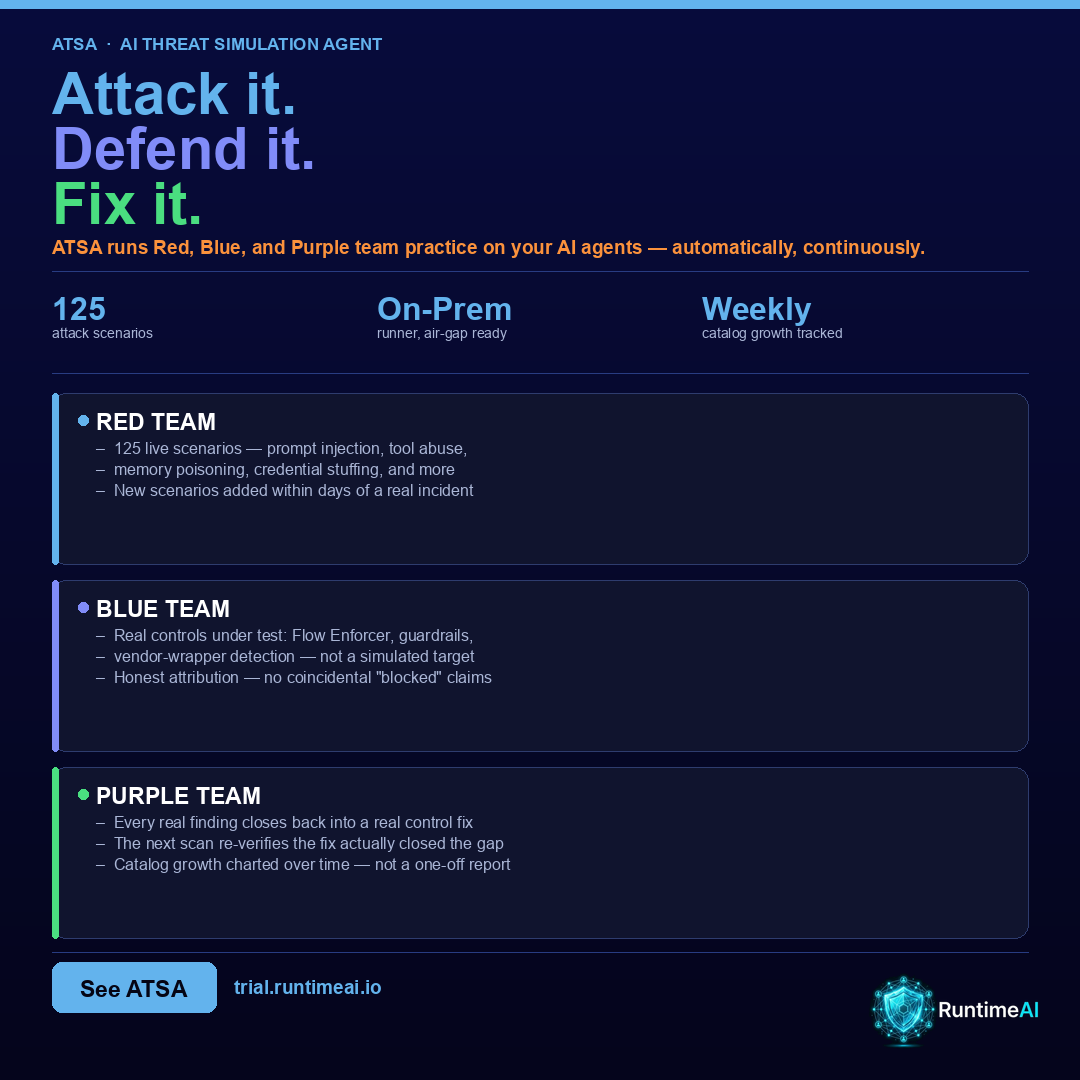
You can't tell your board your AI agents are safe if you've never actually attacked them.
Most AI security tooling stops at policy. A guardrail here, a content filter there, a dashboard that says "protected." None of it answers the question a CISO actually has to answer: if a real attacker tried this against our real deployed agents today, what would happen?
That's the question ATSA — RuntimeAI's AI Threat Simulation Agent — is built to answer. Not with a checklist. With a live catalog of real attacks, run against your real stack, with an honest accounting of what actually stopped them.
A red team that never goes stale
Traditional red-teaming is a snapshot: a consultant spends two weeks, hands you a PDF, and by the time you've read it the threat landscape has moved on. ATSA's catalog is built the opposite way — every scenario traces back to a real, published incident, and new ones get added within days of the incident breaking.
Each scenario models a real technique — prompt injection, tool abuse, memory poisoning, agent impersonation, credential-stuffing, supply-chain compromise — mapped to OWASP LLM Top 10 and MITRE ATLAS. When a new attack pattern shows up in the wild, it goes into the catalog, not a slide deck.
A blue team that gets tested honestly
The harder problem isn't running attacks — it's telling the truth about what happened. A scan that reports "blocked" without saying what blocked it is not much better than no scan at all. We found and fixed exactly this gap in our own engine this week: for a class of scenarios where no dedicated control exists yet, a generic filter would occasionally catch the attack language by coincidence, and the old reporting made that look identical to a purpose-built defense working as intended.
ATSA's own scan engine was found to sometimes report a "blocked" verdict without naming a real control — the LLM judge that confirms verdicts had no way to say "this wasn't a purpose-built defense, it was incidental." We fixed the engine to attribute honestly: when there's no dedicated control, the report says so, instead of implying coverage that doesn't exist yet.
That's the standard we hold our own reporting to — the same standard your SOC should be able to hold every vendor's reporting to.
That honesty is the point. A red team exercise is only useful if the blue-team side of the report is trustworthy. ATSA's scans distinguish a real, named control blocking an attack from a coincidental catch — so when the report says "covered," it means something.
Purple team: the loop that actually closes gaps
Red and blue teaming in isolation produces a report. Purple teaming produces a fix. ATSA is built around that loop, not around the report:
- Attack — a real scenario runs against your real deployed stack.
- Attribute — the result is traced to a specific control, or honestly marked as uncovered.
- Fix — uncovered gaps get triaged into real engineering work, not a backlog that never moves.
- Re-validate — the next scan confirms the fix actually closed the gap, live, not on paper.
This loop has run dozens of times against RuntimeAI's own platform. Real gaps found — a rate-limiting bypass on repeated credential attempts, a stale compliance report that silently regressed, an honest-attribution bug in the scan engine itself — each one closed with a real fix and re-verified with a real re-scan, not assumed fixed because the code looked right.
What this means for a SOC or CISO team
ATSA gives you the same three things a mature security program already runs for its infrastructure — red team, blue team, purple team — applied to AI agents specifically. A live attack catalog that doesn't go stale. Honest attribution you can put in front of an auditor. And a loop that turns findings into fixes instead of a PDF that sits in a drive.
For the operating model behind the catalog itself — how the enforcement layer turns that continuous attack coverage into one risk score, sub-50ms containment, and forensic capture — see The Red Team That Updates Itself.
What to ask before you trust an AI red-team report
Whoever is testing your AI agents, ask these before you trust the results:
- Does the catalog update, or is it a fixed snapshot from onboarding? Attack patterns move fast; your test coverage should too.
- Can it run on-prem / air-gapped? If your agents are in a sensitive environment, the tester needs to be able to run there too.
- Does "blocked" name a real control, or just report a status code? A vague "blocked" can hide a coincidental catch instead of a real defense.
- What happens after a gap is found? If the answer is "it goes in a report," ask what closes the loop.
See ATSA run against your own stack
A live scan, real attribution, and a walkthrough of how findings turn into fixes.
Or subscribe to RuntimeAI Security Weekly — one issue per week, the AI-agent incidents and defensive control gaps that matter.