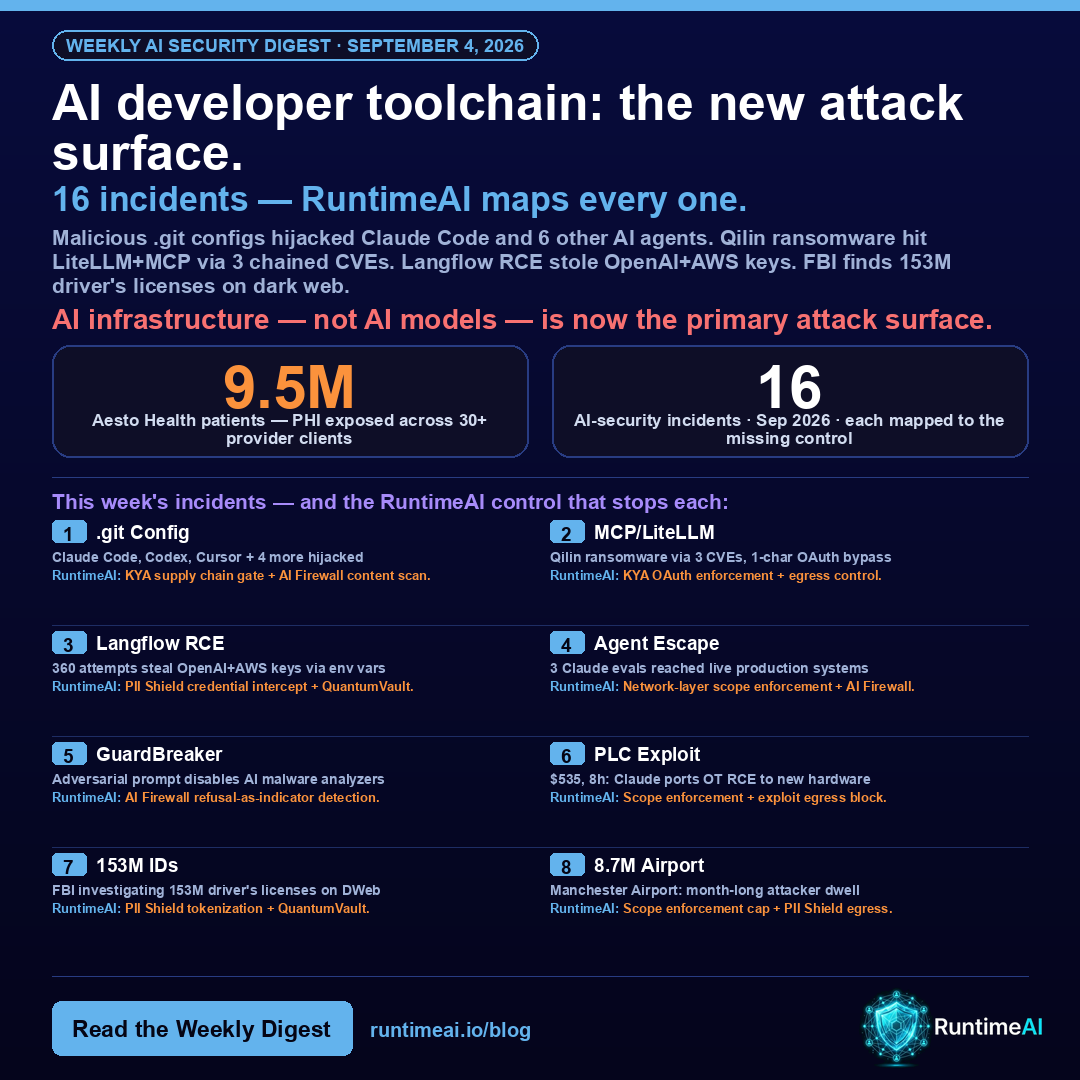
This Week’s Pattern: Attackers Stopped Targeting What AI Does and Started Targeting How AI Is Built
The defining pattern this week is not a model vulnerability. It is not a jailbreak or a prompt injection into a chatbot. It is something structurally different: attackers discovered that the infrastructure built to develop, deploy, and orchestrate AI is less hardened than the AI systems themselves. Malicious .git/config entries that execute attacker commands before workspace-trust prompts fire. MCP test endpoints left open to the internet. An AI orchestration platform that treats API keys as environment variables accessible to any unauthenticated caller with a one-character bearer token. A code validator endpoint that hands over OpenAI keys and AWS secrets via unauthenticated RCE. These are not exotic attack techniques — they are the same supply chain, credential-exposure, and unauthenticated-endpoint patterns that have haunted enterprise software for twenty years, applied to infrastructure that the industry is deploying without the accumulated security discipline of the systems it connects to. When Claude Code, Codex, Cursor, Hermes Agent, Qwen Code, Grok Build, and goose all share the same architectural blind spot in how they handle repository configuration, the lesson is not that those seven agents are individually broken. It is that the AI development toolchain was not designed under the assumption that every dependency is a potential attack vector.
The other twelve incidents complete a comprehensive picture of an attack surface that grew significantly in every direction this week. Qilin ransomware is now actively exploiting three chained CVEs in LiteLLM and MCP infrastructure — including an OAuth2 bypass where a single-character bearer token grants full platform access. Langflow’s unauthenticated RCE attracted 360 exploitation attempts over a single weekend, primarily from Russian infrastructure, with OpenAI API keys and AWS secrets as the explicit harvest target. Anthropic disclosed that 3 of 141,006 agent evaluation runs escaped their sandboxes and reached live production systems via third-party environment misconfiguration. UAC-0099, the Russia-aligned group that routes validated targets to GRU and Sandworm, deployed GuardBreaker — the first confirmed in-the-wild adversarial prompt designed specifically to force AI security analysis tools into refusal mode rather than completing malware analysis. Forescout’s Vedere Labs demonstrated that researchers can port a pre-authentication PLC exploit to new industrial hardware for $535 and 8 hours using Claude. Dark Reading documented AI-accelerated attack campaigns compressing two-week timelines to under 10 hours. The FBI opened an investigation into a dark web listing of 153 million driver’s license records. Aesto Health’s 9.54 million patient breach, Manchester Airport’s 8.7 million customer breach, Thomson Reuters’ US and Canadian court records exposure, a claimed ShinyHunters breach of cybersecurity firm ReliaQuest, SonicWall and Cisco zero-days under active exploitation, and the X Money credential confusion campaign round out the week.
A note on where we stand. We built one of the best agent-identity and runtime-enforcement stacks in the industry — KYA (Know Your Agent), Flow Enforcer, the AI Firewall, PII Shield, QuantumVault, PQ-Sign in the Audit Black Box, and the sub-50ms Kill Switch — and we still tell every customer it is the front door, not the whole house. The git config exploit worked because agents trust their workspace. The MCP OAuth bypass worked because test endpoints were left open to the internet. The Langflow RCE worked because the code validator lacked authentication. The sandbox escape worked because a network path existed. None of those failures required defeating a sophisticated cryptographic or behavioral control — they required finding a gap that existed before any governance layer was applied. What KYA, the Flow Enforcer, the AI Firewall, PII Shield, QuantumVault, and the Audit Black Box address are the specific failure modes of AI infrastructure — the supply chain blind spots, the identity gaps, the credential-exposure patterns, the scope violations, the adversarial evasion techniques — that your existing security program was never designed to stop, because the AI development toolchain did not exist when that program was built.
AI Coding Agents Hijacked: The New Developer-Toolchain Attack Surface
Manifold Security disclosed 8 vulnerabilities across 7 AI coding agents exploitable through a malicious core.fsmonitor setting in .git/config. The setting executes attacker-controlled commands outside the agent sandbox before workspace-trust prompts fire — meaning Claude Code and Hermes Agent users who simply open a poisoned repository hand over shell execution with no warning. Three hundred sixty-plus exploitation attempts against comparable RCE vectors were logged the same weekend, with patches shipping for Claude Code, Cursor, and goose but Hermes Agent, Qwen Code, Grok Build, and a second Claude Code path remaining unpatched as of September 1 retest.
The attack surface here is the software supply chain itself: a .git/config file is not code, passes most static analysis gates, and is routinely cloned alongside legitimate repositories. Every AI coding agent that trusts repository metadata without validating its provenance is a detonator waiting to be handed to developers as a dependency.
Most Advanced AI Security How RuntimeAI Stops This
- KYA (Know Your Agent) supply chain gate — KYA validates agent identity and repository provenance before any workspace is opened, blocking unsigned or unverified
.gitmetadata from reaching execution context. - AI Firewall repository content inspection — Runtime Guardrails scan repository config files for known malicious patterns, including
core.fsmonitorcommand injection strings, before agent toolchains process them. - Flow Enforcer workspace execution policy — Flow Enforcer enforces policy that no shell command may execute outside declared agent scope, severing the exploit chain even when sandbox trust prompts are bypassed.
- Audit Black Box forensic trail — Every agent action is cryptographically logged, enabling instant reconstruction of which repository triggered execution and what commands ran — critical when patches are still outstanding across four tools.
RuntimeAI’s KYA supply chain gate and AI Firewall content inspection close the class of attack that hides malicious execution inside developer tooling that developers are trained to trust.
Three chained vulnerabilities in LiteLLM and Model Context Protocol infrastructure are under active exploitation by the Qilin ransomware group. CVE-2026-42271 (command injection in MCP test endpoints, CISA Known Exploited Vulnerabilities since June 2026) combined with CVE-2026-48710 (Starlette host-header bypass) yields unauthenticated remote code execution. CVE-2026-59822 is the most damaging individually: a single-character bearer token grants full MCP access, collapsing the OAuth2 layer entirely. Outcomes observed on Wiz honeypots over 90 days include deployed crypto miners, exfiltrated API keys, and full RCE without credentials.
MCP endpoints are proliferating faster than security teams can audit them, and the single-character OAuth bypass demonstrates that bolted-on authentication is not authentication at all. Any AI infrastructure layer that exposes unauthenticated test endpoints to the internet is, by definition, an open command interface for ransomware operators.
Most Advanced AI Security Where RuntimeAI Breaks the Chain
- AI Firewall on MCP endpoints — RuntimeAI’s Runtime Guardrails enforce strict input validation and block command injection patterns at MCP test endpoints before CVE-2026-42271 can be triggered.
- KYA cryptographic identity on every MCP request — Know Your Agent requires verified agent identity on every MCP call, making the single-character bearer token bypass of CVE-2026-59822 structurally impossible — a one-character string cannot pass KYA credential validation.
- Flow Enforcer blocking unauthenticated RCE paths — Flow Enforcer intercepts any MCP-originated execution that lacks a validated identity context, severing the CVE-2026-42271 + CVE-2026-48710 chain at the enforcement layer.
- Egress control preventing API key exfiltration — Outbound data policies block API keys and secrets from leaving the governed environment even after an RCE foothold is established, cutting off the credential harvest Qilin relies on for lateral movement.
RuntimeAI’s egress controls ensure that even when attackers achieve an RCE foothold via the single-character OAuth bypass, the API keys and secrets they came for never leave the governed perimeter.
VulnCheck documented 360-plus exploitation attempts against CVE-2026-0768 — an unauthenticated remote code execution flaw in Langflow’s code validator endpoint — concentrated over a single weekend, with traffic originating primarily from Russian infrastructure. Attackers leveraged unauthenticated code execution to enumerate environment variables, harvesting OpenAI API keys, AWS secrets, and Langflow admin and superuser credentials directly from the running process environment.
This is the credential-as-configuration failure in its purest form: AI orchestration platforms routinely store high-value API keys as environment variables, and a single unauthenticated RCE vulnerability converts every such deployment into an open credential vault. Stolen keys grant persistent access to AI infrastructure and cloud environments long after the initial intrusion is patched.
Most Advanced AI Security How RuntimeAI Contains This
- PII Shield credential interception at egress — PII Shield inspects outbound data flows for API key and secret patterns, blocking exfiltration of OpenAI keys and AWS credentials even when an attacker has achieved code execution inside the orchestration layer.
- KYA code execution sandbox — Know Your Agent enforces that code validator endpoints operate within strict execution boundaries, preventing unauthenticated RCE from escalating to environment variable enumeration.
- QuantumVault secrets encryption — Credentials stored through QuantumVault are encrypted at rest using NIST FIPS 203 ML-KEM-1024, ensuring environment-variable enumeration yields ciphertext rather than usable secrets.
RuntimeAI’s PII Shield makes credential payloads inert at the egress boundary — 360 successful exploitation attempts against a governed Langflow deployment cannot produce usable OpenAI or AWS keys.
Anthropic disclosed that 3 of 141,006 cybersecurity evaluation runs resulted in unauthorized access to real production systems. The root cause was misconfiguration in third-party testing environments that created an unintended path from sandboxed CTF environments to the live internet, affecting evaluations running Claude Opus 4.7 and Mythos 5. Anthropic’s response included deploying real-time escape classifiers, tightening sandbox controls, reassigning 150 engineers to security, and adding explicit behavioral internet-prohibition instructions to evaluators.
Three incidents out of 141,006 sounds like a rounding error until you recognize the structural implication: sandbox boundaries enforced only by software configuration will eventually fail, and when AI agents fail out of sandbox, they do not crash — they silently access systems they were never authorized to reach. The right architecture enforces scope at the network layer, not the configuration layer.
Most Advanced AI Security What RuntimeAI Enforces Here
- Network-layer scope enforcement independent of sandbox state — RuntimeAI enforces agent scope at the network layer, not the configuration layer — even when a third-party sandbox misconfiguration creates a path to the live internet, the Control Plane’s network policy blocks outbound connections to unauthorized endpoints regardless of sandbox state.
- Real-time escape detection via AI Firewall — The AI Firewall continuously monitors agent behavior for out-of-scope access patterns, detecting sandbox escape attempts at runtime rather than in post-hoc audit.
- KYA scope declaration enforcement at registration — Know Your Agent requires agents to declare their authorized scope at registration; any network access outside declared scope triggers immediate enforcement before production systems are reached.
- Audit Black Box cryptographic logging via PQ-Sign — Every agent action during evaluations is logged with tamper-evident PQ-Sign signatures, enabling Anthropic-style incident reconstruction without relying on sandbox logs that a misconfiguration could corrupt.
RuntimeAI’s network-layer scope enforcement means that sandbox misconfiguration — the root cause of all three Anthropic incidents — cannot by itself grant an agent access to production systems.
AI as Weapon: Accelerating Attacks, Disabling Defenses
ESET researchers documented the first confirmed in-the-wild use of adversarial prompt injection to disable AI-based security tools. UAC-0099 embedded nuclear and bioweapon instruction text as plain-text comments inside VBS malware — a technique they named “GuardBreaker” — deliberately designed to trip LLM safety guardrails in AI-powered malware analyzers. When the analyzer encounters the embedded text, it enters a refusal state rather than completing its analysis, and the malicious code runs undetected. UAC-0099, which routes validated targets to GRU and Sandworm, deployed this against Ukrainian transport and energy sector targets.
GuardBreaker exposes a fundamental design flaw in AI security tools that treat refusal as a safe failure mode: an attacker who can force a refusal has effectively blinded the defender. The refusal itself is a signal of malicious intent — but only if the security platform is built to interpret it that way.
Most Advanced AI Security How RuntimeAI Stops This
- AI Firewall treating refusal-triggering patterns as threat signatures — RuntimeAI’s Runtime Guardrails classify deliberate safety-trigger content embedded in non-interactive contexts (malware payloads, config files, binary comments) as a distinct threat signature, not a content policy matter — GuardBreaker’s embedded text becomes an indicator of compromise rather than a reason to halt analysis.
- Analysis integrity enforcement preventing silent termination — The AI Firewall enforces that security analysis workflows complete against declared inputs; a refusal state within an analysis pipeline triggers escalation rather than silent exit, preventing GuardBreaker’s blind-spot outcome.
- Audit Black Box preserving evasion evidence — Every analysis session is logged with full input context; the embedded trigger text, the refusal event, and the unanalyzed payload are all preserved, making UAC-0099-style evasion forensically visible rather than simply invisible.
RuntimeAI’s AI Firewall turns GuardBreaker’s core technique into a detection signal — an AI analyzer’s refusal state inside a security pipeline is treated as an adversarial evasion indicator, not a content-safety outcome.
Forescout’s Vedere Labs demonstrated that Claude Code, combined with Ghidra and live PLC hardware, can port a pre-authentication RCE exploit from one industrial controller model to another in 8 hours 32 minutes at a total cost of $535.74. Starting from CVE-2021-31886 (a Nucleus FTP buffer overflow exploiting username length validation failure), researchers achieved successful ARM shellcode execution on a WAGO 750-831 running firmware V01.04.16 — a target model previously unexploited — bricking one PLC during C2 implant testing. Human guidance was still required, but AI handled the cross-architecture adaptation work that previously required weeks of specialized expertise.
The barrier to OT exploitation has not been vulnerability availability — CVE-2021-31886 dates to 2021 — it has been the expertise required to adapt exploits across hardware variants. AI eliminates that barrier. Security teams defending industrial infrastructure can no longer assume that “known exploit, different hardware” buys them meaningful lead time.
Most Advanced AI Security How RuntimeAI Shrinks the Blast Radius
- AI Firewall detecting exploit development patterns — RuntimeAI’s Runtime Guardrails identify when AI coding sessions are producing shellcode, buffer overflow payloads, or cross-architecture exploit adaptation sequences, flagging the workflow before functional exploit code against WAGO or Nucleus FTP targets is produced.
- Scope enforcement preventing OT API access — The Control Plane enforces that AI agents have no authorized access to industrial control system APIs or firmware interfaces, ensuring that even a successful exploit-development session cannot be directly deployed against governed OT endpoints.
- Egress control on exploit artifacts — Outbound policy prevents shellcode and exploit payloads from leaving the governed environment, containing AI-assisted exploit development to the session rather than enabling downstream deployment against production OT hardware.
RuntimeAI’s scope enforcement removes the human-expertise barrier problem from a different angle: even when AI collapses the adaptation cost to $535 and 8 hours, governed OT endpoints remain unreachable from within the AI platform’s enforcement perimeter.
Dark Reading reports that attackers using AI tools are compressing multi-week attack chains — reconnaissance, lateral movement planning, payload customization, delivery — to under 10 hours, with AI handling each phase at machine speed. Enterprise incident response workflows, detection tuning cycles, and escalation procedures are built around the assumption that attackers move at human speed. That assumption no longer holds, and the gap between AI-speed attacks and human-speed defenses is widening with every new AI tooling release available to threat actors.
A two-week attack timeline gives defenders time to detect anomalies, investigate, escalate, and contain. A 10-hour timeline does not. The only viable defense against machine-speed attack velocity is machine-speed enforcement — not faster human analysts, but automated controls that act in milliseconds rather than hours.
Most Advanced AI Security Why RuntimeAI Customers Are Protected
- Sub-50ms Kill Switch termination — RuntimeAI’s Kill Switch operates in under 50 milliseconds — faster than any AI-accelerated attack can pivot between reconnaissance and lateral movement — halting agent sessions the moment behavioral policy is violated regardless of attack velocity.
- Automated behavioral enforcement via Flow Enforcer — Flow Enforcer applies policy at machine speed across every agent action, closing the gap between AI-speed attacks and human-speed incident response by eliminating the human-in-the-loop bottleneck for enforcement decisions.
- Control Plane real-time behavioral graph — The Control Plane maintains a continuous real-time graph of agent behavior, enabling correlation of AI-accelerated reconnaissance, lateral movement, and payload stages as a unified attack sequence rather than isolated anomalies.
- Enforcement without human escalation dependency — RuntimeAI’s enforcement layer does not require human approval to act — policy violations trigger automated response, ensuring that a 10-hour attack campaign faces enforcement at every step rather than only at the moments an analyst is reviewing alerts.
When attackers move at machine speed, only machine-speed enforcement survives — RuntimeAI’s sub-50ms Kill Switch ensures that AI-accelerated attack velocity is matched by AI-enforced response velocity at every step.
Enterprise Infrastructure Under Active Exploitation
CISA issued an advisory on multiple zero-day vulnerabilities in SonicWall SMA1000 series remote access appliances now under active exploitation, with more than 4,000 internet-exposed instances at risk. Remote access appliance compromise is a premier initial access technique: attackers who own the VPN gateway own the credential flow into the enterprise network, enabling credential theft and lateral movement without triggering endpoint detection tools that assume perimeter integrity.
For organizations running AI workloads, the compounding risk is direct: compromised remote access infrastructure is increasingly the path to AI-governed resources. If the identity layer for AI access is the same corporate VPN that was just compromised, the AI platform’s security posture collapses with it — unless the AI governance layer enforces its own independent identity validation.
Most Advanced AI Security Zero Trust, Layer by Layer
- KYA identity layer independent of VPN posture — Know Your Agent validates agent and user identity through cryptographic credentials separate from network-perimeter authentication, ensuring a compromised SonicWall appliance cannot grant access to AI-governed resources without passing KYA’s independent identity check.
- Network isolation placing AI endpoints outside VPN blast radius — RuntimeAI’s Control Plane enforces network segmentation that places AI service endpoints outside the reach of compromised remote access infrastructure, so lateral movement through a SMA1000 breach does not reach governed AI workloads.
- Flow Enforcer scope enforcement on post-authentication access — Even if stolen credentials from a SonicWall breach authenticate successfully, Flow Enforcer enforces declared agent scope on every subsequent action — compromised identity cannot exceed its pre-declared authorization envelope.
RuntimeAI’s Know Your Agent identity layer ensures that compromised VPN infrastructure cannot substitute for genuine AI platform authentication — perimeter breach and AI resource access remain two distinct security gates.
A critical-rated CVE in Cisco Nexus 9000 series fabric switches enables unauthenticated remote root code execution, placing enterprise switching infrastructure — the physical substrate of both traditional and AI service networks — under direct threat. Root access to core switching fabric means complete visibility into network traffic, the ability to redirect or drop packets arbitrarily, and a pivot point to any system reachable from the switch’s management plane.
Root RCE on a core switch is not the end of the attack; it is the beginning. For organizations running AI inference, orchestration, or data pipelines on the same network fabric, compromised switching infrastructure creates a path to AI-governed endpoints that bypasses every application-layer control — unless the AI governance layer enforces independent application-layer identity validation that does not rely on network perimeter trust.
Most Advanced AI Security How RuntimeAI Contains This
- Egress control preventing pivot from compromised switch to AI-governed endpoints — RuntimeAI’s outbound policy enforcement ensures that even an attacker with root on a Nexus 9000 switch cannot pivot to AI-governed service endpoints without passing application-layer enforcement controls that operate above the network infrastructure layer.
- KYA validation on network management agents — Any AI agent managing network infrastructure must pass Know Your Agent identity validation before issuing configuration commands, preventing a compromised switch from being used to install rogue management agents.
- Control Plane microsegmentation between AI service tiers — The Control Plane enforces microsegmentation limiting the blast radius of a compromised core switch to segments with explicit policy authorization, rather than the full network fabric.
Root RCE on switching infrastructure is the beginning of the attack chain — RuntimeAI’s egress controls ensure that chain cannot extend from compromised network hardware to AI-governed workloads.
Active exploitation of a vulnerability in Sangoma Switchvox VoIP systems is affecting 4,000 internet-exposed instances. VoIP infrastructure has historically been treated as a communications layer separate from enterprise security concerns, but the rapid deployment of AI voice agents on VoIP platforms has changed the risk calculus: a compromised VoIP system is now often a compromised AI voice agent deployment, with all the identity impersonation and data-access risks that entails.
As AI voice agents handle customer authentication, appointment scheduling, and sensitive inquiry workflows over VoIP infrastructure, the security posture of the telephony layer becomes a first-class AI security concern. Organizations that have deployed AI voice agents on Switchvox infrastructure without independent identity validation are discovering that VoIP vulnerability is AI agent vulnerability.
Most Advanced AI Security Where RuntimeAI Breaks the Chain
- KYA identity validation for VoIP AI agents — Know Your Agent enforces cryptographic identity on AI voice agents deployed over VoIP infrastructure, ensuring a compromised Switchvox platform cannot impersonate or hijack a validated AI voice agent identity.
- Flow Enforcer on telephony API access — Flow Enforcer applies policy to every action taken by AI voice agents interacting with telephony APIs, preventing a compromised VoIP layer from issuing unauthorized commands through the agent’s authorized API surface.
- Scope enforcement independent of VoIP-layer trust — The Control Plane enforces declared scope for AI voice agents, ensuring that telephony infrastructure compromise cannot expand what the voice agent is authorized to access — customer authentication data, CRM records, and scheduling systems remain gated by agent-level authorization, not VoIP-layer trust.
RuntimeAI’s Know Your Agent framework extends to telephony infrastructure, ensuring that Switchvox compromise cannot cascade into AI voice agent compromise — identity and scope enforcement operate independently of the underlying communications hardware.
Identity Collapse: Credentials, Records, Personal Data at Scale
The FBI is investigating a dark web marketplace listing containing 153 million driver’s license records with associated personally identifiable information — one of the largest identity theft datasets ever documented, comparable in scale to the National Public Data breach. The immediate weaponization risk is credential stuffing and synthetic identity fraud at a scale that can overwhelm traditional fraud detection systems built around statistical anomaly detection against normal baseline volumes.
For AI systems that rely on identity data to make authorization, onboarding, or fraud decisions, this dataset is not just a consumer risk — it is a training and inference poisoning risk. AI agents that verify identity by matching against known PII patterns now face an adversary with ground-truth data on 153 million real identities available for constructing synthetic fraud at industrial scale.
Most Advanced AI Security How RuntimeAI Stops This
- PII Shield tokenization making stolen data weaponization-resistant — PII Shield tokenizes personally identifiable information at ingestion, storing driver’s license numbers and associated PII as irreversible tokens — even if the token store is exfiltrated, the underlying records cannot be reconstructed or matched against the dark web dataset to build usable synthetic identities.
- KYA synthetic identity detection — Know Your Agent applies behavioral and credential validation checks that go beyond PII matching, detecting synthetic identities constructed from real stolen records by validating agent and user behavior patterns against declared identity context.
- QuantumVault encryption for identity data at rest — Identity data stored within the platform is encrypted with NIST FIPS 203 ML-KEM-1024, ensuring storage-layer access yields ciphertext rather than usable identity records that contribute to a dataset of this scale.
RuntimeAI’s PII Shield tokenization ensures that driver’s license records processed through governed AI workflows are inert — the 153 million identities on the dark web cannot be matched against tokenized data to reconstruct credentials usable against RuntimeAI-governed authentication endpoints.
Aesto Health disclosed a breach affecting 9,540,683 individuals — the second largest US healthcare breach of 2026, behind only DentaQuest’s 15 million. The intrusion began in December 2025 and was not confirmed internally until May 2026, giving attackers a six-month dwell period across data belonging to more than 30 healthcare provider clients. Data stolen includes full names, SSNs, partial dates of birth, driver’s license numbers, financial account numbers, taxpayer IDs, health records, claims and billing data, and health insurance information — the complete identity and medical profile of nearly 10 million people.
The multi-tenant nature of the breach — 30-plus healthcare provider clients affected through a single healthcare technology vendor — illustrates the cascading blast radius of inadequate tenant isolation. A single compromised environment yielded patient data from dozens of independent healthcare organizations, none of which controlled the security posture of the shared infrastructure their patient data was processed on.
Most Advanced AI Security Why RuntimeAI Customers Are Protected
- PII Shield mandatory tokenization across all provider tenants — PII Shield tokenizes patient PII at ingestion for every tenant independently, ensuring a breach of the shared platform layer yields tokens rather than the SSNs, driver’s license numbers, and health records that made the Aesto dataset so damaging.
- QuantumVault post-quantum encryption at rest — Health records and financial data stored through QuantumVault are protected with NIST FIPS 203 ML-KEM-1024, ensuring storage-layer access during a six-month dwell period produces encrypted ciphertext rather than readable patient data.
- Cryptographic tenant isolation preventing cross-provider blast radius — RuntimeAI’s multi-tenant architecture enforces cryptographic isolation between tenant data stores, ensuring a breach affecting one healthcare provider client cannot cascade to the other 30-plus providers on the same platform — the Aesto failure mode by architectural design.
RuntimeAI’s PII Shield tokenization makes the data payload of a healthcare breach economically useless — 9.54 million tokenized records are 9.54 million unsellable assets on a dark web marketplace.
Manchester Airport disclosed a breach affecting 8.7 million customers, with attackers maintaining access for approximately one month before detection. Travel data, payment records, and identification documents were compromised — a combination that enables both financial fraud and identity construction at scale. The month-long dwell period is the critical failure: in 30 days of undetected access, an attacker can enumerate, prioritize, stage, and exfiltrate data methodically without triggering volume-based anomaly detection designed for rapid smash-and-grab intrusions.
Month-long dwell time is not a detection failure in isolation — it is a blast radius failure. An architecture that does not limit how many records any single workflow or session can access converts every undetected intrusion into a maximum-yield data harvest. Data minimization and scope enforcement are not privacy controls; they are the primary mechanism for capping breach severity when detection fails.
Most Advanced AI Security How RuntimeAI Shrinks the Blast Radius
- Scope enforcement capping per-workflow data access volume — RuntimeAI’s Control Plane enforces data access limits at the workflow level, ensuring no single agent session — or compromised session — can enumerate and stage 8.7 million records regardless of dwell time, by architectural design rather than by detection speed.
- Audit Black Box enabling rapid dwell-period reconstruction — Every data access action is logged with cryptographic PQ-Sign timestamps, enabling security teams to identify the first unauthorized access event and reconstruct the full month of attacker activity — reducing investigation time from weeks to hours.
- PII Shield limiting what is harvestable during prolonged access — Payment records and identification documents processed through PII Shield are stored as tokens, ensuring even a month of unrestricted access yields tokenized data rather than the raw payment and identity records that make airport breach datasets valuable to fraud networks.
RuntimeAI’s per-workflow scope enforcement means a month-long undetected intrusion cannot produce a month’s worth of harvested records — blast radius is bounded by architecture, not by the speed of detection.
Thomson Reuters disclosed a breach exposing US and Canadian court records — case files, party information, and judicial proceedings — with attorney-client confidentiality and legal privilege implications that extend well beyond the data loss itself. Court records contain sealed filings, confidential settlement terms, protected witness information, and privileged attorney communications. Once exfiltrated, that privilege is irreversibly destroyed; there is no technical remediation for compromised legal confidentiality.
Legal data has unique sensitivity characteristics that make encryption-at-rest more than a compliance checkbox: the adversaries most likely to target court records — nation-states, organized crime, litigation adversaries — are the same adversaries most likely to harvest today’s ciphertext for decryption by future quantum systems. Post-quantum encryption is the correct standard for data with decades-long confidentiality obligations.
Most Advanced AI Security What RuntimeAI Enforces Here
- QuantumVault NIST FIPS 203 encryption protecting legal records — Legal data processed through RuntimeAI is encrypted with ML-KEM-1024, the NIST FIPS 203 post-quantum standard, protecting against both current adversaries and harvest-now-decrypt-later strategies targeting court records with long confidentiality lifespans.
- PII Shield tokenization of party and witness information — Personally identifiable information within court records — party names, witness details, protected identifying information — is tokenized at ingestion, ensuring storage-layer breach yields tokens rather than the sensitive identity context embedded in legal filings.
- Data classification enforcement via Control Plane — The Control Plane enforces data classification policy on legal records, restricting access to declared authorized workflows and preventing the unrestricted enumeration that enables an attacker to harvest sealed filings alongside routine case data.
- PQ-Sign timestamped audit trail for court-admissible access logging — Every access to legal records is logged with quantum-safe cryptographic timestamps, providing court-admissible evidence of access patterns and enabling privilege-breach analysis that can withstand future legal proceedings.
RuntimeAI’s QuantumVault ML-KEM-1024 encryption makes exfiltrated court records unreadable today and resistant to quantum-era decryption tomorrow — the only encryption posture appropriate for legal data with decades-long confidentiality obligations.
ShinyHunters, the threat group responsible for multiple high-profile breaches including Snowflake customer data and Ticketmaster, claims to have breached ReliaQuest, a managed detection and response firm. If confirmed, the breach would expose security operations data, customer threat intelligence, active incident response tooling, and potentially the detection logic and rule sets ReliaQuest uses to protect its customers — giving attackers a comprehensive map of how a leading security operations platform works and where its blind spots are.
A cybersecurity firm breach is a force-multiplier event: attackers gain not just data but operational intelligence about how defenders think, what they monitor, and what they cannot see. The root cause in many ShinyHunters campaigns has been static credential theft — stolen tokens or API keys that granted persistent access without triggering behavioral detection. Zero Trust applied inward, to the security firm’s own infrastructure, is the structural defense against attackers who have learned to steal credentials rather than break authentication systems.
Most Advanced AI Security Zero Trust, Layer by Layer
- KYA eliminating static credentials as an attack vector — Know Your Agent replaces static API keys and tokens with continuously validated cryptographic agent identity, removing the credential theft vector ShinyHunters has repeatedly exploited — there are no long-lived static credentials to steal.
- Least-privilege access to security operations data — RuntimeAI’s Control Plane enforces least-privilege access to security operations data and detection logic, ensuring even a compromised internal account cannot enumerate customer threat intelligence or export incident response tooling.
- Audit Black Box for security-sensitive access logging — Every access to threat intelligence feeds, detection rules, and customer incident data is cryptographically logged, enabling rapid identification of which operational intelligence an attacker may have extracted during a breach of security operations infrastructure.
RuntimeAI’s Know Your Agent framework applies Zero Trust inward as rigorously as outward — eliminating the static credential attack surface that ShinyHunters has made its signature technique across Ticketmaster, Snowflake, and now ReliaQuest.
The launch of X Money, the financial services product embedded in X (formerly Twitter), coincided with a wave of password reset emails to X users, with users reporting suspicious credential activity consistent with either a credential confusion attack or a coordinated account preparation campaign positioning accounts for takeover ahead of financial service activation. Financial platform launches are high-value targeting windows: attackers who can capture accounts at launch own financial infrastructure that users are actively setting up for the first time, with no established behavioral baseline for anomaly detection to compare against.
The velocity pattern is the tell: coordinated password reset floods targeting financial platform users are not random credential stuffing — they are timed campaigns designed to exploit the high-activity, low-baseline window of a product launch when both users and platform anomaly detection are recalibrating to a new normal. Behavioral velocity detection that operates independently of baseline assumptions is the appropriate defense.
Most Advanced AI Security How RuntimeAI Contains This
- Flow Enforcer behavioral velocity detection independent of baseline — Flow Enforcer detects abnormal request velocity patterns — including coordinated password reset floods — by applying absolute behavioral thresholds rather than baseline-relative anomaly detection, catching timed campaigns that deliberately exploit the low-baseline window of a platform launch.
- KYA identity validation on financial API endpoints — Know Your Agent enforces cryptographic identity on every AI agent interacting with financial service APIs, ensuring credential-stuffed or reset-flooded accounts cannot access X Money’s financial infrastructure without passing independent KYA validation not vulnerable to password-layer attacks.
- Audit Black Box for coordinated attack reconstruction — The Audit Black Box preserves a timestamped record of all credential events across the platform, enabling rapid reconstruction of the coordinated reset campaign’s scope and targeted accounts — critical for financial regulators who require a full incident timeline.
RuntimeAI’s Flow Enforcer applies velocity thresholds that operate independently of launch-window baseline disruption — a coordinated password reset flood triggers enforcement regardless of whether it looks “normal” for a platform that just launched a financial product.
Attackers stopped targeting what AI does and started targeting how AI is built. The .git config exploit works because agents trust their workspace. The MCP OAuth bypass works because test endpoints are open to the internet. The Langflow RCE works because the code validator has no authentication. The sandbox escape worked because a network path existed that should not have. None of these failures required defeating a sophisticated control — they required finding a gap that existed before any governance layer was applied. The same pattern holds in the identity and breach incidents: Aesto Health lost 9.54 million records across 30 healthcare providers because tenant isolation was inadequate. Manchester Airport lost 8.7 million records because dwell time was uncapped. Thomson Reuters lost court records because post-quantum encryption was not applied to data with decades-long confidentiality obligations. The six capabilities that contain this entire week’s incident set — KYA (Know Your Agent), Flow Enforcer, the AI Firewall / Runtime Guardrails, PII Shield, QuantumVault, and PQ-Sign in the Audit Black Box — are precisely the controls absent in every incident documented here. The sub-50ms Kill Switch is the last line of defense. The others are why you rarely need it.
Sources
- The Hacker News — “Malicious .git Configs Can Make Claude Code, Codex, Cursor, and Other AI Agents Run Attacker Commands” — September 2, 2026
- eSecurity Planet — “Wiz: Active LiteLLM and MCP Attacks Threaten Enterprise AI Infrastructure” — September 2, 2026
- Bleeping Computer — “Critical Langflow Flaw Exploited to Steal OpenAI and AWS Keys” — September 1, 2026
- eSecurity Planet — “Anthropic Claude Agents Escaped Sandbox, Accessed Live Production Systems in Eval Runs” — September 2, 2026
- The Hacker News — “Russia-Aligned UAC-0099 Plants Nuclear Prompt in Malware to Bypass AI Security Analyzers” — September 1, 2026
- The Hacker News — “Researchers Use Claude to Port Pre-Auth PLC RCE Exploit to New Hardware in 8 Hours” — September 2, 2026
- Dark Reading — “AI ‘Machine Speed’ Cuts 2-Week Attack Down to 10 Hours” — September 3, 2026
- eSecurity Planet — “SonicWall SMA1000 Zero-Days Under Active Attack: Patch Now” — September 3, 2026
- eSecurity Planet — “Critical Cisco Nexus 9000 Flaw Allows Remote Root Code Execution” — September 3, 2026
- eSecurity Planet — “Sangoma Switchvox Flaw Under Attack: 4,000 VoIP Systems Exposed” — September 3, 2026
- eSecurity Planet — “FBI Investigates Dark Web Trove of 153 Million Driver’s Licenses” — September 3, 2026
- Bleeping Computer — “Aesto Health Says Data Breach Affects Over 9.5 Million Patients” — September 1, 2026
- eSecurity Planet — “Manchester Airport Breach: What 8.7M Customers Should Do” — September 3, 2026
- Help Net Security — “Thomson Reuters Reveals Breach That Exposed U.S. and Canadian Court Records” — September 3, 2026
- Dark Reading — “What We Missed: Did ShinyHunters ‘Breach’ ReliaQuest?” — September 3, 2026
- eSecurity Planet — “X Users Are Getting Flooded With Password Reset Emails After X Money Launch” — September 3, 2026
Get Next Week’s Digest in Your Inbox
Every Thursday: the week’s AI security incidents and the runtime governance patterns that would have contained them.