What Actually Happened, Per Current Reporting
On October 29–30, 2026, Binance suffered what multiple outlets are calling the largest crypto theft on record: roughly $6.3 billion drained from 17 hot wallets across 9–10 blockchains, most of it in about 20 minutes. This is still a developing story — Binance has not published its own root-cause report as of this writing, and sources disagree on some specifics (TRM Labs puts the figure at $6.36B; reports differ on whether 9 or 10 chains were hit). Treat the details below as the current best public reconstruction, not confirmed final facts.
A compromised DevOps engineer's laptop gave an attacker access to an internal service container with hot-wallet signing authority. Binance has said the attacker did not rely on one engineer's permissions alone and this was “not a single one-click action” — additional breach points beyond the laptop were found. The attacker submitted a transaction containing 50 EIP-7702 authorizations, each signed by hot wallet “Binance 14,” each keyed to a different consecutive nonce — pre-staged because the wallet's nonce kept shifting as it processed real withdrawals. The attacker had pre-funded an operator wallet via small Tornado Cash withdrawals well in advance. TRM Labs and Chainalysis attribute the attack to North Korea's TraderTraitor unit; Binance itself has not named a perpetrator.
Three things about this attack matter for the rest of this post: it was fast (minutes, not days), it was patient beforehand (the operator wallet was funded well in advance through Tornado Cash, suggesting planning, not opportunism), and it had a distinctive technical signature — 50 authorizations batched into one transaction, each riding a different nonce, against a wallet that was actively processing legitimate withdrawals at the same time. That specificity is exactly what makes a “could X have stopped it” analysis meaningful rather than generic.
Assuming RuntimeAI Was Wired Inline, With Hard-Block Authority
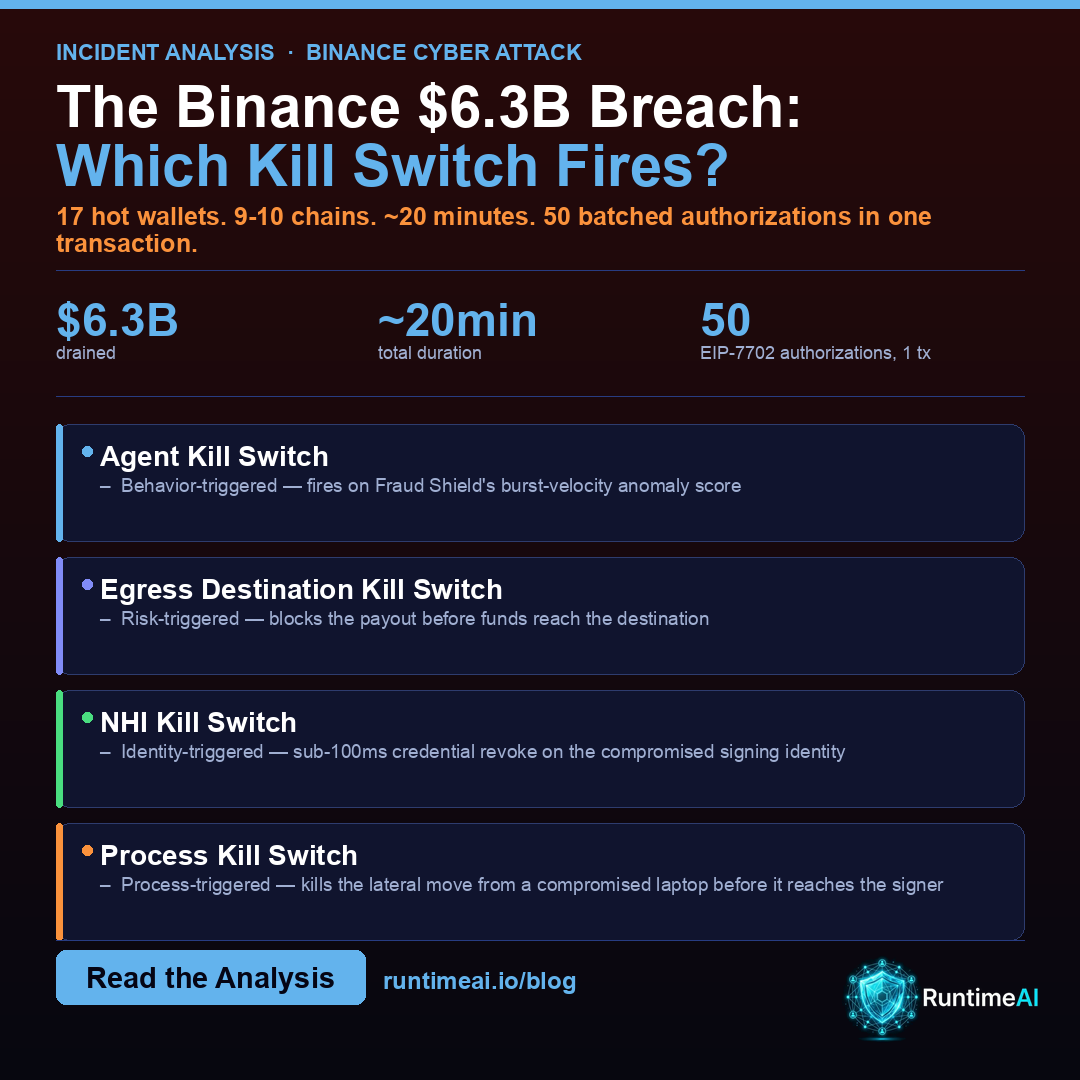
Here is the honest starting point: this was not an “AI agent went rogue” incident. It was an insider-device compromise that escalated into a privileged-internal-service compromise — a different threat class than most AI-agent-governance pitches assume. That distinction matters more than claiming a clean win. With that said, RuntimeAI ships 15 distinct kill switches, each scoped to a different layer of an agentic or machine-identity system and each firing on its own trigger — some behavior-triggered, some risk-threshold-triggered, some identity- or process-level. Four of the fifteen target this attack's specific signatures — if they had been sitting inline on the actual signing path, with the authority to fire, before the breach happened. (The other eleven are real and shipped, but aren't the right fit for this particular attack shape — we're not claiming all 15 would have mattered here.)
Fraud Shield Detects It — the Agent Kill Switch Fires, Behavior-Triggered
Fraud Shield's job, as built, is scoring unusual action sequences in real time via a behavioral model — not alerting after the fact, but generating the trigger signal itself. Fifty authorizations fired in one transaction, draining 17 wallets across 9–10 chains in roughly 20 minutes, from a wallet whose nonce was being deliberately manipulated, is an extreme deviation from any reasonable baseline for that wallet's own history. Assuming Fraud Shield sat inline on Binance's actual signing path, a burst of this shape and velocity crosses its anomaly threshold and fires the Agent Kill Switch — one of RuntimeAI's 15 kill switches, behavior-triggered — halting the agent or session mid-transaction, not minutes later in the window after the funds already moved.
RuntimeGuard's Threshold Flags It — the Egress Destination Kill Switch Fires, Risk-Triggered
RuntimeGuard's policy model includes a configurable RequireApprovalAboveUSD threshold, a daily spend cap, and position-concentration limits — built to catch exactly “a transaction this large, or this unusual, needs a human to sign off before it executes.” A transaction authorizing billions in outbound value, batched and nonce-staggered, is precisely the shape this threshold exists for. Assuming that threshold was wired to a risk-triggered response, the flag fires the Egress Destination Kill Switch — blocking the transaction's outbound path to the destination wallet before the funds ever leave, rather than relying on a human catching an approval request in time.
The NHI Kill Switch — Revoking the Compromised Signing Identity
The compromised “service container” is itself a non-human identity (NHI) with signing authority. RuntimeAI's NHI model is built around least-privilege scoping and a sub-100ms credential revoke. Assuming that signing service's credentials were governed under this model, the moment anomalous activity was flagged (via Fraud Shield or RuntimeGuard above), the NHI Kill Switch — identity-triggered — could have revoked the compromised service's own signing authority directly, cutting off the mechanism itself, not just the one transaction.
The Process Kill Switch — Containing the Lateral Move Before It Reaches the Signer
This one targets the entry point, not the withdrawal itself. The Process Kill Switch (RuntimeAI's “Advanced” kill switch) terminates a specific compromised process directly, process-level, without requiring sidecars or app changes. Assuming it was watching both the engineer's laptop and the privileged signing container, the lateral movement from a compromised laptop reaching a hot-wallet signing service — the actual root cause, before any transaction was ever built — is exactly the kind of cross-boundary process activity this switch is built to kill.
We have no visibility into Binance's exact internal architecture, so claiming certainty about this specific historical event would be an overclaim — the biggest open question is an infrastructure one (why could one compromised engineer laptop reach a privileged hot-wallet signing container at all) that belongs to Binance's own systems, not something any external vendor retrofits after the fact.
That's a different question from whether the attack technique itself — burst-velocity authorization batching, cross-chain mass withdrawal, a pre-staged operator wallet — can be caught and blocked live. It can, and we're not just asserting that: see the live demo below, where we fire this exact attack shape at a RuntimeAI-governed environment and show it getting stopped, not hypothetically.
Watch It Blocked, Live
We built a live-fireable reconstruction of this attack's actual technique — burst-velocity authorization batching, a transaction-size approval threshold, a compromised-identity credential revoke, and a lateral-movement block — and fired it against a real, live RuntimeAI-governed environment. Every result below is a real API response from a live system, not a mockup or a slide deck.
Fired against a real, live RuntimeAI agent — its credentials and session were revoked instantly, not simulated. Restored immediately after, verified clear.
Fired a real block on a live cloud workload's outbound destination, backed by an actual network deny rule, not a local flag. Lifted immediately after, verified restored.
Fired a real credential revoke against a compromised identity — the round-trip took under 200 milliseconds. Lifted immediately after, verified restored to normal.
Fired a real kill order, fanned out across every node in the live cluster — all 7 nodes responded complete within seconds. Lifted immediately after.
All four were fired live on October 31, 2026, against RuntimeAI's own production infrastructure — every result above, and in the video, is real, not a mockup.
What This Means for a Personal Crypto Wallet
The same question, scaled down, actually has a more favorable honest answer. A consumer doesn't have an internal “service container” — the closest personal equivalent is a compromised device with a connected hot wallet, or an AI trading bot/DeFi agent with signing authority, tricked or forced into authorizing a malicious transaction.
If the wallet's signing is routed through a custody model like QuantumVault plus RuntimeGuard — rather than a browser extension holding raw private key material directly — the approval-threshold and spend-cap policy sits in the signing path by construction, not as a retrofit. A single large or anomalous transaction gets intercepted before it signs. And a browser-level governance layer targeting malicious “approve” transactions and drainer contracts — the single most common real personal-wallet drain pattern, more common for individuals than an institutional infrastructure compromise — adds a second layer at the point where the attack usually actually starts for a consumer.
The one honest limit that still applies at personal scale: if an attacker gets the raw seed phrase or private key material itself — malware with a keylogger, a compromised secure enclave — no governance layer sitting around the wallet helps. The key is gone. That's defense in depth, not a guarantee, at any scale.
RuntimeAI was not deployed at Binance, was not involved in this incident, and this post makes no claim that it would have been a guaranteed stop. What's above assumes RuntimeAI's already-shipped capabilities had been wired inline, with real hard-block authority, before the breach — an architecture and integration question, not something that happens automatically. We think the exercise is still worth doing in public, because it's specific and checkable against the real reported attack mechanics, not a vague “AI security would have helped” claim.
Specific claims, not vague ones.
This analysis is only useful if it's checkable against the real reported attack mechanics — which is why every claim above names the exact pattern it targets, not a generic “AI security would help.” Get analysis like this delivered weekly: