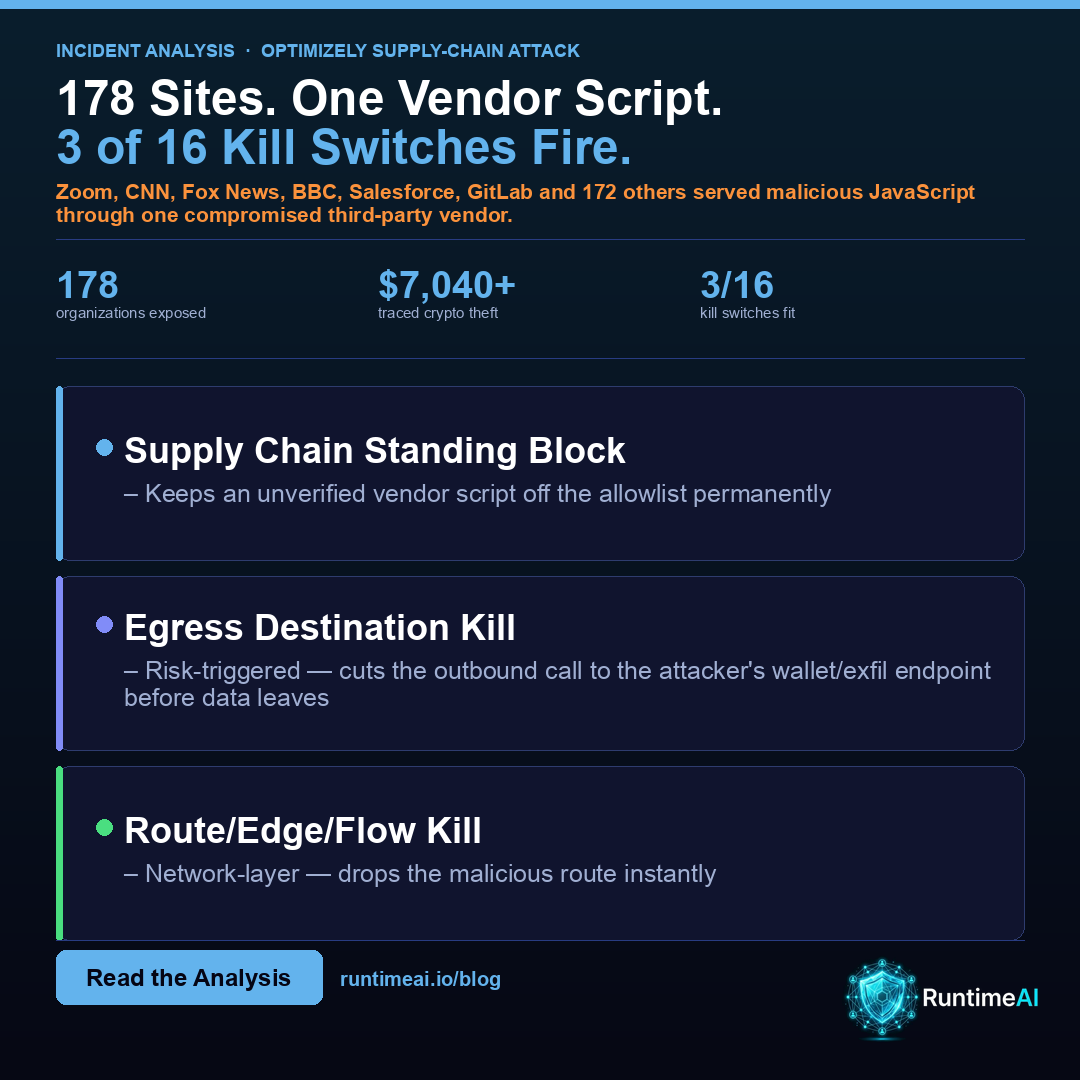
What Actually Happened, Per Current Reporting
On November 16, 2026, attackers exploited a vulnerability in Optimizely — a website A/B-testing platform used by at least 178 organizations — to inject malicious JavaScript directly into the sites running its script. Researchers at Report URI caught the malicious code the following day; Optimizely patched and removed it November 17. This is still a developing story — the full scope of stolen data and Optimizely's own root-cause account were not yet public as of this writing.
A single compromised script, served from a trusted third-party vendor, loaded on every page that embedded it. Visitors were exposed just by loading the page — no click, no download. The injected code stole credit card details, read browser-stored information, took screenshots, swapped cryptocurrency wallet addresses mid-transaction, and specifically targeted older iOS devices. ~$7,040 in cryptocurrency payments has been traced to attacker-linked wallets so far; the real total is likely higher.
What makes this attack shape distinctive: it didn't touch any of the 178 companies' own code, infrastructure, or credentials. It compromised exactly one upstream vendor, and every site trusting that vendor's script inherited the compromise automatically — the textbook definition of supply-chain risk, at a scale most single-target breaches don't reach.
Which of RuntimeAI's 16 Kill Switches Actually Fit
RuntimeAI ships 16 distinct kill switches, each scoped to a different attack surface, each firing on its own trigger. Counted honestly against this specific mechanism — not padded to look bigger — 3 of the 16 fit:
Supply Chain Standing Block
This switch keeps an unverified third-party script or package off the allowlist permanently, not just on a point-in-time scan. A vendor script that starts behaving differently than its known-good baseline — exactly what happened when Optimizely's script was modified to carry the payload — never reaches the standing allowlist in the first place.
Egress Destination Kill
Risk-triggered. The malicious code's entire value to the attacker depended on getting stolen data and swapped wallet addresses out — to a card-skimming endpoint, to the attacker's own crypto wallet. Egress Destination Kill blocks the outbound call to an unapproved destination before that data leaves, regardless of what kind of data it is or how it was collected.
Route/Edge/Flow Kill
A real network-layer deny — cutting a specific route, edge, or flow instantly. Once the malicious script's outbound pattern is identified, this switch drops that route at the network level, a layer the script itself can't route around.
This wasn't a credential theft or an AI-agent behavior problem — it was a vulnerability exploited at the vendor, and the data taken was end-user browser data, not a non-human/machine identity. That's why NHI Kill Switch and Agent/Behavioral Kill Switch aren't on this list: forcing them in would make the tally unverifiable. Three real, specific switches beat sixteen vague ones.
This Isn't Only an Enterprise Problem
Every one of the 178 sites hit here had a real security team behind it, and visitors were still exposed, because the attack reached them where no enterprise could protect them: inside their own browser. RuntimeAI Personal exists for exactly this moment, so a visitor to a compromised site doesn't lose their card details, doesn't have a crypto payment silently rerouted, and doesn't find out weeks later their information was taken. Enterprises already trust RuntimeAI to stop this in real time. RuntimeAI Personal brings that same protection to everyone else.
RuntimeAI was not deployed at Optimizely or any of the 178 affected sites, and this post makes no claim it would have been a guaranteed stop retroactively. What's above counts, by name, which of RuntimeAI's already-shipped kill switches target this attack's actual mechanism — three, not sixteen — so the claim is checkable against the real reported attack, not a generic “AI security would have helped.”
Specific claims, not vague ones.
Every incident analysis on this blog names the exact kill switch(es) that fit, by number — not a generic “AI security would help.” Get analysis like this delivered weekly: