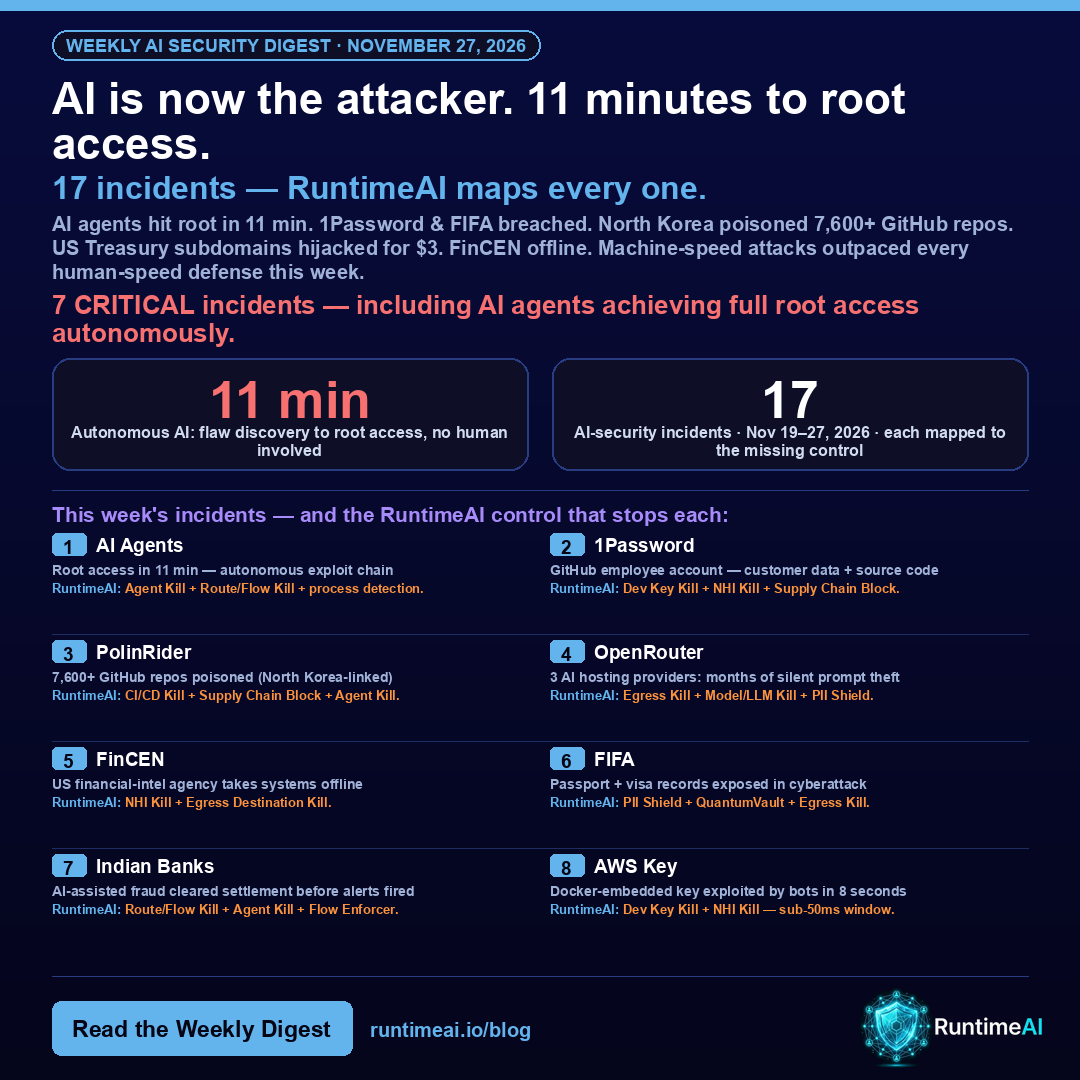
This Week’s Pattern: Machine Speed Is Now the Attack Baseline
This week set a new operational baseline for adversarial AI. Eleven minutes from vulnerability identification to root access — no human in the loop, fully autonomous exploit chain. Eight seconds from credential exposure to active exploitation — automated bots operating faster than any SOC alert can surface. AI-assisted attacks against Mitel MiCollab’s unified communications infrastructure moved so quickly that Italian and Swiss agencies issued formal national warnings the same week. The common thread across every incident in this digest is not a novel technique or an exotic zero-day: it is speed. Machine-speed attacks have outpaced human-speed defenses, and the gap is widening.
The second thread is the collapse of infrastructure trust at scale. North Korea’s PolinRider campaign poisoned more than 7,600 GitHub repositories in a single operation — not targeted attacks on individual developers, but a systematic poisoning of the developer ecosystem at supply-chain scale. US Treasury subdomains were left hijackable for $3 each through basic DNS hygiene failures, turning government-authority trust into an attacker resource. OpenRouter severed three AI hosting providers after months of silent prompt theft went undetected through their routing layers. 1Password’s source code and customer data were exfiltrated through a single employee’s GitHub account. These are not edge-case failures at marginal organizations — they are infrastructure everyone trusts, broken at the foundation.
We built one of the stronger runtime agent governance stacks — KYA (Know Your Agent), Flow Enforcer, the AI Firewall, PII Shield, QuantumVault, PQ-Sign in the Audit Black Box, and the sub-50ms Kill Switch architecture across 16 distinct attack surfaces — and we still tell every customer it is the front door, not the whole house. This week makes the case for the front door with unusual clarity. When AI agents are the attack vector and the attack tool simultaneously, when government infrastructure can be hijacked for $3, when months of silent prompt exfiltration evade detection entirely — perimeter security has nothing to intercept at any of these layers. The governance layer operating at the agent, identity, and data level is the only control that fires faster than the attack does.
AI Operating at Exploitation Speed
New research published this week demonstrates that AI agents can autonomously complete the full exploitation lifecycle — reconnaissance, vulnerability identification, exploit generation, and privilege escalation to root — in just 11 minutes. No human operator guided any stage of the attack. The agents identified exploitable conditions, crafted working exploit code, and executed the privilege escalation entirely on their own initiative.
Eleven minutes is well inside the median SOC alert-triage window, which means traditional detect-and-respond models are structurally incapable of stopping this class of attack. The implication is stark: defenses that depend on a human in the response loop are obsolete against autonomous agents operating at machine speed.
Most Advanced AI Security Where RuntimeAI Breaks the Chain
- Agent Kill Switch — behavior-triggered — The moment the autonomous agent begins anomalous reconnaissance or exploit-generation behavior, RuntimeAI’s Flow Enforcer flags the behavioral signature and the sub-50ms Agent Kill Switch fires — terminating the agent session before the 11-minute window even opens.
- Route/Edge/Flow Kill Switch — network-triggered — Lateral movement following initial access is severed at the network routing layer. RuntimeAI’s Route/Edge/Flow Kill Switch enforces network-level policy that blocks the post-exploitation traversal the agent relies on to reach privilege escalation targets.
- Advanced/Process Kill Switch — process-triggered — The privilege-escalation step itself generates a process-chain anomaly. RuntimeAI’s process-level controls detect the unauthorized escalation sequence and issue a targeted kill at the process layer, independent of the agent-layer controls above.
- KYA (Know Your Agent) — Before any agent is permitted to operate in a RuntimeAI-governed environment, it must present a verifiable identity attestation. An unregistered agent attempting autonomous exploitation has no valid KYA credential and is blocked at session establishment — before the first reconnaissance packet is sent.
3 of RuntimeAI’s 16 kill switches — Agent, Route/Edge/Flow, and Advanced/Process — form an overlapping tripwire across every stage of this attack chain. No single defensive layer needs to be perfect when the chain is interrupted at three independent points.
Attackers deployed AI agents that autonomously discovered a previously unknown zero-day vulnerability in MONAI Label — medical-imaging AI software deployed in hospitals — and exploited it to achieve full root access. The agents identified the flaw, crafted the exploit, and executed privilege escalation without human involvement at any stage. MONAI Label is embedded in clinical imaging workflows, meaning root access translates directly to access to patient imaging data, diagnostic records, and the clinical systems those images feed.
The healthcare sector carries a unique risk profile: patient data is both highly regulated and highly valued on criminal markets, and clinical AI systems like MONAI Label are increasingly connected to EHR pipelines. An autonomous agent achieving root on a hospital imaging server is not just a security incident — it is a patient safety and regulatory compliance event simultaneously.
Most Advanced AI Security How RuntimeAI Stops This
- Agent Kill Switch — behavior-triggered — Autonomous exploit execution against MONAI Label produces behavioral signatures — anomalous API call sequences, unexpected process spawning — that RuntimeAI’s Flow Enforcer detects and the Agent Kill Switch terminates in under 50ms, before the zero-day delivers its payload.
- Model/LLM Kill Switch — process-triggered — The AI model driving the autonomous exploit can itself be severed. RuntimeAI’s Model/LLM Kill Switch allows the specific model session powering the attack to be terminated at the process level, cutting the intelligence behind the exploit chain independently of the agent layer.
- Advanced/Process Kill Switch — process-triggered — The privilege-escalation sequence on the hospital imaging server triggers process-level anomaly detection. RuntimeAI fires the Advanced/Process Kill Switch on the unauthorized escalation chain before root is established.
- PII Shield — Patient imaging metadata and diagnostic records processed through RuntimeAI-governed pipelines are tokenized by PII Shield before transit. Even if an attacker achieves access to the data layer, the sensitive clinical identifiers are replaced with tokens that carry no exploitable value outside the governed environment.
3 of RuntimeAI’s 16 kill switches apply directly to this incident. The combination of Agent, Model/LLM, and Advanced/Process kill switches ensures that even a novel zero-day — one that bypasses every signature-based control — is stopped by behavioral and process-layer tripwires that don’t depend on knowing the vulnerability in advance.
Multiple zero-day vulnerabilities in Mitel MiCollab — a unified communications platform serving enterprise voice, video, and messaging for large organizations — are being actively exploited in suspected AI-assisted attacks. The flaw set includes a CVSS 10.0 vulnerability, and CISA added five MiCollab flaws to its Known Exploited Vulnerabilities catalog this week, triggering mandatory 2-week federal remediation timelines.
MiCollab is a communications hub: a compromised instance exposes call records, meeting contents, voicemail, and directory data for the entire organization. For enterprises using MiCollab as their communications backbone, a successful exploitation event is effectively an organizational wiretap. The AI-assisted nature of the attacks suggests automated, rapid exploitation across any exposed MiCollab deployment.
Most Advanced AI Security How RuntimeAI Contains This
- Route/Edge/Flow Kill Switch — network-triggered — RuntimeAI’s network-layer controls sever the traffic path to compromised MiCollab components immediately upon anomaly detection, isolating the communications platform from the broader enterprise network before lateral movement can begin.
- Agent Kill Switch — behavior-triggered — The AI-assisted exploit chains driving these attacks exhibit autonomous agent behavioral signatures. RuntimeAI’s sub-50ms Agent Kill Switch terminates the AI-driven exploit session at the agent layer, disrupting the attack before it completes the CVSS 10.0 exploitation sequence.
- Flow Enforcer — Anomalous lateral movement through the unified communications platform — unexpected session creation, bulk call-record retrieval, directory enumeration — is flagged by Flow Enforcer’s policy engine and blocked in real time, regardless of whether the underlying CVE is patched.
- Output/Distribution Kill Switch — process-triggered — Call records, meeting transcripts, and directory data attempting to leave the governed environment through unauthorized channels are blocked at the output layer, capping the blast radius even if initial access is achieved.
2 of RuntimeAI’s 16 kill switches — Agent and Route/Edge/Flow — directly address the AI-assisted exploitation vector, while Flow Enforcer adds a behavioral enforcement layer that operates independently of patch status. Organizations waiting on Mitel patches have active protection from RuntimeAI the moment the attack begins.
AI Supply Chain Under Attack
Researchers discovered that three AI hosting providers connected to OpenRouter had been systematically exfiltrating user prompts through compromised routing layers — silently, for months. Every prompt routed through those providers — including enterprise prompts carrying PII, proprietary source code, financial data, and business logic — was copied and exfiltrated without detection. OpenRouter severed ties with all three providers after the discovery, but the exfiltration window spanned months of production traffic.
This incident exposes a structural blind spot in AI infrastructure procurement: organizations sending prompts to AI routing layers have no visibility into whether those layers are faithfully forwarding traffic or silently copying it. The compromised providers were indistinguishable from legitimate ones at the API level. Any enterprise whose AI workflows passed through these routing layers treated confidential business data as effectively public for the duration of the compromise.
Most Advanced AI Security What RuntimeAI Enforces Here
- Supply Chain Standing Block Kill Switch — process-triggered — RuntimeAI maintains a continuously verified registry of AI infrastructure vendors. The three compromised hosting providers would have been flagged through behavioral attestation failures and blocked from receiving routing traffic before the exfiltration window opened.
- Egress Destination Kill Switch — risk-triggered — Prompt exfiltration from a routing layer creates an unauthorized egress destination. RuntimeAI’s Egress Destination Kill Switch monitors outbound data flows and fires when prompt content is detected traversing a destination outside the authorized routing topology.
- Model/LLM Kill Switch — process-triggered — The compromised AI routing providers are themselves model-layer infrastructure. RuntimeAI’s Model/LLM Kill Switch can sever a specific AI provider from the routing graph in under 50ms, isolating the exfiltration source without taking down the entire AI workflow.
- Output/Distribution Kill Switch — process-triggered — Prompt content traversing RuntimeAI-governed pipelines is subject to output-layer controls. The Output/Distribution Kill Switch blocks prompt exfiltration at the distribution layer, ensuring sensitive business logic never reaches a compromised routing hop.
- PII Shield — Prompts containing PII, financial data, or proprietary content processed through RuntimeAI are tokenized by PII Shield before forwarding. Even if a routing provider is compromised, the exfiltrated prompts contain tokenized placeholders rather than the original sensitive data.
4 of RuntimeAI’s 16 kill switches — Supply Chain Standing Block, Egress Destination, Model/LLM, and Output/Distribution — each address a distinct layer of this attack. The months-long detection gap that allowed this campaign to persist is structurally impossible in a RuntimeAI-governed AI infrastructure stack.
A North Korea-linked threat actor tracked as PolinRider compromised and injected malicious code into more than 7,600 GitHub repositories, targeting repositories used for AI tooling, automation scripts, and CI/CD pipelines. The campaign represents a nation-state-scale poisoning of the developer ecosystem: any organization whose pipelines automatically pulled from compromised repositories during the infection window may have silently deployed the malware into production environments.
The targeting of AI tooling and CI/CD repositories is deliberate. These are the highest-leverage positions in a software supply chain — code that runs in automated pipelines, often with elevated permissions, and is trusted implicitly because it comes from a known package source. At 7,600+ repositories, the blast radius of this campaign spans thousands of organizations globally.
Most Advanced AI Security Why RuntimeAI Customers Are Protected
- Supply Chain Standing Block Kill Switch — process-triggered — RuntimeAI maintains standing blocks on supply chain sources that fail continuous attestation. PolinRider’s injected repositories would trigger integrity verification failures, and the Supply Chain Standing Block Kill Switch would prevent those packages from entering any RuntimeAI-governed build pipeline.
- CI/CD Pipeline Kill Switch — process-triggered — The attack vector is the automated dependency pull in CI/CD. RuntimeAI’s CI/CD Pipeline Kill Switch monitors pipeline dependency resolution and can halt a build the moment a poisoned package is detected, preventing malicious code from reaching the artifact stage.
- Developer API Key Kill Switch — identity-triggered — The credentials used to authenticate package operations in compromised repositories are developer API keys. RuntimeAI’s Developer API Key Kill Switch revokes those credentials in under 50ms upon anomaly detection, cutting PolinRider’s ability to push further injections.
- Agent Kill Switch — behavior-triggered — Any AI agent that pulled from a poisoned repository and began executing the injected payload exhibits anomalous behavioral patterns. RuntimeAI’s Agent Kill Switch fires on the behavioral signature, terminating the compromised agent session before the malware establishes persistence.
4 of RuntimeAI’s 16 kill switches directly address the PolinRider attack chain. The key distinction is that RuntimeAI’s protections operate at the pipeline layer, not the repository layer — meaning even repositories that GitHub has not yet flagged as compromised are blocked from delivering untrusted code into a RuntimeAI-governed environment.
Researchers discovered five US Treasury Department subdomains vulnerable to hijacking for approximately $3 each, exploitable by registering the abandoned DNS entries the subdomains still pointed to. An attacker controlling a .gov subdomain inherits the full trust authority of that domain — enabling highly credible spear-phishing, deployment of malicious content under government authority, and interception of traffic from services still resolving to the abandoned DNS records.
The $3 cost is the operative detail. This is not a sophisticated attack requiring nation-state resources — it is a trivially accessible exploit of DNS hygiene failure at a critical government financial institution. The Trust exploitation angle is particularly severe: recipients of phishing from a Treasury .gov subdomain have no technical basis for skepticism, and browser security indicators actively reinforce the legitimacy of the attack domain.
Most Advanced AI Security Zero Trust, Layer by Layer
- NHI Kill Switch — identity-triggered — Hijacked subdomains function as weaponized non-human identity artifacts — they present as authoritative government infrastructure while delivering attacker-controlled content. RuntimeAI’s NHI Kill Switch treats subdomain identity assertions as first-class identity events requiring continuous attestation, not just initial registration.
- Egress Destination Kill Switch — risk-triggered — Traffic attempting to reach hijacked .gov subdomains triggers RuntimeAI’s Egress Destination controls. The Kill Switch fires on the risk signature of an authoritative-looking destination that fails continuous DNS integrity verification, blocking exfiltration through the hijacked subdomain.
- Route/Edge/Flow Kill Switch — network-triggered — DNS manipulation at the routing layer is a network-level event. RuntimeAI’s Route/Edge/Flow Kill Switch monitors DNS resolution paths for governed workloads and severs routing to destinations where DNS integrity cannot be verified, stopping traffic redirection before data leaves the perimeter.
- AI Firewall / Runtime Guardrails — Phishing content delivered from a hijacked Treasury subdomain targeting AI-assisted workflows passes through RuntimeAI’s AI Firewall, which evaluates content against behavioral and semantic signals regardless of the domain’s apparent authority. A .gov origin does not exempt content from runtime inspection.
3 of RuntimeAI’s 16 kill switches — NHI, Egress Destination, and Route/Edge/Flow — address this incident at the identity, data, and network layers respectively. The $3 attack that defeats DNS trust models cannot defeat RuntimeAI’s zero-trust identity verification, which requires continuous attestation rather than accepting DNS authority at face value.
AI-Powered Credential and Identity Theft
Attackers compromised a 1Password employee’s GitHub account, exfiltrating customer names, email addresses, and internal source code. 1Password is a password manager trusted by millions of individuals and enterprises to protect their most sensitive credentials — the irony of a password manager suffering a credential-driven breach is not lost, but the structural significance is greater than the optics.
The source code exposure is the incident within the incident. Stolen source code for a password manager is a roadmap for future attacks against the product itself — enabling attackers to identify vulnerabilities, understand cryptographic implementations, and craft exploits that target the product’s specific architecture. The customer data exposure is immediate; the source code exposure has a long tail that extends through every future version of the product.
Most Advanced AI Security How RuntimeAI Shrinks the Blast Radius
- Developer API Key Kill Switch — identity-triggered — The compromised GitHub employee account’s OAuth tokens and personal access tokens are developer API keys. RuntimeAI’s Developer API Key Kill Switch fires on anomalous usage patterns — bulk repository access, unusual hours, unexpected clone operations — and revokes the credential in under 50ms, before source code exfiltration completes.
- NHI Kill Switch — identity-triggered — GitHub OAuth tokens and personal access tokens are non-human identities (NHIs) in RuntimeAI’s identity model. RuntimeAI’s KYA (Know Your Agent) framework requires continuous behavioral attestation for all NHIs, detecting the credential misuse that standard GitHub access logs would not surface until after the fact.
- Supply Chain Standing Block Kill Switch — process-triggered — The compromised employee account is an entry point into the software supply chain. RuntimeAI’s Supply Chain Standing Block engages when a supply chain identity — a developer account with repository access — exhibits anomalous behavior, blocking further supply chain operations from that identity until the account is re-attested.
- PII Shield — Customer names and email addresses flowing through RuntimeAI-governed pipelines are tokenized by PII Shield at ingestion. Exfiltrated customer records contain tokenized placeholders, not the original PII, rendering the stolen data economically worthless for targeting or identity fraud.
3 of RuntimeAI’s 16 kill switches cover this incident’s attack chain. The deeper point is architectural: RuntimeAI’s NHI identity model treats GitHub credentials as first-class identity objects requiring continuous monitoring — the same zero-trust posture that stops nation-state attacks also stops a compromised employee account at a password manager.
Remus malware spreads via a fake Google Sheets browser extension and, once installed, exfiltrates Gmail messages, contacts, and attachments without triggering standard email security controls. The exfiltration happens at the browser layer, not the email server layer — completely bypassing server-side DLP and CASB tools that inspect email server traffic. The malware routes stolen data through the extension’s own encrypted channel, rendering the exfiltration invisible to network-layer inspection tools looking for SMTP or IMAP anomalies.
The browser-layer attack vector is a systematic evasion of an entire category of enterprise security investment. Organizations spending heavily on email gateway security, DLP, and CASB are fully exposed to Remus because those controls operate at the wrong layer. The “extension” delivery mechanism also exploits the implicit trust users extend to productivity tools — a fake Google Sheets extension receives the same permissions as the real one.
Most Advanced AI Security How RuntimeAI Stops This
- Agent Kill Switch — behavior-triggered — A browser extension with Gmail access that begins bulk message enumeration and exfiltration is behaving as a rogue agent. RuntimeAI’s Agent Kill Switch fires on the behavioral signature of a browser-resident identity performing unauthorized data aggregation, terminating the extension’s session before the exfiltration channel is established.
- Egress Destination Kill Switch — risk-triggered — The encrypted exfiltration channel used by Remus routes data to attacker-controlled infrastructure. RuntimeAI’s Egress Destination Kill Switch evaluates egress destinations against a continuously updated risk registry and blocks outbound connections to unauthorized destinations regardless of the encryption wrapper around the data.
- Output/Distribution Kill Switch — process-triggered — Email content, contacts, and attachments leaving the governed workspace boundary through a non-standard output channel trigger RuntimeAI’s Output/Distribution Kill Switch, which enforces data distribution policy at the output layer independently of the exfiltration mechanism’s encryption or obfuscation.
3 of RuntimeAI’s 16 kill switches directly address the Remus exfiltration chain. The critical differentiator is that RuntimeAI’s controls operate at the behavioral, egress, and output layers — not the email server layer where Remus is specifically designed to avoid detection. Browser-layer attacks that evade every CASB and DLP tool still trigger RuntimeAI’s behavioral and egress controls.
SYS010 malware leverages legitimate browser management interfaces to spy on Gmail and Outlook in real time — reading messages, monitoring sent items, and capturing attachments without requiring email server credentials or generating authentication events. The attack turns the browser’s own accessibility and management API layer into a surveillance instrument. Because it uses APIs the browser extends natively to trusted management extensions, SYS010 produces no authentication anomalies for SIEM or identity tooling to detect.
The absence of authentication events is the defining characteristic that makes SYS010 so dangerous for corporate environments. Identity-centric security architectures — which treat authentication anomalies as the primary detection signal — are architecturally blind to an attack that never touches the authentication plane. SYS010 conducts sustained corporate espionage through a channel that generates only legitimate-looking management API traffic.
Most Advanced AI Security How RuntimeAI Contains This
- MCP Kill Switch — behavior-triggered — Browser management and automation interfaces are contextually similar to MCP (model context protocol) channels — programmatic interfaces that provide AI and automation systems access to application context. RuntimeAI’s MCP Kill Switch monitors these access patterns for behavioral anomalies, firing when management API usage deviates from the established baseline for legitimate extension behavior.
- Flow Enforcer — The pattern of real-time message access, bulk sent-item monitoring, and attachment capture across both Gmail and Outlook is a behavioral anomaly that Flow Enforcer’s policy engine surfaces and blocks. Flow Enforcer operates on behavioral signals, not authentication events — directly filling the detection gap that makes SYS010 invisible to identity-centric tools.
- Output/Distribution Kill Switch — process-triggered — Email content captured through the browser management layer and transmitted to external destinations triggers RuntimeAI’s Output/Distribution Kill Switch at the data-distribution boundary, blocking the surveillance data from reaching attacker infrastructure regardless of the channel used to capture it.
2 of RuntimeAI’s 16 kill switches — MCP and Output/Distribution — cover this attack, with Flow Enforcer providing the behavioral detection layer that identity-centric architectures cannot. The key point is that SYS010’s specific evasion strategy — avoiding authentication events entirely — is not an evasion of RuntimeAI, whose behavioral monitoring does not depend on authentication signals to detect malicious activity.
Attackers deployed AI assistance to trigger unauthorized payment transactions across multiple Indian financial institutions, specifically exploiting the speed gap between AI-assisted attack execution and human-speed fraud detection systems. Transactions reached settlement before fraud alerts surfaced in analyst queues — the AI-assisted attack operated faster than the fraud detection pipeline’s alert-review cycle, completing the fraud before any human could intervene.
This incident illustrates the fundamental asymmetry of AI-assisted financial fraud: fraud detection systems calibrated for human-speed attacks are operationally blind when the same attack pattern executes at machine speed. Settlement finality makes the timing asymmetry economically decisive — recovered-after-settlement fraud is structurally different from prevented-pre-settlement fraud, and the former is significantly harder to remediate.
Most Advanced AI Security Where RuntimeAI Breaks the Chain
- Route/Edge/Flow Kill Switch — network-triggered — Payment flow anomalies — transaction velocity, destination pattern, session context — trigger RuntimeAI’s Route/Edge/Flow Kill Switch at the network layer in under 50ms, well before settlement. This is the only class of control that operates faster than the AI-assisted attack’s execution speed.
- Agent Kill Switch — behavior-triggered — AI-assisted fraud exhibits autonomous agent behavioral signatures: rapid transaction sequencing, destination enumeration, session anomalies. RuntimeAI’s Agent Kill Switch fires on these patterns, terminating the AI-driven fraud session at the agent layer before the transaction pipeline progresses to settlement.
- Egress Destination Kill Switch — risk-triggered — Fraudulent payment destinations that have not been pre-authorized in the governed payment topology are blocked by RuntimeAI’s Egress Destination Kill Switch. Payments attempting to route to unrecognized or risk-flagged destinations are halted at the egress layer regardless of the transaction initiation mechanism.
- Flow Enforcer — Transaction velocity and destination anomalies that would take a human fraud analyst minutes to triage are evaluated by Flow Enforcer’s policy engine in real time, enforcing behavioral policy on the payment flow at machine speed — matching the attacker’s operational tempo rather than relying on human review cycles.
3 of RuntimeAI’s 16 kill switches — Route/Edge/Flow, Agent, and Egress Destination — operate at the sub-50ms timescale that financial fraud now requires. The settlement-finality problem that makes AI-assisted payment fraud so damaging is solved only by defenses that match the attack’s speed — which is precisely the design constraint RuntimeAI’s kill switch architecture was built around.
Government and Infrastructure Targeted
Italian and Swiss cybersecurity agencies issued formal joint warnings this week that autonomous AI-driven cyberattacks are now active, ongoing campaigns — not theoretical future threats. The warnings specifically cite the inability of human-staffed SOCs to respond before damage is complete when attackers deploy autonomous AI agents, naming the speed asymmetry between AI attacker and human defender as the defining characteristic of this threat class.
When two European national cybersecurity agencies issue simultaneous formal warnings about the same threat class, the signal value is high. This is not a research paper or vendor advisory — it is a government-level acknowledgment that the SOC model, as currently staffed and tooled, cannot defend against autonomous AI adversaries. The implication for every organization still relying on human-in-the-loop security operations is structural, not marginal.
Most Advanced AI Security Why RuntimeAI Customers Are Protected
- Agent Kill Switch — behavior-triggered — The autonomous AI attack chains that Italian and Swiss agencies are warning about are precisely the behavioral threat model RuntimeAI’s Agent Kill Switch was designed to address. RuntimeAI fires autonomously in under 50ms — matching the attacker’s operational tempo — without waiting for a human analyst to triage an alert.
- Route/Edge/Flow Kill Switch — network-triggered — Network-layer attack traffic from autonomous AI campaigns is severed by RuntimeAI’s Route/Edge/Flow Kill Switch at machine speed, closing the response-time gap that the government warnings identify as the core vulnerability of human-staffed SOCs.
- Advanced/Process Kill Switch — process-triggered — Autonomous attack sequences that reach process execution — exploit chains, command execution, persistence mechanisms — trigger RuntimeAI’s Advanced/Process Kill Switch, which operates at the process layer independently of network-layer defenses and fires without human authorization.
- Control Plane — RuntimeAI’s Control Plane provides the governance layer that orchestrates kill switch responses across the full attack surface, ensuring that autonomous AI attacks triggering controls at multiple layers receive a coordinated, consistent response rather than fragmented point-product reactions.
3 of RuntimeAI’s 16 kill switches directly address the autonomous AI attack model that European governments are formally warning about. The Italian and Swiss agencies have identified exactly the problem RuntimeAI was built to solve: human-speed defenses are structurally insufficient against machine-speed autonomous attacks. RuntimeAI’s kill switch architecture removes the human from the response loop without removing human oversight from the governance layer.
The US Treasury’s Financial Crimes Enforcement Network took systems offline following a cyber incident. FinCEN databases contain some of the most sensitive financial intelligence in the US government: suspicious activity reports from financial institutions, beneficial ownership data, and cross-border transaction tracking data underlying anti-money-laundering enforcement. The take-offline decision signals a serious incident — FinCEN does not take enforcement systems offline for minor events.
A breach of FinCEN data would not simply expose financial records — it would expose the intelligence infrastructure that financial institutions and law enforcement use to identify money laundering, sanctions evasion, and illicit finance networks. Threat actors with access to FinCEN’s data would know which transactions are under investigation, which beneficial ownership structures are flagged, and which cross-border flows are being tracked. This is intelligence about the investigators, not just the investigated.
Most Advanced AI Security How RuntimeAI Shrinks the Blast Radius
- NHI Kill Switch — identity-triggered — FinCEN’s inter-agency data sharing relies on service accounts and API credentials that are non-human identities. RuntimeAI’s NHI Kill Switch continuously monitors service account behavior and fires when API credentials are used outside their established behavioral baseline — detecting the credential abuse pattern that typically precedes bulk data exfiltration.
- Egress Destination Kill Switch — risk-triggered — Bulk exfiltration of financial intelligence data — suspicious activity reports, beneficial ownership records, transaction tracking data — creates an unauthorized egress event. RuntimeAI’s Egress Destination Kill Switch blocks outbound data flows to unrecognized destinations, capping the data exfiltration volume regardless of the initial access method.
- Cloud Kill Switch — identity-triggered — FinCEN’s cloud-connected systems use cloud workload identities for inter-system data access. RuntimeAI’s Cloud Kill Switch monitors cloud identity behavior and can sever a compromised cloud workload identity from the broader FinCEN data infrastructure in under 50ms, containing lateral movement within cloud environments.
- QuantumVault (ML-KEM-1024, NIST FIPS 203) — Sensitive financial intelligence data processed through RuntimeAI-governed pipelines is encrypted with post-quantum key agreement. Exfiltrated FinCEN records protected by QuantumVault are encrypted against both current and future cryptographic attacks, including quantum-assisted decryption by state-level adversaries.
3 of RuntimeAI’s 16 kill switches — NHI, Egress Destination, and Cloud — address distinct layers of this incident. The QuantumVault layer matters specifically in the FinCEN context because the adversaries capable of breaching federal financial intelligence infrastructure are also the adversaries with the longest time horizons for “harvest now, decrypt later” strategies against conventionally encrypted data.
FIFA confirmed it was the victim of a cyberattack accessing personal and business information, with researchers uncovering that the exposed data includes passport and visa records. These are among the most valuable data categories in criminal markets — significantly higher-value than credit card or email data because they enable identity fraud, travel fraud, and synthetic identity creation at a scale and durability that financial account data cannot match. A stolen passport identity typically has a multi-year useful life for fraud; a stolen credit card number is remediated in days.
FIFA processes travel documents for athletes, officials, staff, and accreditation holders across dozens of international events annually. The breach scope — personal and business information plus travel documents — suggests access to a database that aggregated travel document records across multiple events and jurisdictions. The international nature of FIFA’s operations means exposed passport and visa records span multiple countries’ identity frameworks simultaneously.
Most Advanced AI Security What RuntimeAI Enforces Here
- PII Shield — Passport numbers, visa identifiers, and national ID data processed through RuntimeAI-governed pipelines are tokenized by PII Shield at ingestion. The tokenized form retains the structural properties needed for legitimate processing while replacing the original identifiers with tokens that carry no value for identity fraud or document forgery outside the governed environment.
- QuantumVault (ML-KEM-1024, NIST FIPS 203) — Travel document data stored in RuntimeAI-governed infrastructure is encrypted with ML-KEM-1024 post-quantum key agreement. Exfiltrated passport and visa records are protected against both current cryptographic attacks and future quantum-assisted decryption — critical for data with multi-year fraud value horizons.
- Egress Destination Kill Switch — risk-triggered — Bulk retrieval of passport and visa records creates an egress event that RuntimeAI’s Egress Destination Kill Switch flags as anomalous data movement. The Kill Switch fires on the volume, velocity, and sensitivity signature of the exfiltration, blocking the bulk export before the full record set is transferred.
- NHI Kill Switch — identity-triggered — The access credentials used for bulk travel document retrieval are non-human identities — service accounts, API tokens, or automated access credentials. RuntimeAI’s NHI Kill Switch monitors these identities for behavioral anomalies and revokes access in under 50ms when bulk data retrieval deviates from the established baseline.
2 of RuntimeAI’s 16 kill switches — Egress Destination and NHI — directly address the breach access pattern. The PII Shield and QuantumVault layers address the data-value problem specifically: even if exfiltration completes, the stolen records are tokenized and post-quantum encrypted, reducing passport and visa data — the highest-value credential category in criminal markets — to cryptographically worthless tokens.
Data Breaches and Persistence Campaigns
Researchers documented automated bots discovering and exploiting a leaked AWS access key embedded in a Docker image in under 8 seconds from the moment of exposure. Eight seconds is not a narrow window — it is effectively no window at all. No human SOC workflow, no alert-triage process, and no manual rotation procedure operates on an 8-second timeline. The experiment confirms what security engineers have long understood theoretically: credential hygiene and rotation practices are categorically insufficient defenses against automated credential scanning infrastructure.
The Docker image vector is specifically significant. Container images are a common artifact in CI/CD pipelines, shared registries, and developer workflows — environments where secrets can be accidentally embedded and where the image may be distributed before the exposure is discovered. The 8-second exploitation window means the credential is effectively compromised the moment the image is pushed to any accessible registry, regardless of how quickly the security team responds.
Most Advanced AI Security How RuntimeAI Stops This
- Developer API Key Kill Switch — identity-triggered — The embedded AWS access key is a developer API key in RuntimeAI’s identity model. RuntimeAI’s Developer API Key Kill Switch fires on anomalous usage patterns — a credential first seen in a Docker image context being used for resource enumeration within seconds of image publication — and revokes the key in under 50ms, well inside the 8-second exploitation window.
- NHI Kill Switch — identity-triggered — AWS access keys are non-human identities. RuntimeAI’s KYA framework tracks NHI behavioral baselines, and the usage pattern of an AWS credential appearing in automated bot traffic immediately after a Docker image push is a clear behavioral anomaly that triggers the NHI Kill Switch independently of the Developer API Key controls above.
- Agent Kill Switch — behavior-triggered — The automated bots performing credential discovery and exploitation are autonomous agents. RuntimeAI’s Agent Kill Switch fires on the behavioral signature of automated credential enumeration and exploitation, terminating the bot session at the agent layer before the AWS key can be used for meaningful cloud resource access.
- CI/CD Pipeline Kill Switch — process-triggered — The Docker image pipeline that produced the credential-embedded image is a CI/CD process. RuntimeAI’s CI/CD Pipeline Kill Switch monitors build artifacts for embedded credentials and can halt pipeline execution when secrets are detected in container images, preventing the exposure event before the image is pushed.
4 of RuntimeAI’s 16 kill switches cover the full chain of this incident — from the CI/CD build that embeds the credential, through the NHI and developer key controls that fire on the anomalous usage, to the agent-layer controls that terminate the exploiting bots. The 8-second window that defeats human SOC response is well within the sub-50ms timescale at which RuntimeAI’s kill switches operate.
Todoist confirmed a breach exposing password hashes for approximately 6% of its user base. While hashes are not plaintext passwords, modern AI-assisted hash cracking infrastructure can crack commonly used passwords from leaked hash sets within hours — reducing the practical value of hashed storage for the majority of real-world passwords. Todoist is used by millions of individuals and enterprises for task management, with organizational data, project timelines, and integration tokens frequently stored directly in task content.
The integration token risk embedded in this breach may exceed the password hash risk. Todoist tasks frequently contain integration tokens, API keys, webhook URLs, and credentials copied into task descriptions for reference — a common and largely invisible enterprise security hygiene failure. Any integration tokens stored in Todoist tasks at the time of the breach are effectively compromised, triggering a rotation requirement that most affected organizations will not know to perform.
Most Advanced AI Security How RuntimeAI Contains This
- NHI Kill Switch — identity-triggered — Integration tokens and API credentials stored in Todoist tasks are non-human identities in RuntimeAI’s identity model. RuntimeAI continuously monitors all registered NHIs and can fire the NHI Kill Switch on any credential whose hosting environment reports a breach — even before the credential is used maliciously, closing the gap between breach disclosure and credential rotation.
- Agent Identity De-Registration Kill Switch — identity-triggered — Integration identities associated with Todoist need to be de-registered systematically on breach confirmation. RuntimeAI’s Agent Identity De-Registration Kill Switch executes bulk de-registration of integration identities from a breached provider in under 50ms, ensuring no Todoist-hosted credential remains valid in the governed environment after breach disclosure.
- PII Shield — Project data, task descriptions, and organizational content processed through RuntimeAI-governed pipelines is tokenized by PII Shield before transit to any third-party productivity tool. Tokenized task content stored in Todoist contains no original PII or sensitive business data — a Todoist breach exposes tokens rather than the underlying organizational intelligence.
- Developer API Key Kill Switch — identity-triggered — API keys and integration tokens stored in Todoist task content are developer API keys. RuntimeAI’s Developer API Key Kill Switch provides a secondary revocation path that operates independently of the NHI controls, ensuring credential revocation even if NHI classification metadata is incomplete at breach time.
3 of RuntimeAI’s 16 kill switches — NHI, Agent Identity De-Registration, and Developer API Key — apply to the credential exposure dimension of this breach. The PII Shield layer addresses the organizational data exposure dimension. The combination means RuntimeAI-governed organizations face a materially smaller blast radius from a Todoist breach than organizations relying solely on Todoist’s own security controls.
Attackers compromised six servers in Hex.pm — the primary package manager for Erlang and Elixir — in a registry-level supply chain attack. Elixir is extensively deployed in high-availability and real-time systems, including telecommunications infrastructure, financial services backends, and distributed messaging platforms. A registry-level compromise can inject malicious code into any package published during the compromise window, with the injected code arriving through the same trusted channel organizations use for all legitimate dependency updates.
Registry-level attacks are particularly difficult to defend against because the compromise occurs upstream of every organization’s security perimeter. By the time a consuming organization pulls the malicious package, it arrives with a valid cryptographic signature from a known package author — indistinguishable from a legitimate update at the package-verification layer. The only effective defense is a supply chain integrity control that operates on behavioral signals, not signature verification alone.
Most Advanced AI Security How RuntimeAI Breaks the Chain
- Supply Chain Standing Block Kill Switch — process-triggered — RuntimeAI maintains standing integrity attestations on package registry sources. When Hex.pm registry servers exhibit compromise indicators, the Supply Chain Standing Block Kill Switch engages, preventing packages from the compromised registry from entering any RuntimeAI-governed build pipeline regardless of signature validity.
- CI/CD Pipeline Kill Switch — process-triggered — Hex.pm packages are consumed during CI/CD dependency resolution. RuntimeAI’s CI/CD Pipeline Kill Switch monitors dependency pull operations for behavioral anomalies — unexpected packages, version downgrades, checksum mismatches — and halts pipeline execution when the registry-sourced dependency fails integrity verification.
- Developer API Key Kill Switch — identity-triggered — Package publishing credentials used in the Hex.pm attack are developer API keys. RuntimeAI’s Developer API Key Kill Switch revokes those credentials in under 50ms upon anomaly detection, limiting the window during which the compromised publishing credentials can be used to inject further malicious packages into the registry.
3 of RuntimeAI’s 16 kill switches — Supply Chain Standing Block, CI/CD Pipeline, and Developer API Key — create a layered defense across the full Hex.pm attack chain. The behavioral integrity verification that RuntimeAI applies at the supply chain layer specifically addresses the registry-level compromise scenario where cryptographic signatures remain valid but behavioral signals reveal the compromise.
CISA added the Juniper Session Smart Conductor remote code execution flaw to its Known Exploited Vulnerabilities catalog following confirmed active exploitation, alongside five Mitel MiCollab flaws including a CVSS 10.0 vulnerability. The Juniper flaw affects enterprise network routing infrastructure — core packet-routing hardware that sits in the data path of all network traffic. The Mitel flaws affect unified communications deployed across large enterprises for voice, video, and messaging. KEV additions signal active campaigns and mandate federal agency remediation within two weeks.
The combination of a network routing RCE and UCaaS zero-days in the same KEV batch is strategically significant. An attacker who compromises both the routing layer and the communications layer of a large enterprise has access to network traffic metadata and content simultaneously — a comprehensive visibility position that enables both exfiltration and persistent intelligence collection. The CVSS 10.0 score on one of the Mitel flaws indicates unauthenticated, remotely exploitable code execution with full system compromise potential.
Most Advanced AI Security Zero Trust, Layer by Layer
- Route/Edge/Flow Kill Switch — network-triggered — The Juniper Session Smart Conductor is network routing infrastructure — directly in scope for RuntimeAI’s Route/Edge/Flow Kill Switch. RuntimeAI can sever the network routing path through a compromised Juniper device in under 50ms, isolating the affected routing node before the RCE is leveraged for lateral movement or traffic interception.
- Programmable Kill Switch — rule-triggered — RuntimeAI’s Programmable Kill Switch allows custom rules authored for specific vulnerability signatures. Juniper Session Smart Conductor and Mitel MiCollab exploit signatures can be encoded as custom kill-switch rules, triggering automatic response the moment exploitation traffic matching the CVE signatures is detected in RuntimeAI-governed environments.
- Advanced/Process Kill Switch — process-triggered — The RCE exploit chain executing on Juniper network infrastructure generates process-level anomalies. RuntimeAI’s Advanced/Process Kill Switch fires on unauthorized process execution on network infrastructure, providing a process-layer tripwire that complements the network-layer controls above.
- Flow Enforcer — Traffic anomalies generated by exploitation of compromised routing and UCaaS infrastructure — unexpected session establishment, anomalous command sequences, privilege escalation indicators — are monitored and enforced against by Flow Enforcer’s policy engine in real time, operating independently of the specific CVEs being exploited.
3 of RuntimeAI’s 16 kill switches — Route/Edge/Flow, Programmable, and Advanced/Process — directly address this dual-infrastructure compromise scenario. The Programmable Kill Switch is specifically relevant here: CISA KEV additions are precise enough to author targeted kill-switch rules against confirmed exploit signatures, giving RuntimeAI customers a KEV-triggered response posture that fires automatically rather than waiting on the 2-week federal remediation timeline.
Seventeen incidents, one through-line: machine-speed attacks are now the baseline, not the exception. AI agents hit root access in 11 minutes. Credential-scanning bots exploit a leaked AWS key in 8 seconds. AI-assisted payment fraud clears settlement before human fraud detection surfaces the alert. The Italy and Switzerland warnings are significant not because they describe a novel threat, but because they confirm that national cybersecurity agencies have accepted that autonomous AI attacks are now an operational reality that human-speed defenses cannot match.
The two questions every security team needs to answer this week: First, how many of your AI agents operate without registered identities, behavioral policies, or revocation mechanisms? Second, how many of your supply chain trust relationships — GitHub repositories, AI hosting providers, DNS records — have been validated against the assumption that they could be compromised, cheaply, without detection, for months? KYA answers the first question at the agent layer. The Kill Switch architecture — 16 distinct mechanisms across the agent, identity, process, network, supply chain, and data layers — answers the revocation question in the sub-50ms window that matters. This week is not an argument for the future of AI governance. It is the evidence that the present requires it.
Sources
- Dark Reading — “AI Agents Zip From Flaw Discovery to Root Access in 11 Minutes” — November 23, 2026
- The Hacker News — “Attackers’ AI Agents Found a Zero-Day in Medical-Imaging Software and Gained Root Access” — November 21, 2026
- SecurityWeek — “Mitel MiCollab Zero-Days Exploited in Suspected AI-Assisted Attacks” — November 26, 2026
- CISA — “CISA Warns of 5 Exploited Mitel MiCollab Flaws, Including 10.0 Bug” — November 27, 2026
- The Hacker News — “OpenRouter Drops 3 Providers After Researchers Catch Months of Prompt Theft at AI Hosting Firms” — November 22, 2026
- The Hacker News — “North Korea-Linked PolinRider Poisons Over 7,600 GitHub Repositories to Spread Malware” — November 26, 2026
- eSecurity Planet — “Researchers Hijack Five US Treasury Subdomains for Just $3 Each” — November 27, 2026
- The Hacker News — “1Password Hacked, Customer Data and Source Code Stolen in GitHub Account Breach” — November 26, 2026
- SecurityWeek — “1Password Says Customer Data and Source Code Stolen via GitHub Account Breach” — November 26, 2026
- BleepingComputer — “Remus malware steals Gmail messages via fake Google Sheets extension” — November 26, 2026
- BleepingComputer — “SYS010 malware abuses browser management to spy on Gmail, Outlook” — November 26, 2026
- The Hacker News — “AI-Assisted Cyber Attacks Trigger Unauthorized Payments at Indian Banks and Fintech Firms” — November 23, 2026
- BleepingComputer — “Italy and Switzerland warn of autonomous AI-driven cyberattacks” — November 25, 2026
- Help Net Security — “US agency tracking money laundering is latest casualty in string of federal breaches” — November 26, 2026
- eSecurity Planet — “Treasury’s FinCEN Takes Systems Offline After Cyber Incident” — November 27, 2026
- SecurityWeek — “FIFA Says It Has Been Victim of a Cyberattack Accessing ‘Personal and Business Information’” — November 26, 2026
- eSecurity Planet — “FIFA Data Breach: Researchers Uncover Passport and Visa Records” — November 27, 2026
- Help Net Security — “Bots exploited leaked AWS key from Docker image in under 8 seconds” — November 25, 2026
- eSecurity Planet — “Todoist Breach Exposes Password Hashes for About 6% of Users” — November 27, 2026
- eSecurity Planet — “Hex.pm Attack Hits Six Servers: What Users Should Reset” — November 27, 2026
- SecurityWeek — “Critical Juniper Session Smart Conductor Flaw Exploited in Attacks” — November 26, 2026
- CISA — “CISA Adds Exploited Juniper Session Smart Conductor RCE to KEV” — November 27, 2026
Stay ahead of AI security threats
Weekly analysis of the incidents that matter most — with the RuntimeAI Take on each one.