Security teams need more than a point-in-time assessment of AI risk.
A red team exercise from last quarter tells you what your AI agents were vulnerable to three months ago. It says nothing about the attack pattern that showed up in production this week. Point-in-time assessments were built for a threat landscape that changed slowly enough for a snapshot to still be true by the time you read it. That's not the landscape AI agents operate in.
What security teams actually need is a red team that updates itself — one that ingests this week's real AI attacks and turns them into scenarios that test your actual, currently-deployed controls, continuously, not on a quarterly cadence.
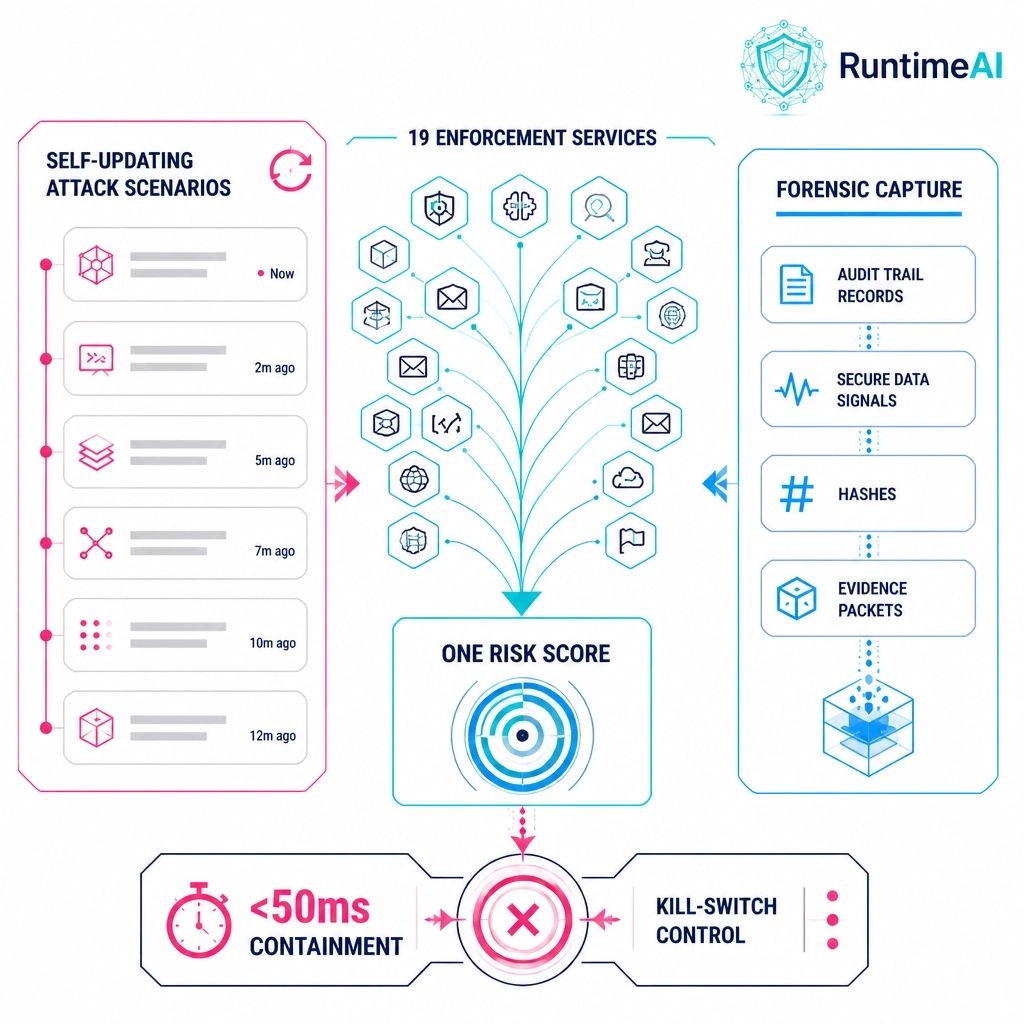
RuntimeAI brings that operating model into one governance layer: an autonomous, self-updating attack scenario catalog; 19 real enforcement services represented in a single risk score; a kill switch with sub-50ms containment; and forensic capture built in, so investigation starts with evidence instead of a blank page.
Autonomous, self-updating attack scenarios
Every scenario in the catalog traces back to something that actually happened — a real, published AI security incident — and new ones are added within days, not quarters. The catalog doesn't wait for an annual pen test cycle to catch up with reality; it's built to already be current when a new technique starts appearing in the wild.
19 enforcement services, one risk score
Most security teams don't lack tools — they lack a single, coherent view across the tools they already have. RuntimeAI takes 19 real enforcement services and represents their combined state as one risk score, so a security-team view of the platform reflects current attack scenarios and enforceable controls underneath every function, not 19 separate dashboards to reconcile by hand.
Kill switch: containment measured in milliseconds
Containment is measured in milliseconds. RuntimeAI's is sub-50. When an autonomous AI agent needs to be stopped, the gap between detection and containment is the whole ballgame — a kill switch that takes seconds is a kill switch that arrives after the damage is already done. Sub-50ms containment means the stop happens inside the same action window the attack is trying to exploit.
Forensic capture: evidence before the investigation starts
Investigation is only as fast as the evidence available when it begins. Forensic capture is built into the enforcement layer itself, so when an incident happens, the audit trail — what the agent did, under what policy, and what stopped it — already exists. Security teams start from evidence, not from reconstructing what happened after the fact.
What this means for a SOC or CISO team
Urgent where it matters. Measured where it counts. The result is a single security-team view of the same platform underneath every function: current attack scenarios, enforceable controls, and evidence captured as actions occur — not a report that's already stale by the time it's read.
This is the same operating model behind RuntimeAI's ATSA — an automated red team for AI agents built around the same red/blue/purple loop: attack, attribute honestly, fix, and re-validate. The self-updating attack catalog described here is what keeps that loop running against this week's real threats, not last quarter's.
See the autonomous red team run against your own stack
A live scan against your real deployed controls, an honest risk score across all 19 enforcement services, and a walkthrough of the sub-50ms kill switch and forensic capture in action.
Subscribe to RuntimeAI Security Weekly — one issue per week, the AI-agent incidents and defensive control gaps that matter.