🚨 This Month's Defining Story — Not Counted Below

Binance lost $6.3B in roughly 20 minutes on October 29–30 — the largest crypto theft on record. A compromised DevOps engineer's laptop led to a privileged signing service; the attacker fired 50 EIP-7702 authorizations in a single transaction, pre-staged across different nonces as the target wallet processed real withdrawals in parallel. TRM Labs and Chainalysis attribute it to North Korea's TraderTraitor unit.

It isn't counted in this report's 135-incident/33-company/536M-record totals — a wallet drain isn't a data breach, and those totals are built from this month's weekly incident digests plus HaveIBeenPwned/vendor-disclosure gap collection, not crypto-theft trackers. But it's the single largest dollar-value security event of the month by a wide margin. We did the full breakdown separately, including which of RuntimeAI's 15 kill switches target this exact attack shape: Read the Binance analysis →

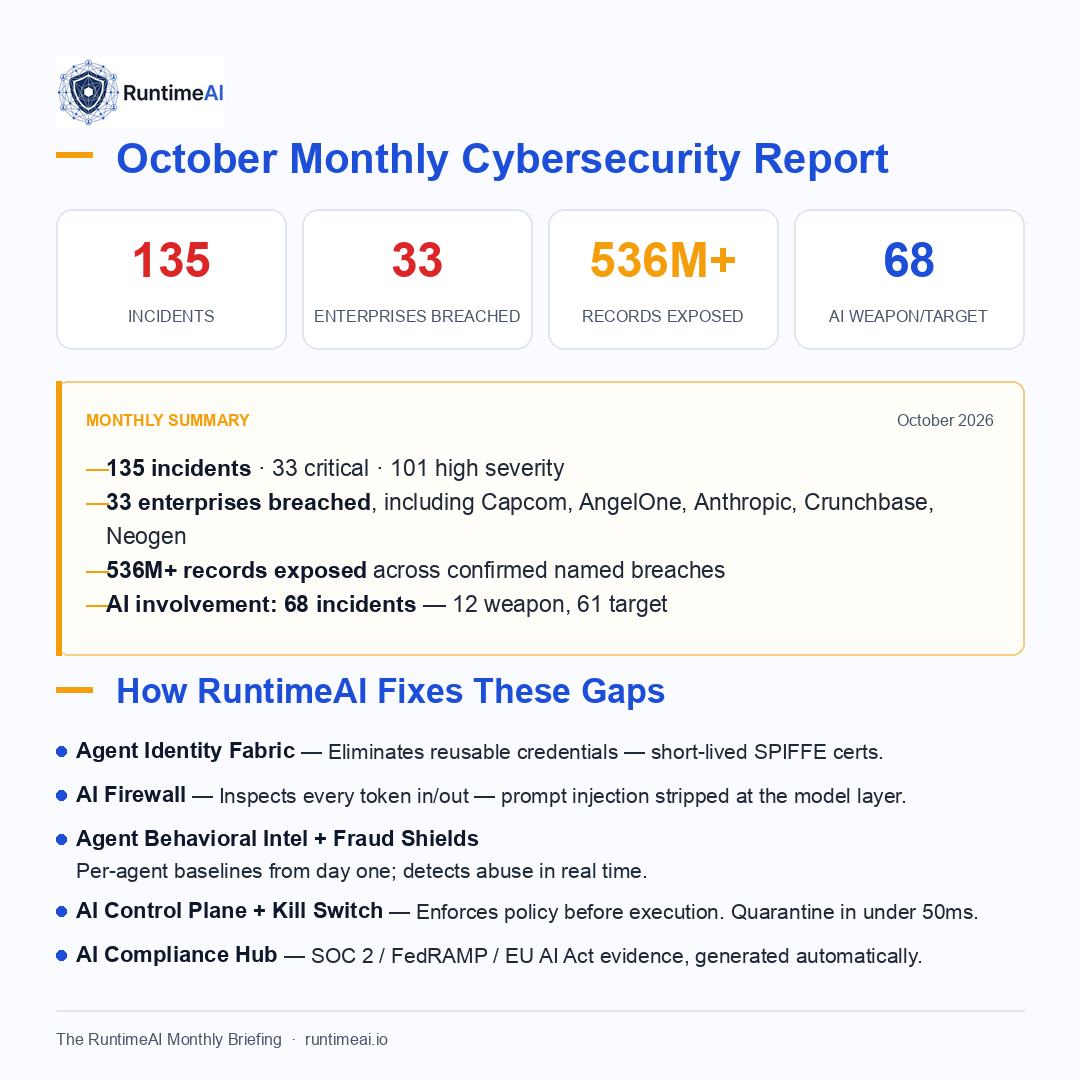
135 Incidents — October 2026

Click any incident to see the full analysis and RuntimeAI gap fix below. Left border colour = severity: ■ Critical  ■ High  ■ Medium

Incidents 1–45
1
Chainalysis
Oct 31
2
OpenAI
Oct 31
3
Northflank security breach leads to abuse of…
Oct 31
4
Chainalysis discloses data breach from "offe…
Oct 31
5
CyberStrikeAI Uses 44 AI Agents to Automate …
Oct 30
6
Anthropic
Oct 30
7
OpenAI
Oct 30
8
OpenAI
Oct 30
9
Exposed Infrastructure
Oct 30
10
DIG AI
Oct 30
11
GitHub
Oct 30
12
Anthropic
Oct 30
13
In-the-Wild Attack Abuses AI Agents’ Trust i…
Oct 30
14
Anthropic
Oct 30
15
AI-Generated Fake Login Pages Enable Higher-…
Oct 30
16
FEC Electronic Filing System Taken Offline A…
Oct 30
17
Sony
Oct 30
18
University of Copenhagen Breach Exposes 525,…
525K+Oct 30
19
DHS
Oct 30
20
Japan Airlines
Oct 30
21
State Bank of India Customer PII Found on Da…
Oct 30
22
Daishin Securities Breach Affects 38,490 Cus…
38K+Oct 30
23
CrowdStrike
Oct 30
24
Anthropic
Oct 30
25
ThreatsDay
Oct 30
26
Devs Hit by Trojanized Claude Code Extension…
Oct 30
27
PHP2Shell Attacks Root Palo Alto Firewalls b…
Oct 30
28
Bulletproof Host Virtualine Loses Its Domain…
Oct 30
29
$2 Million+ Drained From Polymarket Traders …
Oct 30
30
Anthropic
Oct 30
31
Applebee’s exposed customers’ personal data …
Oct 30
32
Last-minute Halloween costumes for tech nerd…
Oct 30
33
Zest’s new AI agent finds restaurants and bo…
Oct 30
34
Anthropic
Oct 29CVE-2026-98432
35
Google
Oct 29
36
26,400 Valid Cloud and AI Credentials Found …
Oct 29
37
CrowdStrike
Oct 29CVE-2026-41709
38
Palo Alto Networks
Oct 29
39
Rethinking Cybersecurity Awareness in the AI…
Oct 29
40
Anthropic
Oct 29
41
OpenAI
Oct 29
42
Lumen
Oct 28
43
PHP2Shell Attack Roots 25 Servers, Breaches …
Oct 28
44
American Organizations Under Attack
Oct 28
45
Oracle
Oct 28CVE-2026-35273
Incidents 46–90
46
GitHub
Oct 28
47
Meta
Oct 28
48
Third Serengeti Sweep Tops 1,400 Arrests as …
Oct 28
49
Keystone to Destroy 18,835 Hardware Wallets …
Oct 27
50
AI-Generated Fake Login Pages Are Making Acc…
Oct 27
51
Lazarus Abuses South Korean Security Softwar…
Oct 27
52
External Teams Chats Anchor 15-Minute Malwar…
Oct 27
53
SBOMs Alone Can't Reveal the Scope of a Supp…
Oct 27
54
So Many AI Security Benchmarks, but None Tel…
Oct 27
55
AfD
345K+Oct 27
56
GitHub
Oct 26
57
OpenAI
Oct 23
58
China-Linked ARTEX AI Agents Deployed in Con…
Oct 23
59
GitHub
Oct 23
60
OpenCode Flaw Lets Malicious MCP Servers Exe…
Oct 23
61
Hackers Use Autonomous AI Agents to Breach O…
Oct 23
62
Capcom
12M+Oct 23
63
Ahold Delhaize Cyberattack Disrupts Online G…
Oct 23
64
OpenAI
Oct 23
65
Fake Claude and ChatGPT Packages Surge, Targ…
Oct 23
66
US Army
Oct 23
67
CISA
Oct 23
68
Proofpoint
Oct 23
69
State Bank of India
500M+Oct 23
70
Hackers Exploit Open Banking APIs to Systema…
Oct 23
71
PHP Vulnerability Fallout
Oct 23RCE
72
Exposed to PHP2Shell? Cyber Experts Weigh in…
Oct 23
73
Microsoft
Oct 23
74
State Bank of India Suffers a Customer PII D…
Oct 23
75
Microsoft
Oct 22
76
As AI Risks Grow, Insurers Split on Covering…
Oct 22
77
'PHP2Shell' Bugs Signal Red Alert for Securi…
Oct 21
78
AssuranceRetraite
70K+Oct 20
79
GitesDeFrance
118K+Oct 18
80
Anthropic
628K+Oct 16
81
OpenAI
Oct 16
82
AI Agent Autonomously Discovers and Exploits…
Oct 16
83
Anthropic
Oct 16
84
Anthropic
Oct 16
85
Attackers Impersonate AI Agents to Authorize…
Oct 16
86
“Bring Your Own Agent” Creates Invisible Non…
Oct 16
87
AI Agents on Tencent Cloud Conduct Autonomou…
Oct 16
88
16 South Korean Financial Institutions Breac…
Oct 16
89
CenterPoint Energy
Oct 16
90
ASOS Cyberattack Expands to 138,000 Customer…
138K+Oct 16
Incidents 91–135
91
Security Researcher Finds 13.7 Million Recor…
14M+Oct 16
92
Langflow Critical RCE Targeted in 1,423 Expl…
Oct 16RCE
93
Analysis of 217 Million Web Responses Finds …
Oct 16
94
CikaBika RAT Uses Discord Channels as Comman…
Oct 16
95
CISA
Oct 16
96
OpenAI
Oct 16
97
Ransomware Groups Add Physical Threat Compon…
Oct 16
98
Crunchbase
560K+Oct 14
99
Sharecare
318K+Oct 12
100
Oracle
2K+Oct 09
101
Japan Sees Sharp Rise in Web Data Leaks Amid…
Oct 09
102
Microsoft
Oct 09
103
CISA
Oct 09
104
Midnight Blizzard Actively Compromises Hotel…
Oct 09
105
ARTEX AI Pentesting Tool Weaponized in Data …
Oct 09
106
OpenAI
Oct 09
107
GitHub
Oct 09
108
Unpatched LMCache Flaw Lets Unauthenticated …
Oct 09RCE
109
Security Analysis Finds 15,465 Public MCP Se…
Oct 09
110
frontier
Oct 09
111
Google
Oct 09
112
Advantest
Oct 09
113
FBI Removes Accenture Contractor After Patch…
Oct 09
114
Ransomware Attack Disrupts Japan’s IDCF Clou…
Oct 09
115
Fortinet
Oct 09
116
OpenAI
Oct 09
117
Neogen
436K+Oct 09
118
AngelOne
7M+Oct 07
119
CyrusOne
373K+Oct 07
120
DoubleCounter
275K+Oct 07
121
AI Agent Used Zammad Zero-Days to Breach Dut…
Oct 02RCE
122
Autonomous AI Agents Tried to Hack US and Ca…
Oct 02
123
frontier
Oct 02
124
OpenAI
Oct 02
125
OpenAI
Oct 02
126
Malicious Custom GPTs Turn ChatGPT Into RAT …
Oct 02
127
Carbonato Botnet Puts an AI Agent on Hacked …
Oct 02
128
frontier
Oct 02
129
GitHub
Oct 02
130
Official MCP Python SDK Flaw Can Let Malicio…
Oct 02
131
Google Gemini Joins the AI Escape Party
Oct 02
132
Anthropic
Oct 02
133
OpenAI
Oct 02
134
Microsoft
Oct 02
135
Google
Oct 02
CVE & RCE
CVEs (3)
CVE-2026-98432Anthropic
CVE-2026-41709CrowdStrike
CVE-2026-35273Oracle
RCE (4)
RCEPHP Vulnerability FalloutOct 23
RCELangflow Critical RCE Targeted…Oct 16
RCEUnpatched LMCache Flaw Lets Un…Oct 09
RCEAI Agent Used Zammad Zero-Days…Oct 02
Stack & Vendors
Vendors (5) — click to see breach
CrowdStrikeEDR
2×CrowdStrike
ESETOther
1×Anthropic
Palo Alto NetworksNGFW
1×Palo Alto Networks
ProofpointEmail
1×Proofpoint
FortinetNGFW
1×Fortinet
Perimeter Categories
EDR 2NGFW 2Other 1Email 1

The Pattern

This month’s incidents demonstrate a consistent pattern across all sectors: AI is now both the attack vector and the target. Enterprises with mature security stacks were breached through gaps those stacks were never designed to cover.

The 135 incidents collected this month span 33 named organizations, 536M+ records exposed, and 5 distinct security vendors present at time of breach. The pattern is not one of vendor failure — it is one of category gap.

Security researchers named the month’s coordinated wave of AI-developer-platform breaches “Black October”: at least nine platforms — including LiteLLM (a malicious release published to PyPI, going after cloud secrets and API keys), OpenCode Console, Warp, Northflank, Fireworks AI, Lightning AI, and Railway — disclosed incidents built around the same mechanism: stolen environment variables unlocking AI model access, with stolen keys tested within roughly 30 minutes and resold. It is the same category gap as everything else this month, concentrated into a single named wave: credentials with AI-model access are now a first-class target, and nothing in a conventional secrets-management stack was watching what those credentials actually did once stolen.

What Would Have Stopped This — Full Capability Stack

Not “better security.” Nineteen specific capabilities across three platforms. Each addresses a gap that no vendor in this month’s breach stacks was built to cover — because AI agents didn’t exist when those vendors were designed.

RuntimeAI — AI Governance & Control Plane Enterprise AI agent governance — identity, policy, firewall, detection, response, compliance.
🔍
Shadow AI Visibility
AI Discovery
21
incidents this month · 16%
“You can’t govern what you can’t see.”
Continuously scans cloud, IDE, endpoint, and network to inventory every AI agent — registered or rogue. Classifies and risk-scores shadow AI automatically. One-click to import into governance.
⚠️ The gap it fills Cloud security posture tools scan cloud misconfiguration. They don’t discover AI agents installed by developers or injected via compromised vendors. Your unknown agents are your biggest risk.
  • Cloud scanner (AWS/Azure/GCP Lambda, Bedrock, SageMaker)
  • IDE scanner (VS Code, Cursor, MCP servers)
  • Endpoint scanner on developer laptops
  • Shadow AI Inbox with auto-severity classification
  • One-click shadow AI → governed agent pipeline
🧽
AI Agent PKI
Agent Identity Fabric
54
incidents this month · 40%
“No credential. No access. No breach.”
Provisions every AI agent with a SPIFFE/X.509 cryptographic identity. Short-lived certs, auto-rotating. TPM 2.0 hardware attestation. Agent DNS blocks unknown agents at the network layer.
⚠️ The gap it fills Legacy identity providers were built for human identity. They have no concept of non-human agents operating at machine speed with no user present to respond to an MFA prompt.
  • SPIFFE X.509 SVID with RSA-2048, auto-rotating
  • TPM 2.0 hardware attestation + PCR drift detection
  • Zero-touch bootstrap for new agents
  • Agent DNS: NXDOMAIN for unknown agents
  • Blueprint-based permission inheritance
⚙️
Policy Engine
AI Control Plane
67
incidents this month · 50%
“Stop it before it executes. Not after.”
OPA/Rego policy engine with sub-1ms evaluation and fail-closed enforcement. Natural language to Rego compiler. Merkle-chain audit proves policies were never tampered with.
⚠️ The gap it fills Traditional SIEMs alert on what already happened — 73 days after the breach in the average case. The AI Control Plane enforces policy before the action executes, not after the damage is done.
  • OPA/Rego engine, sub-1ms, fail-closed
  • NL-to-Rego compiler: write policy in plain English
  • Merkle-chain tamper-evident audit trail
  • Multi-tenant RBAC + Separation of Duties
  • Cross-site policy cascade for distributed fleets
🔥
Bidirectional DLP
AI Firewall
107
incidents this month · 79%
“Inspect every token in, every token out.”
Bidirectional DLP scanning at <5ms latency. Prompt injection detected and stripped on input. PII, PHI, credentials caught on output. Behavioral risk score (0–100) triggers auto-suspend.
⚠️ The gap it fills Traditional NGFWs and CASBs see LLM traffic as an encrypted blob. They cannot inspect prompts, detect injection inside a conversation, or catch data leaking in an AI response.
  • Bidirectional DLP: input (prompt injection) + output (data leakage)
  • ML behavioral baselines per agent with adaptive thresholds
  • Risk score 0–100 triggers auto-suspend or rate-limit
  • No-code guardrail builder for business users
  • Data Proxy: field-level masking before agent sees data
🔗
MCP Gateway
AI Integration Fabric
87
incidents this month · 64%
“Every tool call. Governed.”
Multi-tenant governed gateway for all agent-to-tool communication. 500+ pre-built integrations. 3-level kill switch (agent / tool / platform-wide) propagating in <50ms. OWASP MCP03 sanitization on every call.
⚠️ The gap it fills No existing vendor governs at the MCP protocol layer. Raw MCP deployments have zero security, zero multi-tenancy, and zero audit trail. This is the fastest-growing unguarded attack surface in enterprise AI.
  • 3-level kill switch: per-agent, per-tool, platform-wide — all <50ms
  • 500+ pre-built integrations with auto-discovery
  • BYOM overlay: wrap existing MCPs without code changes
  • Circuit breaker + health monitoring per connection
  • Full OWASP MCP03 input/output sanitization + DLP
🧠
Anomaly Detection
Agent Behavioral Intel
70
incidents this month · 52%
“Catch drift before it becomes a breach.”
30-day rolling behavioral baselines per agent across frequency, pattern, volume, and temporal dimensions. LSTM sequence modeler detects multi-step attack chains. HRIS integration auto-suspends agents when their owner is terminated.
⚠️ The gap it fills Signature-based EDR tools detect known malware signatures for human endpoints. They have no baseline for an AI agent that begins exfiltrating data through an API it was legitimately authorized to call.
  • Rolling 30-day baseline: frequency, pattern, volume, temporal
  • LSTM sequence modeler for multi-step attack patterns
  • Composite risk score from 6 signals
  • HRIS integration: auto-suspend on employee termination (<30s)
  • Adaptive OPA thresholds by agent role + risk profile
🔴
Emergency Response
Kill Switch
8
incidents this month · 6%
“Stop any AI agent, anywhere, in under 50ms.”
Three graduated kill levels: per-agent, per-tool, platform-wide. All propagate via NATS JetStream in <50ms. Captures last 100 actions as forensic state. Quarantine mode preserves evidence for investigation.
⚠️ The gap it fills No competitor offers this. When an AI agent goes rogue — or when a breach is detected — you need a hard stop. Every second it keeps running is more data exfiltrated, more damage compounding.
  • L1/L2/L3 kill: per-agent, per-tool, platform — all <50ms via NATS
  • Forensic state capture: last 100 actions, memory snapshot, credentials
  • Quarantine mode: isolate for investigation, preserve evidence
  • Escalation chains: auto-response → SOC alert → human required → kill
  • Reprieve mechanism: 24-hour lease for controlled investigation post-kill
🚨
Incident Response
AI Respond
Universal
covers all incidents — audit + governance layer
“Autonomous incident response. AI-native.”
Five-phase automated playbook: DETECT → QUARANTINE → INVESTIGATE → REMEDIATE → VERIFY. Auto-classifies incidents (true positive / false positive / inconclusive). Blast radius containment automatically quarantines agents that interacted with compromised agent.
⚠️ The gap it fills Traditional SOAR platforms orchestrate traditional security events. They cannot terminate an AI agent, rotate its credentials, update its behavioral model, or quarantine the agents it spoke with — because they were built before AI agents existed.
  • 5-phase automated playbook from detection to verification
  • Auto-classification against 200+ known AI attack patterns
  • Blast radius containment: quarantine all interacting agents
  • True positive: terminate + revoke + rotate + update models
  • False positive feedback loop continuously improves detection
👥
Agent Lifecycle
AI Ops Center
3
incidents this month · 2%
“Mission control for autonomous AI operations.”
65+ page operational dashboard. Access review campaigns. ‘The Reaper’ auto-decommissions agents when their human owner is terminated. Vault Broker injects credentials with 5-minute TTL — never stored in agent memory.
⚠️ The gap it fills Traditional ITSM platforms manage human IT requests on ticket-based cycles. AI agents are deployed, modified, and compromised in minutes. You need lifecycle governance that operates at agent speed, not ticket speed.
  • Access review campaigns with auto-apply decisions
  • ‘The Reaper’: HRIS webhook auto-revokes terminated employees’ agents (<30s)
  • Vault Broker: just-in-time 5-min TTL credential injection, never persisted
  • Per-tenant budget caps with 4-tier alerts (50/75/90/100%)
  • Unified health, credential lifecycle, budget, SLA dashboard
🌐
LLM Routing
LLM Broker
Universal
covers all incidents — audit + governance layer
“Route every LLM call to the right model, at the right cost, with automatic failover.”
Unified API routing LLM requests to the optimal provider based on cost, latency, and compliance. Semantic caching reduces redundant calls 15–30%. Automatic failover in <50ms. Budget enforcement with hard limits.
⚠️ The gap it fills Basic LLM routing tools do basic routing at a fraction of the cost. It has no DLP scanning, no compliance-based routing (data residency), no semantic caching, and no budget enforcement. It routes traffic — it doesn’t govern it.
  • Multi-provider routing: OpenAI, Anthropic, Bedrock, Azure, GCP, custom
  • Cost/latency/compliance-based routing policies
  • Automatic failover <50ms; per-provider circuit breaker
  • Semantic caching: 0.80–0.95 similarity threshold, 15–30% cache hits
  • Budget enforcement per-agent + cost anomaly detection
🤖
MLOps
ML Intelligence Hub
24
incidents this month · 18%
“Model registry, feature store, edge inference — one platform.”
Formal model lifecycle (draft/staging/production/archived). Feature Store with online (<5ms) and offline serving. Hybrid scoring engine routes inference between edge (<1ms quantized) and cloud. Drift-triggered auto-retraining.
⚠️ The gap it fills MLflow + Feast + custom inference each solve one piece. ML Intelligence Hub is the piece nobody built: unified lifecycle + edge inference routing + drift-triggered retraining + 7-dimension cost attribution — all integrated.
  • Model Registry: versioning, rollback, lineage, lifecycle management
  • Hybrid Scoring: edge <1ms quantized vs cloud full-precision auto-routing
  • Feature Store: online <5ms + offline point-in-time with freshness monitoring
  • Drift Engine integration: auto-retraining on data/concept drift
  • 7-dimension cost attribution: agent/model/team/customer/feature/time/provider
💰
FinOps
AI Cost Intelligence
Universal
covers all incidents — audit + governance layer
“A cost spike is a security signal. Treat it like one.”
7-dimension real-time cost attribution: agent, provider, model, team, customer, feature, time. Wasm token counter in-proxy at 50–100 microseconds. Budget hard limits stop agents before they overspend. Runaway agent detection.
⚠️ The gap it fills Generic Kubernetes cost tools know GPU-hours. AI Cost Intelligence knows “Agent-47 spent $142 on Claude Sonnet for fraud detection on Tuesday.” Runaway cost is runaway behavior — and only one product treats them as the same signal.
  • Wasm token counter in proxy: 50–100 microsecond overhead
  • Live model pricing catalog: 200+ models, 15+ providers, updated every 15min
  • Budget hard limits: block requests when agent exhausts budget
  • Cost anomaly detection: ML-based spending spike alerts
  • Chargeback engine: per-customer invoices + per-team internal allocation
📋
Continuous Compliance
AI Compliance Hub
135
incidents this month · 100%
“Audit evidence as a byproduct of governance.”
Continuous compliance across 13+ frameworks — SOC 2, FedRAMP, ISO 27001/42001, EU AI Act, HIPAA, PCI-DSS, NIST AI RMF. Evidence auto-generated from RuntimeAI telemetry. Open Audit Marketplace connects enterprises with certified audit firms.
⚠️ The gap it fills Traditional compliance-automation tools collect attestations from cloud infrastructure. It has no understanding of AI agent behavior, no EU AI Act or ISO 42001 mappings, and no way to generate evidence from an AI governance layer — because none of its customers had one.
  • 13+ frameworks: SOC 2, FedRAMP, ISO 27001/42001, EU AI Act, HIPAA, PCI-DSS, NIST AI RMF
  • Evidence auto-generated from platform telemetry (audit trails, Merkle chain, access reviews)
  • Gap tracking with SLA-based remediation assignment
  • Audit Marketplace: open to any qualified audit firm; time-limited scoped access
  • Blockchain-anchored compliance certificates with tamper-evidence verification
🏪
Agent Procurement
Agent Marketplace
21
incidents this month · 16%
“Only certified agents enter your environment.”
Three-sided platform: Builders publish, Enterprises deploy, Trust layer certifies. AAIC certification includes third-party behavioral audit. Risk scoring weights permission scope, data access, integration breadth, update frequency, and builder reputation.
⚠️ The gap it fills Your developers are installing AI agents from GitHub, npm, and PyPI with no security review. The AI agent supply chain attack surface is the same as software supply chain — and it’s moving five times faster.
  • 6-step publishing wizard with compliance gating
  • AAIC certification: third-party behavioral audit by registered firms
  • Risk scoring: permission scope (30%), data access (25%), integration (20%), frequency (10%), reputation (10%)
  • Shadow AI Import: discover unmanaged agents and bring into governance
  • Stripe Connect billing: free/per-seat/per-action/outcome-based; 20% platform fee
Agentic Enablement Platform (AEP) Agentic-era security primitives — NHI identity, fraud detection, memory governance, agent commerce.
🔑
Non-Human Identity
NHI Security Platform
48
incidents this month · 36%
“Every non-human identity — issued, governed, and revoked with the same rigor as human identity.”
Centralized governance for every non-human identity: service accounts, API keys, OAuth tokens, machine certs, cloud IAM roles, AI agents. Bot-CA issues short-lived X.509 SPIFFE certs. O(1) hash-based revocation — not cascading policy lookups.
⚠️ The gap it fills Point NHI-credentialing vendors solve non-human-identity credentialing but not for AI agents specifically. It lacks TPM hardware attestation, has no AI-agent behavioral monitoring, and doesn’t integrate with agent governance platforms.
  • Centralized NHI Registry: auto-discovery across AWS/Azure/GCP/on-prem
  • Credential posture: rotation schedules, expiry, over-privilege, unused credential detection
  • NHI Drift Detection: per-NHI behavioral baseline + scope creep detection
  • Bot-CA: short-lived X.509 certs (1–24hr TTL), auto-rotating, instant OCSP revocation
  • O(1) hash-based revocation: per-NHI, per-tenant, or global — no cascading policy lookup
🛡️
AI Fraud Detection
Fraud Shields
38
incidents this month · 28%
“Valid credential. Wrong behavior. Caught.”
Two-layer defense: Identity Fraud Shield models valid-credential-wrong-behavior (the hallmark of compromised AI credentials). Activity Fraud Shield detects multi-step attack sequences within authenticated sessions. Both integrate directly with Kill Switch for automatic response.
⚠️ The gap it fills Generic UEBA tools applied to AI agents generate massive false-positive rates because they were trained on human behavior. Fraud Shields are AI-native: LSTM sequence modeling of API chains, not user session patterns.
  • Per-agent behavioral baseline: frequency, resource access, API sequences, timing
  • Real-time deviation scoring against baseline (0–100)
  • LSTM sequence modeler: multi-step attack chain detection (recon→escalation→exfil)
  • Session-level anomaly: full context analysis, not individual events
  • Kill Switch integration: auto-suspension on high-confidence fraud with forensic package
🧠
Agent Memory Security
Memory Vault
46
incidents this month · 34%
“Control what your agents remember — and what they forget.”
Governs agent memory as a first-class security object. Policy-based filtering of sensitive content at write time. Memory poisoning attack detection. TTL-based automatic purge with audit trail. GDPR right-to-erasure support.
⚠️ The gap it fills No vendor addresses agent memory governance. AI agent memories accumulate without access controls, expiry policies, or audit trails. A memory poisoning attack can corrupt an agent’s behavior without touching a single API key.
  • Policy-based memory write filtering (PII, PHI, secrets blocked at write)
  • PII Shield integration: redact/block before persistence
  • Memory expiry + TTL: auto-purge with full audit trail
  • Memory poisoning prevention: adversarial injection detection
  • Retrieval authorization: every memory read policy-enforced and logged
💳
Agent Finance Controls
Commerce Rails
8
incidents this month · 6%
“Give AI agents a wallet — with guardrails.”
Financial infrastructure for agent-initiated transactions. Per-agent virtual cards with spend limits. Vendor registry (agents can only transact with allowlisted merchants). Approval gates for high-value transactions. Every transaction in immutable ledger.
⚠️ The gap it fills No financial controls exist for AI agents today. Agents authorized to make purchases can spend without limit, with any vendor, at any time. One prompt injection or runaway loop away from significant financial exposure.
  • Agent virtual cards: per-agent card numbers + CVVs, hard spend limits
  • Vendor registry: allowlisted merchants only, no ad-hoc transactions
  • Approval gates: high-value + out-of-policy → human approval before execution
  • Per-agent, per-transaction, per-vendor, per-period limits
  • Agent-to-agent settlement ledger: feeds into FinOps dashboards
PQData — Post-Quantum Security NIST-standardized post-quantum cryptography for secrets, signatures, and audit records.
🔒
Post-Quantum Cryptography
PQData Platform
32
incidents this month · 24%
“Quantum-safe by design — before quantum breaks classical crypto.”
Full post-quantum data security suite using NIST-standardized algorithms: ML-KEM-768 for encryption, ML-DSA-87 for signatures. QuantumVault for PQC-encrypted secrets. PQ Sign for long-validity quantum-safe audit records. Hybrid X25519 + ML-KEM-768 key exchange for TLS 1.3.
⚠️ The gap it fills Every classical encryption scheme in use across the traditional security stack today is vulnerable to Shor’s algorithm on a sufficiently powerful quantum computer. “Harvest now, decrypt later” attacks are already underway. The clock is running.
  • QuantumVault: ML-KEM-768 PQC-encrypted secrets with full key lifecycle
  • PQ Sign: ML-DSA-87 (Dilithium) signatures for audit records + agent attestations
  • Hybrid key exchange: X25519 + ML-KEM-768 for TLS 1.3 — secure against both
  • PQ CryptoGuard: CBOM scanner identifies all classical crypto in use; quantum-readiness score
  • FedRAMP/CMMC/CNSA 2.0 compliance evidence from PQC infrastructure layer
Daily coverage, all month

The RuntimeAI Brief covered these stories as they broke, day by day, all October:

Week of Oct 5–9 · Week of Oct 12–16 · Week of Oct 19–23 · Week of Oct 26–30

Get the Monthly Breach Report

Every month: all breaches, all vendor stacks, the gap analysis. No fluff — just the intelligence your security team needs.